
13 min read ·
Similar Chemistry Does Not Make These Glues Interchangeable
Both may use cyanoacrylates, but labels, formulations and intended uses can differ. For press-ons, choose an adhesive specifically labeled for them.
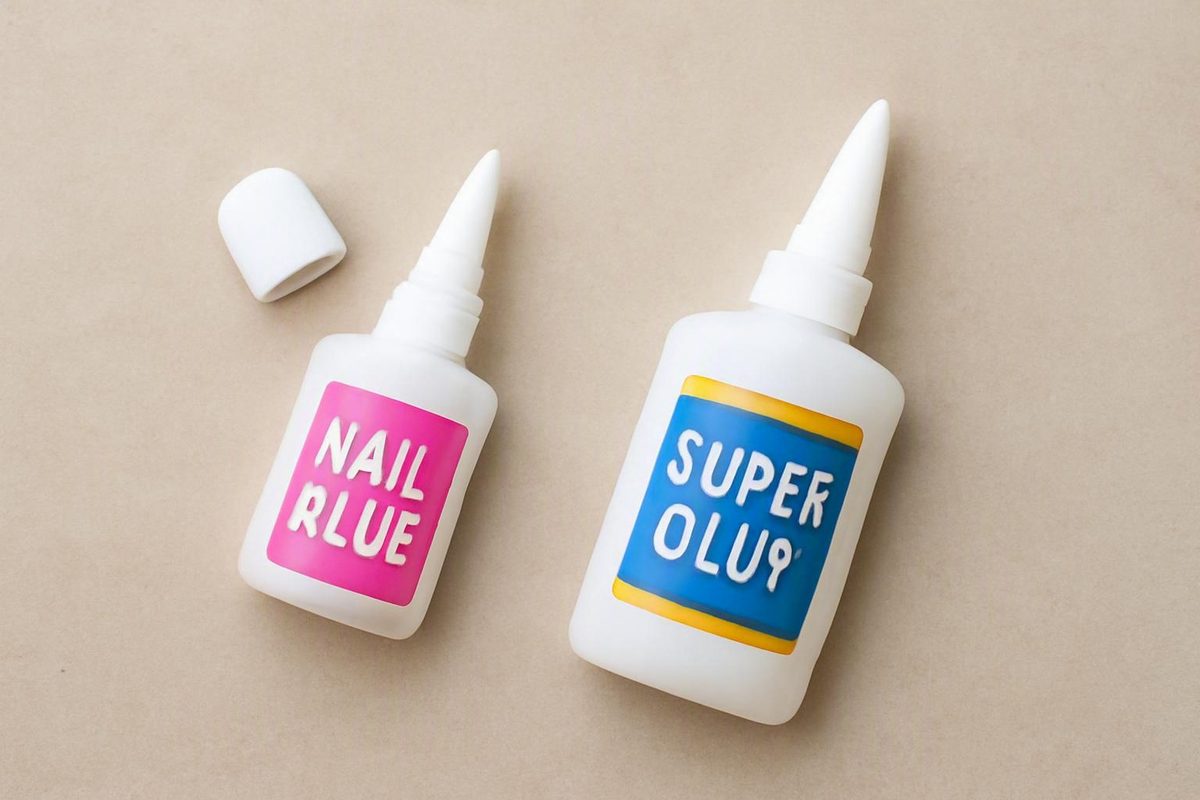
Nail glue and household super glue can belong to the same broad adhesive family without being the same finished product. A shared chemical base does not establish identical formulations, packaging, directions, warnings, or intended uses.
For routine press-on nails, nail art, or enhancement work, choose a traceable cosmetic adhesive labeled for that specific application. Do not treat household super glue as a routine substitute—and do not assume nail glue is harmless simply because it is sold as a cosmetic product.
The short answer: related adhesives, not automatically the same product
No. Nail glue is not necessarily the same as household super glue, and the two should not automatically be treated as interchangeable.
The confusion is understandable because products in both categories can use cyanoacrylate chemistry. The Chartered Trading Standards Institute (CTSI) says nail adhesives often contain ethyl cyanoacrylate or other acrylates, while household super glues may also contain cyanoacrylates. CTSI describes the ingredients and potential hazards associated with nail adhesives.
However, identifying a shared chemical family does not establish that two products have the same:
- Complete ingredient list
- Type or concentration of primary adhesive
- Handling and curing characteristics
- Applicator or packaging
- Directions and warnings
- Intended surfaces or applications
- Exposure and removal instructions
It is therefore inaccurate to claim that every nail glue is chemically identical to household super glue. It is equally misleading to insist that the two categories always use completely different chemistry.
The defensible answer is product-specific: some nail glues and household super glues may use related cyanoacrylates, but their complete formulations and labeled purposes are not necessarily the same.
For a definitive comparison, inspect the ingredient labels and safety data sheets for the two products, where available. Compare the named adhesive, intended use, warnings, application directions, and removal information rather than relying on the broad category names.
Nail glue versus super glue: a practical comparison
The practical distinction is not simply “weak glue versus strong glue.” Neither category has one universal formulation or performance profile. The more useful comparison is what each product is sold to do and whether its instructions address that use.
| Point of comparison | Cosmetic nail glue | Household super glue |
|---|---|---|
| Intended use | Cosmetic applications such as attaching artificial nails or nail art, depending on the label | Multipurpose household bonding |
| Product category | Nail or cosmetic adhesive | General-purpose consumer adhesive |
| Known chemistry | Product-dependent; nail adhesives often contain ethyl cyanoacrylate or other acrylates | Product-dependent; products may use cyanoacrylate chemistry |
| Formulation certainty | Cannot be generalized across all nail glues; check the individual label or safety data sheet | Cannot be generalized across all super glues; check the individual label or safety data sheet |
| Packaging and application | Supplied with directions for the nail application stated on the label | Supplied with directions for the household materials and applications listed by the manufacturer |
| Routine recommendation | Use a reputable product labeled for the exact nail task | Do not use as a routine replacement for cosmetic nail adhesive |
| Principal safety limitation | Nail-specific labeling does not eliminate the risks associated with a fast-bonding adhesive | Not labeled for cosmetic nail use and may not provide nail-specific application or removal directions |
A commercial retailer article describes household super glue as a multipurpose adhesive for materials such as plastic, metal, and wood, while describing nail glue as intended for nail applications. That source discourages routine substitution, although it also presents super glue as an emergency-only option—a recommendation that is not established as safe by the supplied evidence. The retailer’s comparison should therefore be read as product-use commentary, not medical approval.
Nevertheless, the category name alone does not establish a product’s viscosity, cure time, bond strength, water resistance, or removal method. Those characteristics require product-specific documentation.
It is also unsafe to assume that nail glue is always weaker, gentler, easier to remove, or less likely to cause injury. Suitability depends on the particular product, the application covered by its label, the condition of the nail, and whether the directions are followed.
The practical decision rule is simple: for routine cosmetic nail use, choose a reputable cosmetic adhesive expressly labeled for that application and follow its instructions.
Why intended use matters even when the chemistry overlaps
A chemical family is a starting point for understanding an adhesive, not a complete product specification.
Even if two labels identify a cyanoacrylate, that fact alone does not prove that the products have identical ingredients, application characteristics, packaging, warnings, or exposure instructions. It also does not show that both manufacturers intend their products to be used on natural nails or near surrounding skin.
The label matters because it serves several purposes.
It identifies the intended job. A cosmetic adhesive may be labeled for press-ons, artificial tips, nail art, or another defined application. A household adhesive may instead list materials such as plastic, metal, or wood.
It supplies product-specific directions. Preparation, quantity, placement, storage, and removal instructions can vary. Generic online advice cannot account for every formulation.
It communicates warnings. Nail-specific labeling does not make an adhesive harmless, but it should tell the user how the manufacturer expects the product to be handled for its stated application.
It supports traceability. A named manufacturer or responsible supplier gives consumers a way to find product information and seek product-specific assistance. An unidentified or inadequately labeled bottle makes it difficult to determine what it contains or how its manufacturer says an exposure should be handled.
Product quality also varies within the nail-glue category. CTSI has warned specifically about extremely potent nail glues sold online without adequate ingredient labeling or instructions. That warning does not mean every online product is unsafe. It means that unknown or poorly labeled products prevent consumers from assessing their contents, directions, and possible side effects.
Before using a nail adhesive, look for:
- An identifiable product and responsible manufacturer or supplier
- A readable label
- A clearly stated cosmetic nail use
- Application and removal directions
- Safety warnings
- Ingredient information where provided
- Packaging that allows the directions to be followed
The relevant choice is therefore not merely nail glue versus super glue. It is also a traceable, properly labeled cosmetic product versus an unknown adhesive with inadequate information.
Can super glue substitute for nail glue in an emergency?
The supplied consumer sources disagree.
One commercial retailer article presents household super glue as an emergency-only option while discouraging routine substitution. In contrast, NailKnowledge advises against substituting super glue for cosmetic nail adhesive, including when applying fake nails.
The more permissive article should not be treated as proof that emergency use is safe. The supplied evidence does not establish household super glue as medically approved or appropriate for temporary cosmetic nail use. Calling a situation an “emergency” also does not change the intended use stated on the bottle.
The evidence supports waiting for a suitable nail adhesive or obtaining help from a qualified nail professional instead of improvising with a household adhesive.
Reasonable alternatives include:
- Leaving the cosmetic item off temporarily
- Obtaining a reputable adhesive labeled for the intended nail application
- Following the enhancement system’s instructions
- Asking a qualified nail professional about a nonmedical enhancement repair
A damaged natural nail is a different matter. Household super glue should not be presented as a first-aid product or as a treatment for damaged tissue.
Exact product labels take priority over broad assumptions. If a bottle does not identify the cosmetic nail application you have in mind, do not infer approval merely because its chemistry sounds similar to nail glue.
Choose by scenario: press-ons, enhancements, and natural-nail damage
The appropriate response depends on whether you are attaching a removable cosmetic item, repairing an enhancement system, or dealing with natural-nail damage.
Press-on nails
Use a reputable cosmetic adhesive whose label expressly includes press-on nails. Apply only the amount directed and follow the instructions supplied with both the adhesive and the press-on system.
Do not assume that every product marketed as nail glue is compatible with every press-on. Some kits specify a particular adhesive or another attachment method.
A detached or lifting enhancement
A salon enhancement may belong to a specific product system.
Do not choose an adhesive solely because it appears to create the fastest or strongest bond. If the natural nail has been damaged or symptoms are worsening, cosmetic reattachment is not a substitute for suitable professional assessment.
Nail art
Use a cosmetic product labeled for the relevant nail-art application rather than household super glue. Check that the decorative item, coating, and adhesive are intended to be used together.
The small size of a decoration does not make an adhesive labeled only for household use appropriate for application on or near a natural nail.
A superficial split in the natural nail
A minor cosmetic defect at the free edge is not necessarily equivalent to a significant nail injury. Even so, avoid improvising with household super glue or an unsupported repair method.
For an intact, painless nail, use only a nail-specific product whose instructions expressly cover the situation, or ask a qualified nail professional whether cosmetic repair is suitable.
A painful, bleeding, inflamed, or deeply split nail
Do not treat clearly damaged tissue as an ordinary adhesive task. CTSI warns that applying nail adhesive to damaged nails may increase infection risk.
Significant or worsening nail damage requires appropriate professional assessment rather than concealment beneath an artificial nail or enhancement. The important question is not simply which glue bonds most strongly, but whether the situation is cosmetic at all.
Nail glue is not harmless either
Choosing nail glue instead of household super glue does not eliminate risk. The reason to prefer a properly labeled nail adhesive is its suitability for the stated cosmetic task—not a guarantee that it cannot cause harm.
CTSI says nail adhesives can cause skin irritation, redness, blistering, or burns, particularly when a user is sensitive to their ingredients or when a product is misused. It also reports that fumes can irritate the respiratory system, especially in poorly ventilated spaces. Repeated use may weaken natural nails, aggressive removal may damage the nail plate, and application to damaged nails may increase infection risk.
Risk can arise during several stages:
- Application: Adhesive may reach surrounding skin.
- Spillage: A fast-bonding product can affect a larger area than intended.
- Ventilation: Fumes may cause respiratory irritation in poorly ventilated spaces.
- Sensitivity: A person may react to an ingredient even when using a cosmetic adhesive.
- Repeated wear: Repeated application may weaken natural nails.
- Removal: Aggressive removal may damage the nail plate.
- Use over damage: Applying adhesive to an already damaged nail may increase infection risk.
Severe injury is possible, although one case cannot establish how often it happens. CTSI reported that a 12-year-old required specialist burn treatment and a skin graft after nail glue from an online false-nail set spilled onto her hands. The CTSI report presents this as an individual severe incident, not an injury-rate estimate.
“Nail glue” should therefore be understood as a fast-bonding cosmetic adhesive, not an inherently gentle beauty product.
Safer selection and application principles
Risk reduction begins with product selection and continues through application and removal.
Select for the exact application
Choose a traceable cosmetic adhesive that names the task you intend to perform. A general reference to artificial nails may not necessarily cover every enhancement system, nail-art material, or natural-nail repair.
If the adhesive belongs to a kit, follow that kit’s instructions. Avoid unknown products that lack adequate labeling, warnings, or a responsible supplier.
Read the label before application
Read the product’s application, exposure, storage, and removal directions before opening it.
Do not assume that a solvent or technique recommended for one product is suitable for another adhesive, artificial nail, coating, or affected area.
Check the nail
Cosmetic adhesive is intended for cosmetic tasks, not treatment of damaged tissue. If the nail is meaningfully damaged or the condition is worsening, pause and obtain suitable professional advice rather than covering it with an enhancement.
Control the application
Use only the amount directed and follow the supplied placement instructions.
Provide ventilation
Use nail adhesive in a well-ventilated space. This precaution follows CTSI’s warning that adhesive fumes can irritate the respiratory system, particularly where ventilation is poor.
Plan removal in advance
Read the manufacturer’s removal directions before attaching the cosmetic nail. The evidence does not support treating acetone—or any other solvent—as universally safe or effective for every nail adhesive, enhancement material, coating, or affected area.
Consider professional application
Professional application does not eliminate all risk, but CTSI describes it as the safest option.
Pre-use checklist
Before applying nail adhesive, confirm that:
- [ ] The product is identifiable and has a readable label.
- [ ] The label includes your intended cosmetic nail application.
- [ ] You have read the directions, warnings, and removal method.
- [ ] The nail is suitable for a cosmetic application rather than requiring assessment for damage.
- [ ] The space is adequately ventilated.
- [ ] You can apply only the amount directed.
- [ ] You will follow the labeled removal process.
If any essential information is missing, pause rather than improvise.
If glue is already on the skin, nail, or another sensitive area
The supplied evidence does not support a universal first-aid or removal procedure for every nail glue, household super glue, artificial-nail material, or type of exposure.
Find the product container and consult its exposure and removal instructions. Do not assume that one solvent or home method is suitable for every product or affected area.
This is more reliable than trying multiple improvised treatments without knowing the exact formulation.
For nail damage or an adverse reaction, NailKnowledge recommends consulting a qualified nail technician or dermatologist. A nail professional is appropriate for nonmedical questions about an enhancement system; suspected injury or a physical reaction requires assessment by a healthcare professional.
Identifying the exact product is more useful than describing it only as “nail glue” or “super glue.”
Frequently asked questions
Do nail glue and super glue both contain cyanoacrylate?
They can. Household super glues may use cyanoacrylate chemistry, while CTSI says nail adhesives often contain ethyl cyanoacrylate or other acrylates.
That does not mean every product contains the same cyanoacrylate, concentration, or complete formulation. Check the labels or safety data sheets for the two specific products if you need an exact comparison.
Can I use super glue for press-on nails just once?
It is better to wait for a cosmetic nail adhesive labeled for press-ons. One retailer article describes super glue as an emergency-only option, but the supplied evidence does not establish household super glue as safe or approved for temporary cosmetic nail use.
Leave the press-on off until you have the appropriate product rather than disregarding the household adhesive’s labeled purpose.
Is nail glue safer than household super glue?
A reputable nail glue is the more appropriate choice for a nail application because it is labeled and supplied for that purpose. That does not prove it is universally gentler or incapable of causing harm.
Nail glue can still cause irritation, blistering, burns, fume irritation, or nail damage when spilled, misused, repeatedly applied, or aggressively removed. “More suitable for the application” is more accurate than “always safer.”
Can I put nail glue on a split or damaged natural nail?
Do not present adhesive as treatment for damaged tissue. CTSI warns that using nail adhesive on damaged nails may increase infection risk.
For a minor cosmetic issue on an otherwise intact, painless nail, use only a nail-specific product whose instructions expressly cover that application, or ask a qualified nail professional. Significant or worsening damage requires suitable professional assessment.
How can I tell whether a nail adhesive is reputable?
Look for an identifiable product and responsible supplier, a readable label, a clearly stated cosmetic use, adequate instructions and warnings, and ingredient information where provided.
Avoid suspicious or unknown products with missing labels, unclear contents, no instructions, or no traceable supplier. This does not mean every online product is unsafe; it means a marketplace listing is not a substitute for proper product information.
The final decision rule is straightforward: chemical similarity is not practical equivalence. For an intact nail and a routine cosmetic application, use a reputable adhesive labeled for that specific task and follow its instructions. Do not treat household super glue as a routine substitute, and seek appropriate professional advice for significant exposure or worsening nail or skin damage.