
6 min read ·
What to Check Before Gluing Press-Ons, Tips or Nail Wraps
Explains how to confirm the formulation, intended nail use, warnings and removal directions using the current label or safety data sheet.
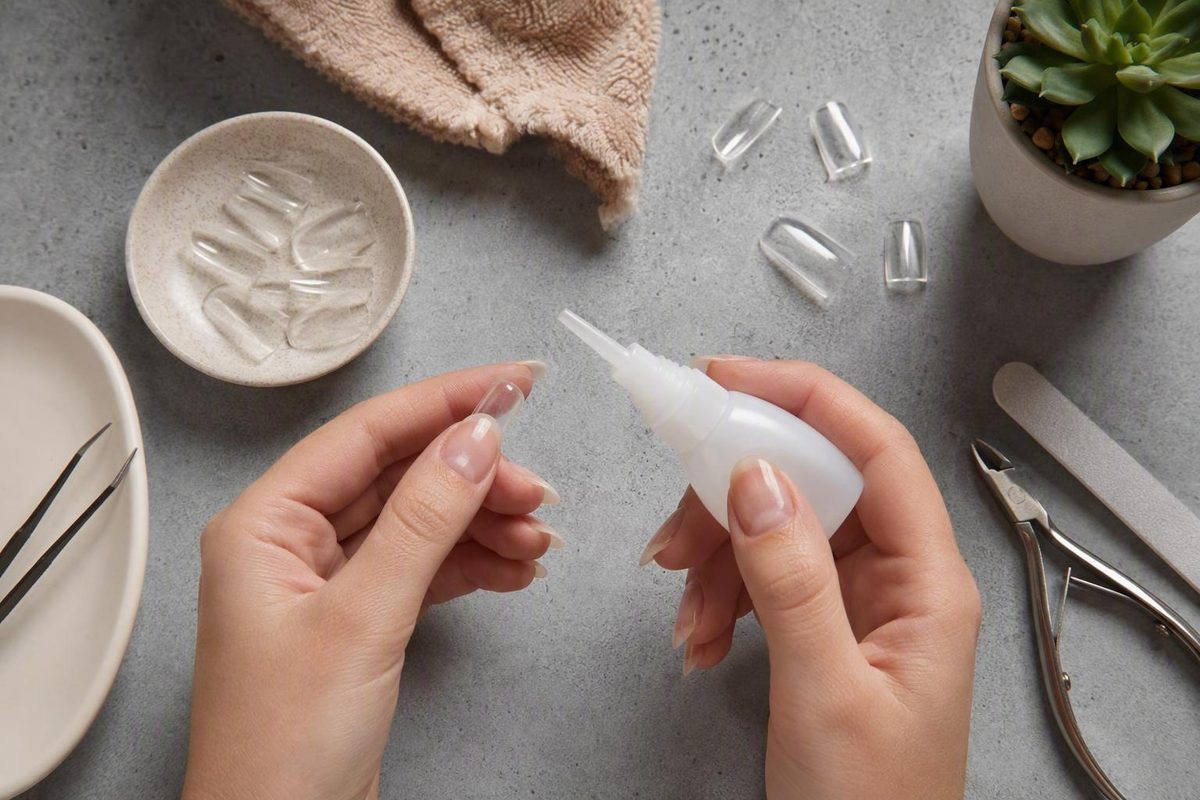
Cyanoacrylate nail glues should not be treated as interchangeable. One seller identifies its product as n-butyl cyanoacrylate and contrasts it with conventional ethyl-cyanoacrylate nail glue, but that single listing does not establish the composition of every nail adhesive. Before applying a product, confirm its formulation, intended nail use, warnings, and removal directions on the current label or safety data sheet.
The short answer: identify the formulation before using the glue
For the product in your hand, check:
- The named cyanoacrylate type and any disclosed concentration
- Whether the instructions name press-ons, pre-formed tips, or nail wraps
- Application limits and compatibility warnings
- Exposure precautions and storage requirements
- The manufacturer’s removal procedure
If the retail label is abbreviated, consult the current safety data sheet from the manufacturer or supplier.
KISS publishes instructions for applying fake nails with nail glue, but its guide does not identify the adhesive chemistry. Its procedure is therefore brand guidance for press-on application, not evidence that the same quantity, positioning method, or holding period applies to every cyanoacrylate formula.
Match the product to the nail job
Start with the nail system and then choose an adhesive whose documentation names that use. Chemical family alone does not establish compatibility.
| Job | Evidence-supported option | Limitation |
|---|---|---|
| Attach pre-formed nails | The cited n-butyl product is marketed for this use | Applies only to that seller’s product |
| Strengthen natural or artificial nails | The seller markets its n-butyl product for reinforcement | Not a universal use for cyanoacrylate glue |
| Secure silk or fiberglass wraps | The seller names both wrap types | Confirm compatibility with the exact wrap system |
| Apply press-ons or full-cover nails | KISS provides general nail-glue application steps | The guide does not identify the glue chemistry |
| Apply press-ons without liquid glue | KISS covers adhesive tabs as an alternative | Wear and removal expectations differ from glue |
The n-butyl seller also makes a product-specific exception: it recommends regular nail glue or super glue, rather than its n-butyl product, for the seller’s Instant Nail strips. The page does not explain whether that restriction concerns viscosity, curing behavior, strip material, or another factor, so it should not be generalized to other strips.
This exception also does not prove that household instant adhesive and nail-formulated glue are generally interchangeable.
How to apply a press-on with nail glue
The following procedure is KISS brand guidance. Use it only where it agrees with the directions for the selected glue and artificial nails.
- Prepare your hands and natural nails. Wash your hands, gently push back the cuticles, and lightly buff away the nail’s surface shine. Wipe each nail with alcohol or a nail-prep pad to remove dust and surface residue.
- Dry-fit every artificial nail. Select a size that fits from sidewall to sidewall without being forced. File the sides if necessary.
- Arrange the nails. Lay them out in application order before opening the glue.
- Apply a thin layer. Following the adhesive instructions, place a thin, even layer on the natural nail or the underside of the artificial nail.
- Position the press-on. Starting near the cuticle, place it at approximately a 45-degree angle and roll it forward toward the tip.
- Maintain pressure. KISS says to hold the artificial nail in place for at least 10–15 seconds in its fake-nail application guide.
Aftercare and qualified wear expectations
KISS advises avoiding soaking the nails for the first few hours after application, wearing gloves while washing dishes or doing other wet chores, and not using artificial nails as tools. Daily cuticle oil is also part of the brand’s aftercare routine, although the cited material does not independently establish that it improves adhesive performance.
The company estimates 7–10 days of wear for press-ons applied with glue and 5–7 days with adhesive tabs, depending on preparation and lifestyle. These are company estimates rather than guaranteed service periods or independently tested performance ranges in the cited material. They appear in the same KISS application and aftercare guidance.
KISS also says carefully removed press-ons may be reusable after residual glue has been removed. Follow the removal directions for the relevant adhesive and press-on system rather than assuming that one method is suitable for every product.
What n-butyl versus ethyl does—and does not—tell you
The cited seller identifies its product as n-butyl cyanoacrylate and contrasts it with what it calls regular ethyl-cyanoacrylate nail glue. It also claims that its n-butyl product is less brittle, has little odor, and creates a smooth, durable nail.
Those descriptions are promotional assertions. The listing supplies no comparative test method, results, sample information, or independent analysis establishing that n-butyl cyanoacrylate performs better than ethyl cyanoacrylate on nails.
Knowing the named chemical is useful, but it does not by itself establish:
- Compatibility with a particular press-on, strip, tip, silk, or fiberglass wrap
- Relative flexibility, odor, smoothness, or durability
- The correct application quantity or setting period
- Suitable removal or accidental-exposure procedures
- Suitability for uses not named by the manufacturer
Treat the disclosed chemistry as one product-selection field, not as a substitute for the complete instructions.
Safety and removal: where the evidence stops
The cited seller page and brand application guide do not provide enough information for detailed cyanoacrylate first aid, allergy precautions, ventilation requirements, spill response, storage, disposal, or removal instructions. This article therefore cannot supply a general acetone, soaking, peeling, or debonding procedure. Use the current label and safety data sheet for the exact adhesive.
Because the available pages do not provide adequate exposure-response instructions, do not use the application steps above as first-aid guidance.
The seller compares its cosmetic product with a type of glue used by veterinarians for sutures and calls a veterinary tissue adhesive equivalent. That marketing comparison does not establish that the nail product is sterile, medically approved, equivalent to a named tissue adhesive, or suitable for wound closure, as the seller’s own product description supplies no supporting regulatory or independent evidence.
A documented n-butyl product example
As a commercial example rather than a recommendation, the cited product page listed these details:
| Listing field | Seller-stated detail | Qualification |
|---|---|---|
| Product | n-Butyl cyanoacrylate fingernail glue | Confirm the current formulation |
| Bottle size | 22 mL, described as 3/4 ounce | Commercial detail may change |
| Price and stock | $13.95; marked out of stock | Recheck before publication or purchase |
| Package contents | Dispensing pipettes and silk wrap | Verify the current package |
| Named uses | Pre-formed nails, reinforcement, and silk or fiberglass wraps | Applies only to this product |
| Instant Nail strips | Seller recommends regular nail glue or super glue instead | Reason is not stated |
The size, price, availability, included items, uses, and exception appeared on the n-butyl cyanoacrylate fingernail-glue listing. Because commercial details can change, verify the live page and current product documentation before buying or applying it.
A practical selection checklist is short:
- Confirm the formulation rather than assuming it.
- Verify that the label names the intended nail application.
- Choose an artificial nail that fits correctly from sidewall to sidewall.
- Follow the product-specific application and removal directions.
- Do not substitute cosmetic nail glue for a medical adhesive.