
20 min read ·
Match the Sealant to the Roof Detail—not Just the Metal
At exposed seams or flashing edges, a gun-grade product must suit outdoor exposure, the actual substrate and finish, movement and application conditions.
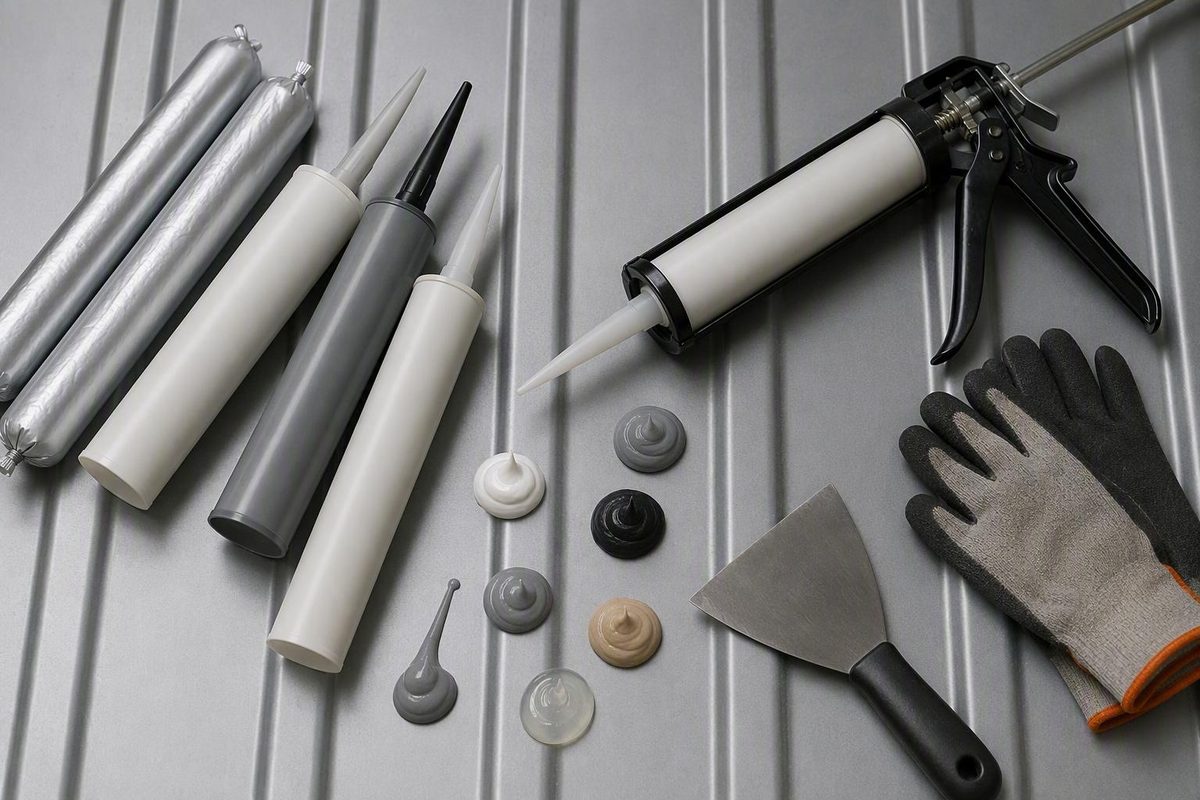
There is no universally best sealant for metal roof repairs. The right choice depends on the roof assembly, the defect, whether the repair is concealed or exposed, the substrate and finish, expected movement, application conditions, and the roof and sealant manufacturers’ instructions.
Start with diagnosis, not chemistry. A concealed panel lap may require compressed butyl tape. An exposed flashing edge may need a UV-resistant gun-grade sealant. A broad, aging roof may be suitable for an elastomeric coating system—but only after failed fasteners, flashing, seams, penetrations, drainage defects, and corrosion have been addressed.
Sealant is a secondary water barrier. It should not replace correctly formed seams, intact flashing, secure fasteners, sound panels, or adequate drainage. Sheffield Metals, a metal-roofing manufacturer, makes the same distinction between sealant and the roof’s primary defenses against water intrusion. Its guidance covers both tape and gun-applied sealants.
The quick answer: choose by roof detail and exposure
Begin with the panel manufacturer’s approved installation and repair details whenever they are available. A detail may specify the sealant form, placement, dimensions, compression, fasteners, closures, primer, and relationship to nearby flashing. An aftermarket product labeled merely “for metal roofs” does not override those requirements.
Use this matrix to identify the product form worth investigating:
| Roof detail or condition | Product form to investigate | Main questions before use |
|---|---|---|
| Concealed panel lap | Butyl tape, when specified | Is it approved for the assembly, correctly sized, continuously placed, and compressed as required? |
| Exposed seam | Gun-grade sealant | Is the seam correctly formed? Is the product UV-resistant and approved for the metal, finish, and expected movement? |
| Flashing edge | Gun-grade sealant after flashing repair | Is the flashing intact, correctly lapped, and secure? Is the sealant compatible with both adjoining surfaces? |
| Pipe, vent, curb, or other penetration | Approved flashing or boot plus specified tape or gun-grade sealant | Does the detail rely on mechanical flashing rather than caulk alone? |
| Exposed fastener | Correct fastener and washer repair; sealant only when specified | Is the fastener loose, missing, corroded, misaligned, overdriven, or underdriven? |
| Small localized gap | Compatible gun-grade sealant | Is the gap stable, prepared, and within the product’s permitted joint dimensions? |
| Seam requiring reinforcement | System-specific tape or fabric plus compatible coating | Is the reinforcement part of the selected coating system, and must it be embedded or covered? |
| Localized surface corrosion | Preparation, primer, repair, or coating specifically permitted for that condition | Is the corrosion limited to the surface, or is there pitting, perforation, or meaningful metal loss? |
| Broad aging roof surface | Complete elastomeric coating system | Is the roof sufficiently sound and compatible, and have all defects been repaired first? |
For a concealed, compressed metal-to-metal joint, butyl tape is the usual product form when the panel design specifies it. It remains protected inside the assembly and may stay tacky rather than curing into a hard bead. H.B. Fuller’s manufacturer-authored guide likewise assigns butyl tape to concealed joints and advises following the metal-panel manufacturer’s details. The guide distinguishes concealed butyl tape from exposed liquid sealants.
For an exposed seam, flashing edge, penetration, or localized gap, investigate a gun-grade product whose current technical data confirms suitability for outdoor exposure, the actual substrate and finish, the anticipated movement, and the application conditions. A chemistry name such as “silicone” or “polyurethane” is not enough by itself.
For an aging but otherwise repairable roof, a liquid coating can provide broad surface coverage. It is a multi-component restoration system, not a large bucket of joint sealant. Cleaning, drying, primers or base coats, reinforcement, specified film build, multiple coats, and product-specific cure intervals may all be required.
Diagnose the leak before buying sealant
Treat a ceiling stain or drip as evidence of moisture, then inspect the roof assembly rather than automatically sealing the area directly above it.
Where inspection can be performed under an appropriate site-specific safety plan, check for:
- Loose, missing, backed-out, corroded, or damaged fasteners
- Split, displaced, missing, or deteriorated washers
- Fasteners driven too tightly, too loosely, or off-center
- Gaps at side laps, end laps, seams, and overlaps
- Improperly formed, separated, or damaged standing seams
- Loose, missing, damaged, or poorly integrated flashing
- Openings around pipes, vents, curbs, chimneys, and other penetrations
- Missing or displaced trim, closures, ridge components, and edge details
- Damaged, obstructed, or poorly joined valleys
- Loose gutters or downspouts and obvious drainage defects
- Punctures, holes, exposed cut edges, rust, or thinning metal
- Detached, cracked, eroded, or visibly misapplied sealant
- Missing, displaced, or exposed tape sealant
Fasteners deserve particular attention. A fastener driven too tightly can damage or distort its washer; one left too loose may not compress the washer adequately; an off-center fastener can leave an opening. Sheffield Metals identifies these installation errors, malformed seams, failed flashing, and damaged or incorrectly installed sealant among potential metal-roof leak causes. Its overview also recommends checking proposed details against the panel manufacturer’s requirements.
Do not bury a defective fastener in caulk and call it repaired. Correct or replace the fastener and washer as required by the roof system, then use sealant only if the approved detail calls for it.
Match the response to the scale of the defect:
- Localized sealing may be reasonable for a small, stable gap or a minor flashing-edge defect after the underlying component is corrected.
- Component repair may be required for damaged flashing, detached trim, an improperly formed seam, a puncture, or a failed fastener assembly.
- Professional evaluation is appropriate for substantial corrosion, holes or perforated panels, loose panels, extensive flashing failure, recurring leaks, suspected structural movement, or uncertain substrate conditions.
This article is not a roof-access, fall-protection, chemical-handling, or occupational-safety procedure. The supplied evidence does not establish a complete safe-work method. Before any work begins, use the site’s applicable safety requirements and the selected product’s current safety data sheet. If safe access or the correct repair cannot be established, use a qualified metal-roofing contractor.
Do not assume that every interior moisture problem is an exterior roof leak. If the entry path remains uncertain, further roof or building-envelope diagnosis is more useful than adding caulk.
Butyl tape, caulk, seam tape, and coatings do different jobs
Two decisions are often confused:
- Chemistry describes the formulation, such as silicone, polyurethane, acrylic, butyl, or a hybrid polymer.
- Product form describes how the material is installed, such as preformed tape, gun-applied sealant, reinforcing fabric, or liquid field coating.
Likewise, an acrylic joint product and an acrylic coating system may have different preparation, geometry, application, and cure requirements.
Butyl tape
Roofing butyl tape is a flexible sealing material installed inside a joint and compressed between components. Depending on the roof design, specified locations may include panel laps, end laps, closures, cleats, boots, vents, and similar metal-to-metal details.
Some roofing butyl tapes remain tacky, which can help maintain contact in a protected assembly. Do not generalize that behavior to every butyl formulation; use the current documentation for the exact tape.
Ordinary butyl tape should not be installed as an exposed topical patch unless its documentation expressly permits that placement. Products designed for concealed joints may not tolerate direct UV and weather exposure. A metal-roofing vendor’s guide similarly places butyl tape beneath boots, closures, and cleats while assigning gun-applied sealant to exposed details. Its placement guidance illustrates the difference between the two product forms.
Gun-applied sealant
Cartridge and sausage-pack sealants are localized products. Depending on the roof and product instructions, they may be used at exposed flashing edges, penetrations, stable gaps, selected seams, patch edges, or fastener details.
An exposed product must be documented for the weather exposure, substrate, finish, and movement involved. It must also be installed in the required joint shape and dimensions.
Seam-reinforcement tape or fabric
Reinforcement tape and fabric are components of some liquid coating systems. They may be used over cracks or at seams, vents, penetrations, and flashing transitions before surrounding coats are applied.
These products are not automatically interchangeable with concealed butyl tape. Reinforcement should be selected as part of a compatible coating system and embedded, covered, or overlapped as that system requires.
Whole-roof coatings
A coating is a broad restoration assembly. Depending on the selected system, it may require:
- Repair of fasteners, flashing, holes, seams, and penetrations
- Removal or treatment of corrosion
- Thorough cleaning and complete drying
- A substrate-specific primer or base coat
- Reinforcement at seams and transitions
- One or more field or top coats
- Specified film thickness and coverage
- Product-specific recoat and cure intervals
A bucket coating should not replace correctly positioned lap tape inside a panel assembly. Conversely, isolated beads of caulk do not constitute a complete roof-restoration system.
Compare silicone, polyurethane, hybrid, acrylic, and butyl
Chemistry affects weathering, movement, paintability, application, and future serviceability. These category-level tendencies are only a screening tool: the current technical data for the exact product must control the final decision.
| Chemistry | Common role to investigate | Exposure and movement considerations | Paintability and future work | Product-specific checks |
|---|---|---|---|---|
| Silicone | Exposed localized joints or coating systems when approved | Commonly associated with strong UV, water, temperature, and movement resistance | Many formulations are not paintable; later bonding or recoating may be difficult | Cure chemistry, substrate and finish compatibility, primer, movement class, joint dimensions |
| Polyurethane | Localized flashing, seam, screw, patch-edge, and gap repairs | Weathering, UV durability, cold-weather application, and movement vary | Often paintable, but later compatibility still requires verification | Primer, metal adhesion, exposure limits, tooling and cure conditions |
| Hybrid or polymer | Exposed localized details where specifically approved | Some products promote lower shrinkage, faster cure, or broad weather resistance | Often marketed in paintable or color-matched versions, but not universally | Exact polymer type, approved substrates, movement class, UV rating, cure |
| Acrylic | Frequently encountered in liquid roof-coating systems | Drying conditions, weather window, drainage, reinforcement, and film build can be important | Often available in finished colors or intended for compatible top-coating | Primer, coat thickness, coverage, rain-free period, slope and drainage restrictions |
| Butyl | Primarily concealed, compressed tape joints | Normally protected from direct weather exposure; product behavior varies | Intended for joint sealing rather than exposed finish work | Tape size, placement, continuity, compression, temperature and substrate requirements |
Suitable silicone formulations are often considered for exposed weathering because of their UV, water, temperature, and movement performance. Their main practical tradeoff is serviceability: many cannot be painted, and cured silicone may complicate later adhesion. Not every silicone is suitable for every metal, coating, or factory finish.
Polyurethane is commonly used for localized roofing details and is often paintable. It may be worth considering where color finishing or adjoining construction materials matter, but its UV performance, primer needs, cure behavior, and metal adhesion vary by formulation.
Hybrid or polymer products may offer paintability, color choices, lower shrinkage, or faster cure. Treat these as features to verify, not properties guaranteed across the category.
Acrylic is found in some liquid roof-coating systems. It should not be treated as the universal answer for moving joints because its suitability depends on the complete system, including preparation, reinforcement, drying conditions, film build, slope, and drainage.
Butyl is best understood primarily as concealed tape technology. Its performance under compression does not make it the default exposed caulk.
What movement class means
Movement class describes how much dimensional change a cured sealant joint is designed to accommodate relative to its original width. Because metal-roof joints can move, adhesion alone is not sufficient if the cured joint cannot tolerate the expected change.
One building-components manufacturer recommends considering classes 35 and 50 for moving metal-roof joints. That is industry guidance, not a universal design rule; the required class must come from the joint design and applicable product documentation. Its comparison discusses movement class alongside UV resistance, paintability, cure, and temperature performance.
Why silicone cure chemistry matters
“Silicone” is not a complete compatibility specification. A trade-publication column written by a sealant manufacturer’s sales manager warns that acetoxy-cure silicone releases acetic acid during curing and may be unsuitable for certain metals or painted finishes; the author favors metal-compatible oxime silicone. This is commercially interested guidance, but it identifies a legitimate specification to check rather than assuming all silicone products are interchangeable. The column explains the acetoxy-versus-oxime distinction.
Do not rank these chemistries using broad lifespan claims. The supplied comparisons are largely manufacturer, seller, distributor, or contractor guidance rather than independent head-to-head testing.
Check metal, finish, old materials, and warranty compatibility
Before buying a sealant, document the assembly that actually exists.
Pre-purchase compatibility checklist
- Is the system standing seam, mechanically seamed, snap-lock, corrugated, or exposed-fastener?
- Is the substrate galvanized steel, another coated steel, aluminum, copper, or another metal?
- Is the surface bare, factory painted, field painted, or already coated?
- Is a primer present, and can it be identified?
- What old caulk, asphaltic material, tape, patch, or coating is already there?
- Is the corrosion superficial, pitted, perforated, or associated with metal loss?
- Will the new material be concealed and compressed or exposed to weather?
- Which materials meet at the joint?
- How is movement accommodated by the roof detail?
- Must the repair accept paint or match a particular color?
- Will the area need to be recoated or disassembled later?
- Is the roof subject to a finish, materials, workmanship, or weathertightness warranty?
A broad statement such as “bonds to metal” does not establish compatibility with every metal, factory finish, primer, old repair, or existing coating. Approval must cover the surface condition actually present.
Read the current technical data for:
- Approved and excluded substrates
- Primer requirements
- Cure chemistry
- Movement class
- Permitted joint dimensions and backing materials
- Application and service-temperature limits
- Tooling and skin times
- Weather and cure requirements
- Paintability and overcoating restrictions
- Storage conditions and shelf life
Review the current safety data sheet separately for chemical-handling information. Marketing terms such as “water-based,” “solvent-free,” or “low-VOC” are not substitutes for the product’s safety documentation.
Check the panel manufacturer’s repair details, approved accessories, and warranty terms before using an aftermarket material. Warranty coverage cannot be determined from a generic guide; only the applicable documents and issuing parties can establish the effect of a proposed repair. If a manufacturer calls for field adhesion testing, follow that specified procedure rather than inventing a general-purpose pass criterion.
Future serviceability matters as well. A non-paintable product may leave a visible repair, while a material that is difficult to overcoat can narrow later maintenance options.
Preparation and application: a product-neutral workflow
This workflow is deliberately limited to repair sequencing. It does not provide a complete roof-access, fall-protection, structural, chemical-safety, or trade procedure. Use the roof manufacturer’s details, the selected product’s current technical and safety documents, applicable site requirements, and qualified assistance where needed.
1. Identify the likely defect
Inspect the exterior assembly rather than sealing directly above an interior stain. Examine relevant seams, penetrations, flashing, fasteners, valleys, edges, and transitions. If the entry path remains uncertain, stop before added material obscures useful evidence.
2. Correct defective components
Replace or reset defective fasteners and washers as required by the roof system. Repair malformed seams, secure loose trim, restore drainage, and repair or replace damaged flashing before resealing.
A small flashing hole may be repairable with a compatible patch and sealed edges when the applicable detail permits it. Extensive damage, separation, or corrosion usually calls for component repair or replacement rather than a wider bead of caulk.
3. Remove unsound or incompatible material
Remove detached caulk, loose rust, flaking paint, failed coating, residue, and other material as required to expose a sound, compatible surface. Do not assume that a new silicone, polyurethane, hybrid sealant, or coating will adhere to an unidentified old repair.
The permitted removal method depends on the panel finish and selected product. Avoid improvising with tools or cleaners that the relevant documentation does not approve.
4. Clean and dry the substrate
Dirt, chalk, grease, residue, loose coatings, and moisture can prevent reliable contact with the substrate. Use the cleaning method specified for the roof and product, then allow the surface and joint to reach the documented application condition.
Do not use a surface-preparation allowance for light rust as permission to cover deep pitting, holes, or substantial metal loss.
5. Prime if specified
Some products are applied directly to particular prepared surfaces; others require primer. The requirement can change with the substrate, finish, existing coating, weathering, or exposure. Use only the specified primer and follow its application and timing requirements.
6. Apply the required geometry
Install concealed tape in the position, size, continuity, and compression required by the panel detail. For gun-grade sealant, follow the specified joint dimensions, backing, bead placement, and tooling instructions rather than applying an arbitrary surface smear.
In a coating system, reinforce seams, cracks, penetrations, and flashing transitions with the specified tape or fabric before the field coats when the system requires it.
There is no universal bead size, coat count, coverage rate, tooling time, temperature limit, rain-free interval, or cure time. Each comes from the current instructions for the exact product and assembly.
For example, AMES specifies a completely dry substrate and particular coat and cure intervals within one of its base-and-top-coat systems. Those requirements belong to that system and cannot be generalized to other roof coatings. AMES publishes its product-specific preparation and coating sequence.
Similarly, one EcoFoil retail listing gives a 10-minute tack-free time and 48-hour full cure for a particular NovaFlex tube product. Those seller-stated figures do not transfer to another silicone or necessarily to another formulation sold under a similar name. The listing provides the product-specific cure figures.
7. Protect and inspect the repair
Keep the repair within the product’s documented application and cure conditions. Recognize that “tack-free,” “skinned,” “functional,” “recoat-ready,” and “fully cured” may identify different milestones.
After application and again at the specified inspection point, check for:
- Missed or exposed gaps
- Loss of contact at either bond surface
- Voids or thin areas
- Incomplete tape compression
- Wrinkled or incompletely embedded reinforcement
- Sealant displacement
- Coating extended onto an unapproved surface
- Signs that the repair was disturbed before reaching the required cure stage
Correct defects within the same approved system rather than casually layering on an unidentified second material.
When a whole-roof coating is—and is not—the answer
A whole-roof coating is a restoration option to evaluate for an aging but sufficiently sound roof. It is not the default response to every leak and should not conceal unresolved defects.
Depending on the manufacturer’s system, the assembly may include:
- Substrate and component repairs
- Corrosion treatment or primer
- A base coat
- Reinforcement at seams, penetrations, flashing, and cracks
- One or more field or top coats
- Product-specific recoat, cure, and inspection steps
Before coating, inspect and repair fasteners, washers, seams, flashing, penetrations, trim, drainage, holes, and corrosion.
Distinguish limited surface rust from severe corrosion. Liquid Rubber markets one brush- or roller-applied metal coating for cleaned, lightly rusted areas and separately recommends reinforcement at leak-prone seams and vents. Those are manufacturer claims for that product—not general permission to coat over substantial corrosion. The product page limits its direct-to-rust claim to cleaned, lightly rusted areas.
Coating suitability depends on the combined roof conditions, including:
- Metal and factory finish
- Existing field coating
- Old sealants and patches
- Corrosion severity
- Panel attachment and movement
- Roof slope and drainage
- Climate and application conditions
- Compatibility among primer, reinforcement, base coat, and top coat
Application may involve a brush, roller, or spray equipment, depending on the product. The approved method, equipment, coverage, wet- and dry-film requirements, coat count, and cure schedule remain system-specific.
Consider the next maintenance cycle before selecting a coating. Some systems call for periodic recoating, while certain cured silicone surfaces may be difficult to bond to later. A distributor that favors polyurethane makes this repairability argument against silicone coatings, but its discussion is commercial guidance rather than independent comparative testing. Its comparison presents later bonding and recoating as practical tradeoffs.
Do not assume that a coating necessarily tolerates ponding water, reduces energy costs, increases property value, eliminates maintenance, or extends roof life by a particular period. Such outcomes require product- and project-specific evidence.
If deterioration is widespread or the condition of the structure, deck, insulation, or metal substrate is uncertain, obtain a professional assessment before investing in coating.
Avoid the repair mistakes that cause repeat leaks
Many repeat leaks begin with a plausible material installed in the wrong place. Common failure patterns include:
- Leaving ordinary butyl tape exposed. Tape intended for a protected, compressed joint should not become a topical patch unless that use is expressly approved.
- Choosing incompatible cure chemistry. A product may be unsuitable for a particular metal, finish, primer, coating, or adjoining material.
- Applying over moisture or contamination. The substrate must meet the selected product’s preparation requirements.
- Leaving loose rust or detached caulk in place. The new repair then depends on unstable material.
- Ignoring a defective fastener. Caulk does not restore attachment or correct washer compression.
- Coating over substantial corrosion. A liquid film cannot replace lost panel thickness or repair perforation.
- Working outside the documented application window. Weather and cure limits are product-specific and must be followed.
- Using sealant as the flashing. Penetrations and transitions require properly designed, formed, lapped, and secured components.
- Using a bead to replace a formed seam. A malformed or separated seam requires mechanical correction.
- Assuming new material bonds to old material. Old silicone, polyurethane, asphaltic compounds, acrylic coatings, and unidentified repairs require explicit compatibility guidance.
- Mixing coating components casually. Primer, reinforcement, base coat, and top coat must function as one compatible system.
- Adding material instead of finding the defect. A large surface mound can mask the entry point and make later diagnosis or removal harder.
Inspect repaired details for separation, cracking, loss of adhesion, exposed gaps, renewed corrosion, displaced reinforcement, and recurring water entry. Loctite advises inspection twice yearly, particularly at seams, flashing, fasteners, overlaps, valleys, gutters, and gaps; treat that interval as manufacturer guidance rather than a universal evidence-based schedule. Its guide also outlines a commercially interested localized repair sequence.
The decision rule is straightforward: stop resealing when the underlying fastener, seam, flashing, panel, or supporting assembly continues to loosen, move incorrectly, corrode, separate, or admit water. Repair or replacement is then the appropriate next step.
Frequently asked questions
What is the best sealant for an exposed metal-roof seam?
Look for a UV-resistant gun-grade sealant whose current technical data confirms compatibility with the exact metal, finish, existing materials, expected movement, joint dimensions, and application conditions.
Silicone may suit an exposed detail where its cure chemistry is compatible and paintability is unnecessary. Polyurethane or a hybrid may be considered where paintability or color matching matters. Chemistry alone does not decide the question: primer requirements, movement class, joint geometry, weather limits, and future serviceability can be equally important.
First confirm that the seam is correctly formed and secure. Sealant should not compensate for a seam that needs mechanical repair.
Can butyl tape be used on top of a metal roof?
Ordinary roofing butyl tape generally belongs inside concealed, compressed joints rather than on top of the roof as an exposed patch. Use it in an exposed location only if the current documentation for that exact tape permits the application and the roof manufacturer approves the detail.
Do not infer exposed suitability from a tape’s performance inside protected panel laps.
Can I apply metal-roof sealant over rust or old caulk?
Not by default. Remove loose rust, detached caulk, failing coating, residue, and other unsound material as required by the selected product. Clean and dry the remaining substrate, then prime it if specified.
Some coating products permit application over properly prepared light surface rust. That narrow allowance does not extend to deep pitting, holes, substantial metal loss, or loose corrosion. Existing silicone, polyurethane, asphaltic compounds, and coatings also require explicit compatibility guidance.
How long does metal-roof sealant take to cure?
There is no universal cure time. The schedule depends on the exact formulation, application geometry, substrate, and documented environmental conditions. Coating systems may also distinguish among dry-to-touch, rain resistance, recoat time, and full cure.
Use the current technical data for the exact product. Do not transfer a retailer’s cure figures for one tube sealant to another silicone, and do not apply one coating system’s schedule to another.
When should a leaking metal roof be repaired instead of resealed?
Repair the component when the problem is a failed fastener or washer, malformed seam, damaged or detached flashing, loose panel, puncture, significant corrosion, or suspected structural movement. Perforated panels, extensive flashing failure, widespread corrosion, recurring leaks, and uncertain substrate conditions warrant professional evaluation.
Use this final decision sequence:
- Identify the actual defect and likely entry point.
- Correct failed fasteners, seams, flashing, panels, corrosion, or drainage.
- Determine whether the sealing detail is concealed or exposed.
- Choose compressed butyl tape, gun-grade sealant, system-specific reinforcement, or a complete coating system accordingly.
- Verify compatibility, primer, movement class, application geometry, weather limits, cure requirements, safety information, and any warranty implications in the current roof and product documentation.
More sealant is not the answer when flashing, fasteners, seams, panels, corrosion, drainage, or structural conditions are the real source of failure.