
4 min read ·
Choose Construction Adhesive by the Joint, Not the Label
Compare construction adhesive types by materials, gap, load and exposure. Check preparation, cure times, exclusions and mechanical-support requirements.
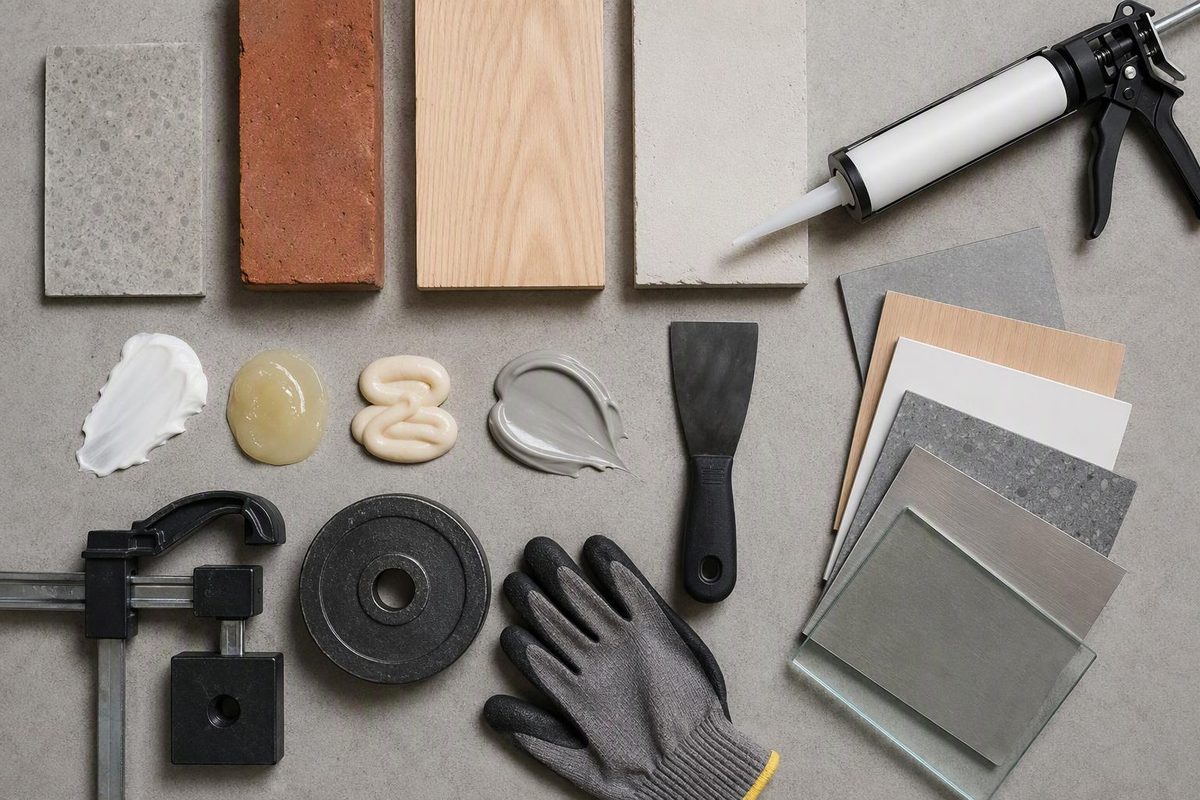
Choose construction adhesive by both bonding surfaces, the joint gap, the load and the exposure—not by “heavy duty” or “instant grab.” Construction adhesive is a product category, not one chemistry: formulations include water-based latex, solvent-based elastomer, polyurethane and silane-modified polymer. Their compatibility and curing requirements differ substantially.
Identify the joint first
Before choosing a cartridge, record:
- Both surfaces: wood to concrete is different from metal to metal. Identify coatings, plastic types and insulation facings, not just the material underneath.
- Fit and gap: dry-fit the parts and measure the separation. “Gap-filling” is not an unlimited gap rating; a specified application bead is not necessarily the permitted final bond-line thickness.
- Load: distinguish decorative trim from a wall cabinet, stair component or load-bearing attachment. Keep fasteners required by the assembly specification. For example, Liquid Nails LN-903 explicitly requires mechanical fasteners for wall cabinets, while Titebond’s solvent-based Heavy Duty instructions retain nails or screws for subfloors. LN-903 data sheet; Titebond application instructions.
- Exposure: indoor dryness, occasional wetting, constant dampness and immersion are separate conditions. “Exterior” does not automatically mean suitable underwater.
- Temperature: check both the application/cure range and the cured adhesive’s service range. They are not interchangeable.
For a specific substrate pair, see bonding wood to concrete or bonding steel to wood.
Prepare and plan support before opening the cartridge
Pre-cut and dry-fit the pieces, protect finished surfaces, and arrange clamps, bracing or fasteners in advance. Remove dust, grease, loose particles and other contaminants. The surface must be sound: adhesive cannot compensate for a loose layer underneath it.
Follow the chosen product’s moisture instructions. A dry surface is required for Power Grab Express All-Purpose, whereas PL Premium permits moisture-assisted curing but still requires surfaces free of standing water, frost and contamination. Do not translate “wet-surface compatible” into permission to bond through puddles or ice. Power Grab Express technical data; PL Premium technical data.
Check ventilation and protective-equipment requirements on the label and safety data sheet. Low odor or solvent-free wording is not a reason to skip them: the Power Grab Ultimate sheet calls for ventilation, gloves and safety glasses and notes that methanol is released during application and cure. Power Grab Ultimate technical data.
Compare the chemistry and its exclusions
These are documented U.S. product examples, not interchangeable recommendations for every member of a chemistry family. Match the exact product and current label to the job; similarly named formulations can differ.
| Type and example | Where to consider it | Limits that change the choice |
|---|---|---|
| Water-based latex: Power Grab Express All-Purpose | Interior trim and other listed building materials where at least one surface is porous | Excludes mirrors, stainless steel and glass; unsuitable for permanently damp or underwater areas |
| Solvent-based elastomer: Titebond Solvent-Based Heavy Duty | Listed interior/exterior building materials where a permanently flexible bond is wanted | Excludes plastics, polystyrene and polyethylene foams, and continuous submersion; do not bond two nonporous surfaces together because this can slow or prevent drying |
| Moisture-curing polyurethane: Loctite PL Premium | Listed wood, concrete, masonry, metal, PVC trim and insulation applications | Excludes immersion, PE, PP, PTFE and flexible vinyl; some natural stones and plastics present bonding difficulties |
| Silane-modified polymer: Power Grab Ultimate, white, item 2999434 | Listed interior/exterior materials, including porous-to-nonporous and two-nonporous joints | Excludes constant dampness, immersion, mirrors, PE, PP, PTFE, acrylic glass and certain metals and stones |
Sources: Power Grab Express sheet, revised November 2016, Titebond product specifications, PL Premium sheet, revised December 2019, and Power Grab Ultimate sheet, revised February 2025.
Read the exact formulation’s exclusions. Even “heavy duty” products differ: LN-903 is latex-based and excludes flooring and subfloors, despite listing wood and concrete as compatible substrates. A substrate listing alone does not approve the installation. LN-903 data sheet.
For full-floor installations, follow the flooring system rather than substituting cartridge beads: see glue-down engineered hardwood and glue-down vinyl flooring. For stone repairs, seams and attachments, use the stone adhesive selection guide.
Apply within open time; load only after cure
Open time is the interval available to make the joint after dispensing. Initial grab is early holding ability—not full strength.
PL Premium’s sheet specifies 15–20 minutes open time, 24 hours of mechanical support, and 24–48 hours cure at approximately 25°C and 50% relative humidity. Cold or low-humidity conditions increase cure time. Power Grab Ultimate’s 2025 sheet specifies 10–15 minutes open time and 24–48 hours cure at 23°C and 50% relative humidity, with support or bracing for 24–48 hours according to the project. These are condition-dependent times, not universal deadlines for removing support or loading the joint. PL Premium directions; Power Grab Ultimate directions.
Use the specified bead pattern and press the parts firmly together before open time expires. For two nonporous surfaces, Power Grab Ultimate requires moisture access: its beads must not merge into a continuous area, and its directions call for a very light mist on the adhesive. Do not generalize that misting instruction to other products. Power Grab Ultimate application directions.
Plan quantity from the required bead size, not cartridge volume alone. PL Premium lists approximately 30.6 ft (9.3 m) from a 10 fl oz cartridge at a ¼-inch (6 mm) bead, but only 13.6 ft (4.1 m) at ⅜ inch (9.5 mm). Allow for waste without enlarging the bead beyond the installation instructions. PL Premium coverage and application data.
Clean squeeze-out while it is uncured, using the product’s specified method and checking compatibility with the finish. Cured PL Premium requires mechanical removal; Power Grab Ultimate also directs cutting or scraping and warns of possible surface damage. Protecting the finish beforehand is easier than removing a cured bead. PL Premium cleanup directions; Power Grab Ultimate cleanup directions.