
3 min read ·
Hot glue bonds wood, but it is not the default for furniture repairs
Hot glue works on wood for crafts and light-duty attachments. Learn how to apply it, why bonds fail, and when to choose wood glue instead.
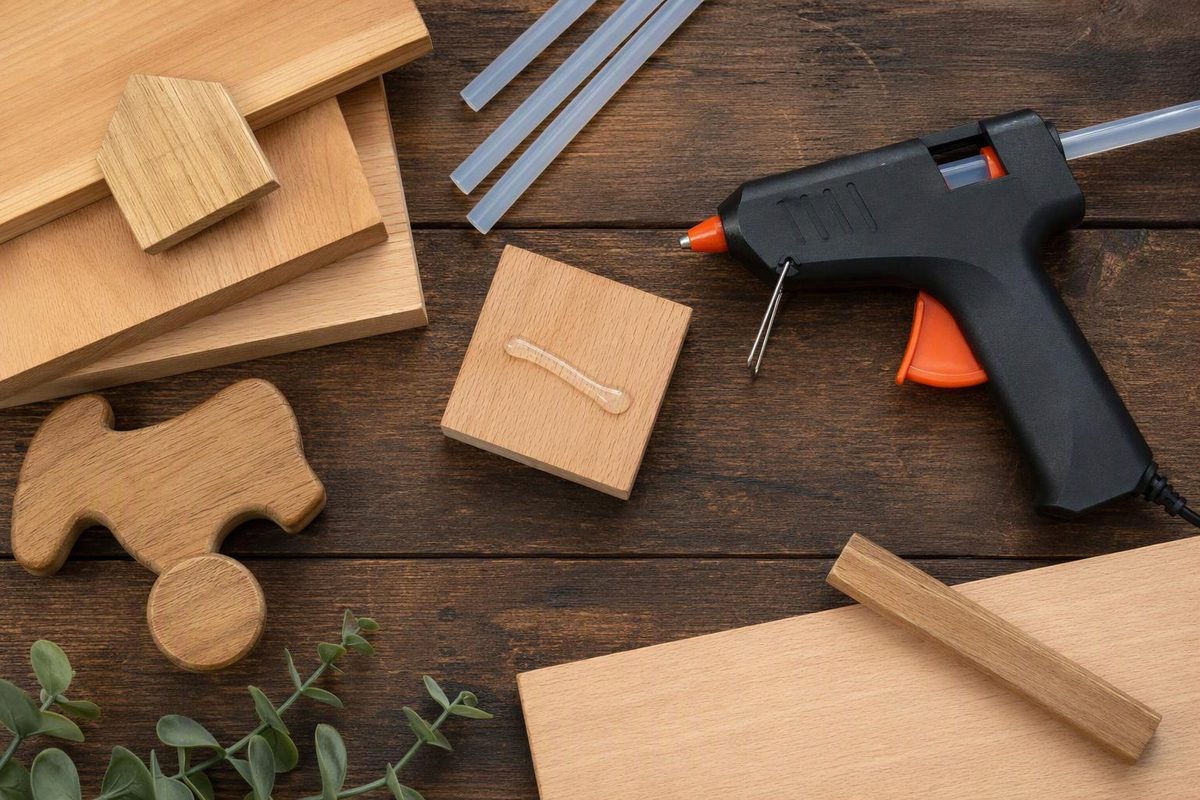
Yes, hot glue works on wood. It is a useful choice for indoor crafts, small decorative attachments and temporary positioning. For a chair joint, shelf support or another connection that must carry weight reliably, choose a woodworking adhesive and suitable joinery—not an unspecified craft glue stick.
Wood compatibility is documented: Gorilla’s hot-glue directions recommend high-temperature application for strong bonds on wood. But compatibility alone does not establish how much weight your joint can hold.
When hot glue is a good choice
Use it when the parts are lightweight, the bond has enough contact area, and failure would be an inconvenience rather than a safety risk. Examples include attaching wooden embellishments to a craft project or assembling a small display model.
Hot glue is fast because it sets by cooling, rather than drying like water-based wood glue. Gorilla’s US guidance says its hot glue typically sets within minutes, depending on gun temperature and bond size. That speed is useful for small assemblies, but leaves little time to spread glue and align a large panel.
Not all hot melts are interchangeable. Industrial formulations also bond wood: 3M’s 3792 technical data sheet documents wood compatibility and tested performance. Those results do not establish the strength of a generic craft stick; 3792 is an industrial product, not a consumer recommendation.
How to apply hot glue to wood
- Dry-fit the pieces. Check alignment and arrange any supports before dispensing glue. Keep the joint easy to assemble quickly.
- Prepare clean, dry, dust-free surfaces. Remove loose fibers and sanding dust. These are also the preparation requirements in 3M’s hot-melt instructions. On painted or varnished wood, the adhesive bonds to the coating; a loose coating remains a weak link. Test a hidden area before using heat on a finish.
- Match the stick to the gun. Check stick diameter and permitted operating temperature. Use the setting specified by the adhesive maker for wood—not simply the hottest setting available. Gorilla, for example, recommends high temperature for wood and low temperature for delicate materials such as foam and fabric.
- Apply and join promptly. Press the parts together while the glue is still molten, before it forms a cooled skin. Gorilla lists a 45-second working time for its UK sticks, but says temperature and the amount applied affect that time.
- Keep the parts still until the glue hardens. Allow a thick bead to cool before testing the attachment. Do not touch the nozzle or molten glue, or attempt removal while hot; both can cause burns. Application and safety directions.
Why the bond may fail
Heat and water can change the decision. Gorilla’s UK guidance lists a cured temperature range of −20°C to 49°C (−4°F to 120°F), describes resistance to slight water exposure, and specifically warns that bonds on untreated wood may be water-sensitive. These are product-specific limits, not a rating for every hot glue.
A bead that peels off cleanly is a reason to check dust, contamination, the finish and whether the glue cooled before assembly. Adding a larger blob does not resolve a weak surface or make a load-bearing joint dependable.
When to use wood glue instead
For a well-fitting, bare wood-to-wood joint intended to last, PVA wood glue is usually the better starting point. It requires more assembly support and cure time: Gorilla Wood Glue specifies 20–30 minutes of clamping and 24 hours for full cure.
If the joint has a substantial gap, joins wood to another material, or faces outdoor exposure, choose by those conditions rather than by speed alone. See adhesive for wood-to-wood joints for the broader selection.