
9 min read ·
A Completed Explorer Roof-Trim Repair May Not Be Final
Check whether an earlier Explorer roof-rail repair may be failing, what Ford’s mechanical remedy changes, and what to verify with the dealer.
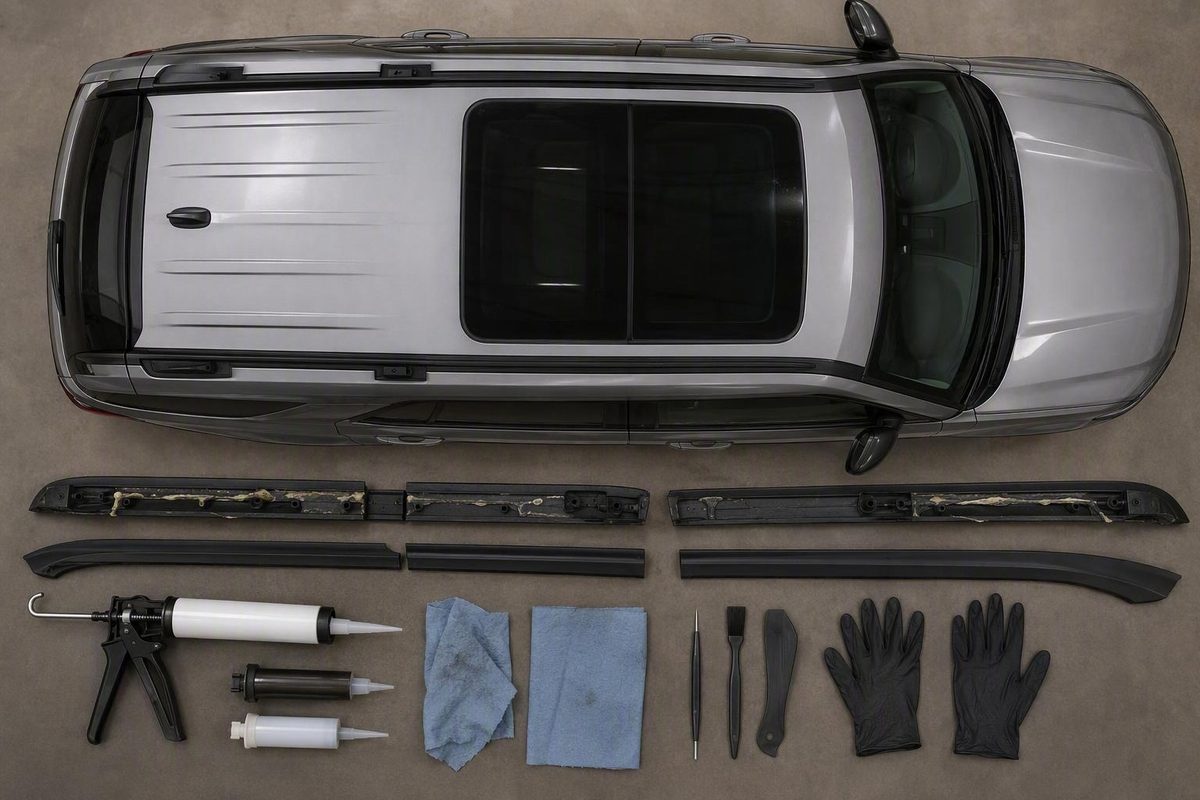
A “completed” repair does not prove the Ford Explorer roof-rail-cover problem is permanently resolved. Ford’s 2026 campaign covers 288,314 selected 2016–2019 Explorers, including some vehicles that had already received an adhesive-based repair, because retention can still degrade when clips, adhesive placement, adhesive quantity, or curing conditions are wrong (NHTSA Part 573 report).
What Recall 26S54 Actually Means
Ford campaign 26S54, also identified as NHTSA recall 26V448, concerns inadequate retention of the long exterior covers along the Explorer’s roof rails. It is not a recall of a branded glue or retail adhesive.
A cover can loosen or detach while the SUV is moving, creating a road-debris hazard for following traffic. Ford estimated that approximately 1% of the recalled population may have the defect. It reported no known injuries and one alleged accident involving a vehicle previously repaired with adhesive, although the filing does not establish that detached trim caused that accident (NHTSA Part 573 report).
The campaign applies only to selected vehicles. The reported production period is September 19, 2014, through March 3, 2019, but Ford did not identify the affected vehicles through a simple sequential VIN range. Model year and build date therefore cannot establish eligibility.
The current remedy is also not another instruction to apply stronger glue. Dealers check for added mechanical push pins, replace broken clips or damaged covers when necessary, and install four plastic push pins per side when the specified fasteners are absent. Required recall work is free for an eligible VIN.
Why Completed-Recall Records Are Usually Trusted
The conventional view has a sound basis. A dealer repair order or vehicle-history entry marked “completed” normally shows that an authorized repair was recorded against the VIN. It is far more useful than a seller’s unsupported claim that all recalls were handled.
That record is particularly meaningful when it identifies the campaign, describes the installed parts, and matches Ford’s current system. Ford reported that covers repaired with the specified push-pin fasteners under 21S22/21V316 were performing as intended. Mechanical fastener presence can also be checked during a later inspection.
The limitation is narrower than saying recall records are worthless. A completed status proves that work was recorded; it does not, by itself, reveal whether an earlier adhesive bond received the correct material placement, quantity, preparation, fixture control, and curing conditions. Reporting on the new campaign confirms that some previously repaired vehicles are again affected (Claims Journal).
A current 26S54 completion supported by a detailed repair order and dealer verification is stronger evidence than an old generic “recall completed” stamp. Even then, an active gap, rattle, or lifting edge deserves evaluation rather than dismissal based on paperwork.
Choose the vehicle’s repair history and symptoms; the checker will show whether it fits the repeat-failure profile and what to ask the dealer.
This checker compares repair history with current symptoms. It does not determine VIN eligibility or replace dealer inspection.
The filing provides no failure-mileage cutoff.
No symptoms are selected, but a completed status alone does not show which repair was performed or verify an earlier adhesive bond. Check the VIN and obtain a repair order describing the physical work.
- Which program was performed: 20N11, 21S22/21V316, or 26S54/26V448?
- Were the specified mechanical push pins present on both sides?
- Were broken clips or damaged covers found and replaced?
- If adhesive was previously used, which Ford procedure governed surface cleaning and preparation?
- Did that procedure specify primer, part holding, or cure conditions, and were those steps documented?
- If required under 26S54, were four additional plastic push pins installed per side?
| Recorded History | Symptoms Now | Profile | Next Verification |
|---|---|---|---|
| Completed roof-cover repair | Gap, rattle, lift, or wind noise | Repeat-failure profile | Photograph condition; check VIN; request dealer inspection |
| Completed repair | None observed | Paperwork only | Identify campaign, parts, and current VIN status |
| No repair or history unsure | One or more symptoms | Active retention concern | Check VIN and contact dealer; history does not prove a repeat |
| No completed repair | None observed | No symptom profile | Run current VIN lookup; absence of symptoms does not close a recall |
| Push-pin repair documented | None observed | Stronger repair evidence | Retain detailed order and verify current VIN record |
| Model year outside 2016–2019 | Any | Outside stated 26S54 model years | Use the VIN to check for other campaigns |
Default-state finding: A 2018 Explorer with a completed but unspecified repair and no current symptoms still needs record verification.
Mileage rule: — No mileage threshold is stated in the filing.
Source: Ford/NHTSA Part 573 report for 26V448; figures and campaign details reproduced from the article. This tool does not access VIN records.
An Adhesive Bond Depends on the Whole Process
An exterior trim bond is not validated merely because adhesive is visible. The service process has to control the condition of both joining surfaces, the approved preparation steps, adhesive location and quantity, part positioning, and the conditions maintained while the material develops retention.
Ford’s filing specifically identifies damaged clips, incorrect adhesive location, incorrect adhesive quantity, and unsuitable curing conditions as variables in the earlier 20N11 repair pathway. It does not publish the complete workshop procedure or identify a retail adhesive owners can substitute (NHTSA Part 573 report).
Surface Preparation Must Match the Approved Procedure
Adhesive cannot compensate for a damaged mechanical assembly. If a clip was cracked, worn, or no longer engaged, bonding the cover did not restore the clip to its original geometry. Retention depended on the cover, clips, mounting surfaces, adhesive where used, and execution of the repair as a system.
Cleaning and surface preparation matter because a bond is formed against the surface actually presented to the adhesive. An owner should ask whether the old material and contamination were removed and whether the Ford procedure required any specified cleaner, abrasion, or primer.
Those are verification questions, not a claim that Ford required a particular cleaner or primer. The public filing does not provide those product details. A shop should be able to identify the applicable service procedure rather than improvise a preparation method.
Placement And Quantity Are Separate Controls
Using enough adhesive somewhere on the part is not the same as placing the specified quantity in the specified location. Ford expressly identified both location and quantity as potential shortcomings in earlier repairs.
Excess material is not automatically safer. It can be displaced away from the intended bond area or interfere with seating. Too little material or a misplaced bead may fail to bridge the intended interface. The public documents do not provide dimensions or an owner-usable application pattern, so online measurements should not be treated as an approved repair specification.
Clamp And Cure Dwell Cannot Be Inferred From Paperwork
The filing identifies curing conditions as a failure variable but does not state the required cure time, temperature range, clamp force, fixture method, or official labor allowance. Those figures are therefore unknown from the available public evidence.
The relevant service question is whether the cover remained correctly seated for every dwell or environmental condition specified by Ford before the vehicle was released. A repair order that merely says “secured trim” does not answer that question.
There is also no sourced evidence that dealers generally rushed these repairs or that recall time pressure caused the failures. The supported conclusion is that an adhesive process can lose retention when its specified curing conditions are not achieved. Owners should ask for the procedure and recorded work rather than accuse a shop of shortening a cure it may not have performed.
For 26S54, this distinction is crucial: the documented remedy centers on inspectable mechanical retention, not a repeat adhesive application.
The Three Campaigns Used Different Repair Approaches
The Explorer’s roof-cover history includes a customer-satisfaction program and two federal safety recalls. They should not be collapsed into one repair record.
| Action | Type | Repair Approach | Present Meaning |
|---|---|---|---|
| 20N11, 2020 | Ford program | Adhesive-based service process and retention assessment | Some repaired vehicles later showed continuing risk |
| 21S22/21V316, 2021 | Safety recall | Added mechanical push-pin fasteners | Ford reported these repairs performing as intended |
| 26S54/26V448, 2026 | Safety recall | Verify push pins; replace damaged parts; add missing pins | Current VIN-specific campaign |
Ford’s page for 21S22/21V316 describes inspection and securing of roof-rail covers at no charge. Ford’s later analysis distinguished the push-pin repairs from original plated covers and covers repaired with adhesive under 20N11.
Some 2026 recall vehicles entered through a separate aging pathway. Ford reported that certain plated covers could lose retention as their clips experienced additional heat cycles and wear. An Explorer therefore does not need a prior 20N11 adhesive repair to be included.
This is where the consensus view remains correct: the current VIN record determines whether a federal campaign is open. The record is not, however, a physical inspection of an actively lifting cover.
Verify More Than The Word “Completed”
A useful repair order should identify what was inspected and what was installed or replaced. For 26S54, ask the service adviser to document whether the specified push pins were already present, whether any clips were broken, whether either cover was damaged, and whether four additional push pins per side were installed when required.
For an earlier adhesive repair, the public evidence supports asking these specific questions:
| Verification Point | What To Ask |
|---|---|
| Repair authority | Was this 20N11, 21S22/21V316, or 26S54? |
| Existing hardware | Were damaged clips found and replaced? |
| Surface preparation | Which Ford procedure governed cleaning and preparation? |
| Primer | Was one specified, and was that step documented? |
| Adhesive control | How were location and quantity controlled? |
| Seating | How was the cover held in position? |
| Cure | What specified conditions were met before release? |
The filing does not supply the primer, clamp, or cure-time answers. If the dealer cannot retrieve them for an old repair, that uncertainty should be recorded rather than filled with a guessed specification.
A vehicle-history report may also omit which side was repaired or whether a cover was replaced. Bring the invoice to an authorized dealer, but run a new VIN lookup through the NHTSA recall lookup or Ford’s system. Ford’s recall line is 1-866-436-7332, as listed in the Part 573 filing.
Symptoms Override Reassurance From Old Paperwork
Ford identified increased wind noise, squeaking, rattling, a visible gap, and roofline misalignment as possible warning signs. A cover lifting at one edge also warrants dealer attention, although symptoms alone cannot determine campaign eligibility.
A visibly normal cover is not proof that an open recall can be ignored. Conversely, a rattle may have another cause. The combination most consistent with a repeat concern is a documented earlier roof-cover repair followed by a new gap, rattle, misalignment, or lifting edge.
Photograph the condition without pulling on the cover. Record the affected side and when the symptom occurs, then give the dealer the prior repair order. Do not press the trim back and assume it has reattached.
The available evidence establishes no owner-applied temporary repair. It does not support reglueing, taping, removing, drilling, or screwing down the cover before dealer evaluation. If the cover appears actively loose or partly detached, contact an authorized Ford dealer and describe that condition when requesting guidance.
Mileage since repair can help establish when a symptom appeared, but the filing provides no mileage threshold for success or failure. A bond that has covered a particular distance is not automatically verified, and low mileage does not prove that an installation was correct.
Current VIN Status Still Controls Recall Eligibility
Owning a 2016–2019 Explorer does not automatically place it in 26S54. Two vehicles from the same model year may have different statuses because Ford used plant assembly and repair records to identify individual vehicles.
Check the complete 17-character VIN rather than relying on model year, build date, or an old seller printout. Save the current result and ask the dealer to search specifically for Ford 26S54 or NHTSA 26V448 if records appear inconsistent.
The filing scheduled interim owner notices for August 24–28, 2026, and remedy notices for September 21–25, 2026. Those windows do not guarantee appointment timing, dealer capacity, or immediate availability of every possible replacement part. The public evidence also does not provide official labor time, regional parts availability, reimbursement rules for earlier owner-paid work, or a universal escalation procedure.
Before leaving after service, retain a final repair order that identifies the campaign and states whether the dealer inspected existing push pins, replaced clips or covers, or installed the specified fasteners. “Recall completed” is the database result; the repair description is the evidence of what was physically done.
Roof-Rail Covers Are Not A-Pillar Trim
Campaign 26S54 concerns the long covers running along the roof rails. Ford campaign 24S02 concerns A-pillar exterior trim beside the windshield on certain 2011–2019 Explorers.
Ford attributes the A-pillar issue to clip attachments that may not have been properly engaged during assembly or later field repairs. It does not identify failed adhesive as the cause or prescribe an adhesive remedy for 24S02 (Ford’s A-pillar recall page).
An Explorer can have one campaign, both, or neither open. Use the VIN for eligibility and let the dealer identify the affected component. For 26S54, the practical standard is not whether old paperwork says “done,” but whether the current VIN record and the physical fastener inspection agree.