
7 min read ·
Remove Super Glue From Skin Without Tearing It
Follow safe steps for loosening super glue with soapy water, oil or acetone, and learn when an eye exposure, burn or torn skin needs help.
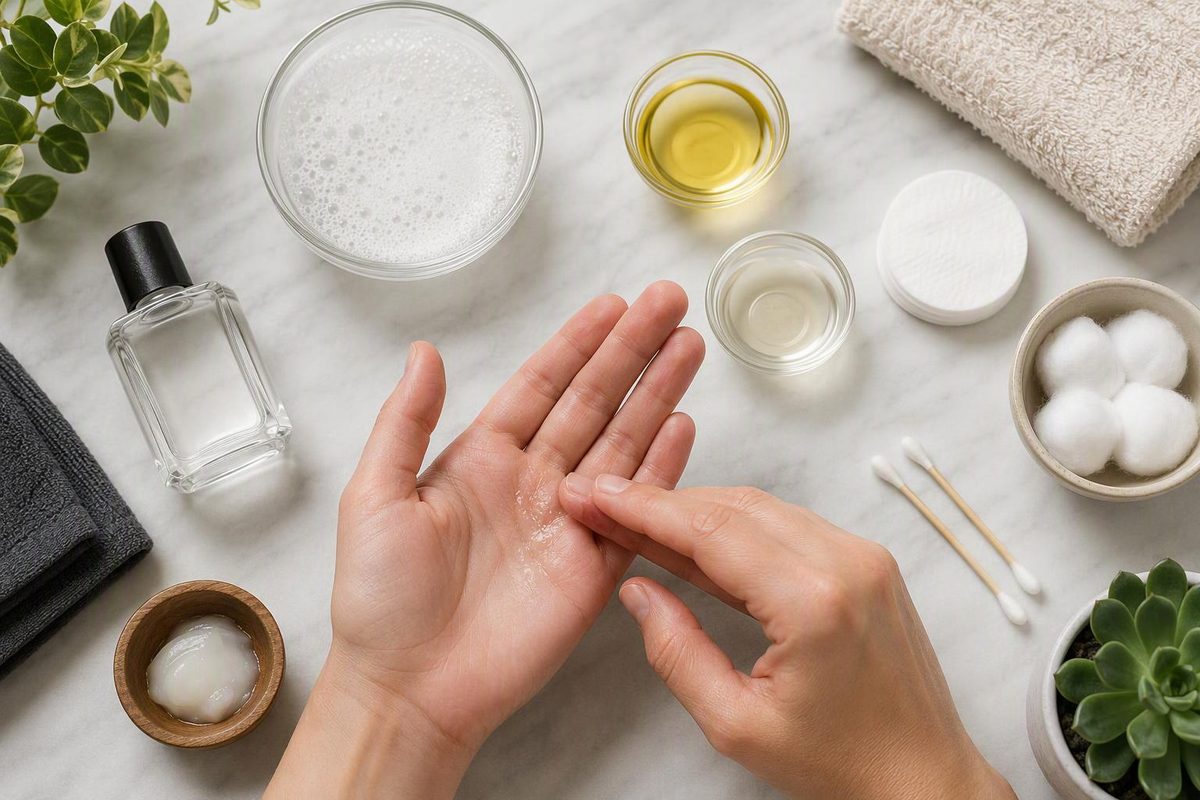
Soak super-glued skin in warm, soapy water, then gently roll the bonded surfaces apart instead of pulling them. If soaking is not enough, massage vegetable oil, mineral oil or petroleum jelly around the bond. Acetone can soften cured glue on intact skin, but it should not touch cuts, irritated skin, eyes, the mouth, the nose or other sensitive areas.
Choose where the glue landed and its condition; the guide shows the safest next step.
Super Glue Skin Response Guide
Select the exposure and the glue’s condition.
Soak, Then Roll Apart
Soak the bonded skin in warm, soapy water. Work from an edge with a gentle back-and-forth rolling motion. Do not pull or pry.
If needed, massage in vegetable oil, mineral oil or petroleum jelly. Acetone is an option only after the glue has cured and only while the skin remains intact.
Always get help for severe pain, blistering, torn skin, persistent irritation or glue in or near an eye, mouth or nose.
Sources: Poison Control, Ontario Poison Centre and MedlinePlus.
Remove The Glue In Four Steps
1. Soak The Bond In Warm, Soapy Water
Place the affected skin in warm, soapy water. Make sure the water reaches the edges of the glue rather than wetting only the middle of the dried patch. A light bond may loosen within several minutes, while a firm bond can require repeated or prolonged soaking.
Do not treat the first unsuccessful soak as a reason to pull harder. The Ontario Poison Centre notes that separation may take several hours, depending on the bond and the affected area (Ontario Poison Centre). Repeating the soak is safer than trying to overcome the adhesive with force.
If two fingers are bonded, keep the joined area in the water and test only the outer edge. If skin is attached to an object, soak the contact line where the skin meets the object. The aim is to loosen an accessible edge before attempting separation.
2. Roll The Skin Apart From An Edge
After soaking, start at a loose edge and use a slow back-and-forth rolling motion. This is different from pulling the two surfaces directly away from each other. Work only where the bond is beginning to release.
Stop if the movement hurts, stretches the skin sharply or begins to tear it. Pulling or prying bonded skin can remove layers of skin and cause bleeding (MedlinePlus; Missouri Poison Center). More soaking is appropriate when the edge does not move without force.
Do not expect the whole bond to release at once. Loosen a small section, soak again if necessary and continue from the newly exposed edge. A slow release avoids turning an adhesive problem into a torn-skin injury.
3. Work Oil Or Petroleum Jelly Around A Stubborn Bond
When soap and water do not release the edge, massage mineral oil, vegetable oil or petroleum jelly around it. Let the lubricant work along the contact line, then repeat the gentle rolling motion. These options are particularly useful when the skin is too tender for a harsher solvent (Poison Control).
Apply the lubricant to the perimeter rather than trying to scrape through the center of a thick glue patch. As an edge lifts, work more lubricant into the newly opened space. Continue only while the skin separates without pain or damage.
Oil does not justify pulling harder. Its purpose is to assist the same gradual edge-first method used after soaking. If the bond remains firm, return to warm, soapy water and repeat the process rather than inserting a sharp tool underneath it.
4. Reserve Acetone For Cured Glue On Intact Skin
If soaking and lubrication are not enough, a small amount of acetone-based nail-polish remover can soften cured super glue on ordinary, intact skin. Wait until any wet glue has cured before using it. Dab a small amount onto the bond, allow the glue to soften and rub gently rather than scraping.
Use the smallest practical amount. Acetone can leave skin dry, cracked and irritated. Wash the area with soap and water afterward and apply moisturizer (Cleveland Clinic). Do not mix acetone with other chemicals.
Do not use acetone on a cut, torn, blistered or already irritated area. Keep it away from the eyes, eyelids, mouth, nose and other sensitive areas. Those exposures require a different response and should not be treated as ordinary glue on a fingertip.
If wet glue is still present, do not use cotton balls, cotton cloth or cotton clothing to apply or wipe anything. Wet cyanoacrylate can react rapidly with cotton and generate enough heat to cause a serious burn.
A Dry Film Can Usually Be Left Alone
Complete removal is not necessary when the skin is already separated and only a thin, dry film remains. If that residue is not painful or irritating, leave it alone rather than repeatedly treating or scraping the skin.
Dried super glue on skin has a low poisoning risk and wears off as the outer skin cells shed (Ontario Poison Centre). This applies to residue on skin, not glue in an eye, the mouth or the nose, and not to an area with a burn or torn skin.
A remaining film also does not need to be removed in one session. Wash normally and avoid picking at firmly attached sections. If the skin becomes painful, blistered or persistently irritated, stop home removal and seek advice.
Pulling, Cutting And Hard Scrubbing Can Worsen The Injury
Do not yank bonded fingers apart or pull skin directly away from an attached object. The adhesive may remain stronger than the outer skin layers, so force can produce bleeding before it separates the glue.
Do not slide a knife, razor blade or other sharp tool under the bond. Even if an edge is visible, the blade can cut skin as the adhesive releases. Use soaking, lubricant and gentle rolling to work from that edge instead.
Do not scrub the patch hard with an abrasive. Abrasion may damage the surrounding skin while leaving the deeper part of the bond in place. If a harmless dry film remains after the skin has separated, allowing it to wear off is safer than grinding it away.
Do not place acetone or another solvent near an eye or inside the mouth or nose. Acetone is an option only for cured glue on ordinary, intact skin. It is not the general treatment for every cyanoacrylate exposure.
For removing cyanoacrylate from objects and other materials rather than skin, see Acetone for Super Glue Removal: Where It Is Safe.
Wet Super Glue And Cotton Can Cause A Heat Injury
Keep cotton balls, cotton pads, cotton cloth and cotton clothing away from wet super glue. Cyanoacrylate reacts rapidly with cotton, releasing heat. Treat this as a burn hazard rather than merely a stain-removal problem.
One published experiment illustrates how intense that reaction can become. A 3 g tube emptied onto cotton pajamas reached 91°C (196°F) after about 90 seconds (Journal of Burn Care & Research abstract). That experiment demonstrates the hazard; it does not predict the temperature of every spill, garment or quantity of glue.
If a spill on cotton produces heat or burns the skin, seek prompt medical care. Do not continue ordinary glue-removal steps over a painful or blistered burn. The priority is the injury, not removing every trace of adhesive.
Eye Exposure Needs A Different Response
Do not apply acetone or alcohol to the eye or eyelids. Do not force bonded eyelids open, cut the eyelashes or try to peel glue away from the eye. Mechanical separation and solvents can cause additional injury in an area that should not be handled like bonded fingers.
If the eyelids are not bonded shut and the eye can be rinsed, flush it with water for 15 minutes. Contact a poison center or obtain prompt medical guidance after the exposure.
If the eyelids are bonded shut, apply a warm compress and contact a poison center or seek urgent medical care. Do not try to open them yourself. Guidance depends on the exact location of the glue and whether the eye can be rinsed, so follow the poison center’s instructions rather than improvising a separation method (Poison Control; MedlinePlus).
The usual soak, oil and acetone sequence is intended for ordinary skin. It does not establish a home-treatment method for the eye itself or for glue trapped beneath an eyelid.
Mouth And Nose Exposures Need Prompt Advice
Contact a poison center or seek prompt medical care when super glue is in or near the mouth or nose. Do not place acetone or another solvent inside either area, and do not force apart tissue that appears bonded.
Because the appropriate response depends on where the glue landed and whether tissue is bonded, use product-specific instructions from a poison center. Keep the glue container or label available when calling so the adviser can identify the product involved.
Burns, Torn Skin And Persistent Pain Need Medical Care
Contact a poison center or seek prompt medical care if a large spill produces heat or a burn. Severe pain, blistering, torn skin, bleeding after attempted separation or persistent irritation are also reasons to stop home removal.
Once skin has torn, acetone is no longer an appropriate next step. The instruction allowing acetone applies only to cured glue on intact skin. Continuing to pull, scrub or apply solvent to damaged skin can add irritation to the existing injury.
Get help as well when the glue is in or near an eye, mouth or nose, even if the amount appears small. These locations fall outside the routine removal method for hands and other ordinary skin.
In the United States, Poison Help is available at 1-800-222-1222. Elsewhere, contact the local poison center or emergency service. Keep the product container or label nearby when calling.