
19 min read ·
How to Choose a PSA That Will Actually Work for Your Materials
Light pressure helps the tacky layer spread across surface texture. No heat, water or solvent activation is normally needed. Excess flow can contribute to residue.
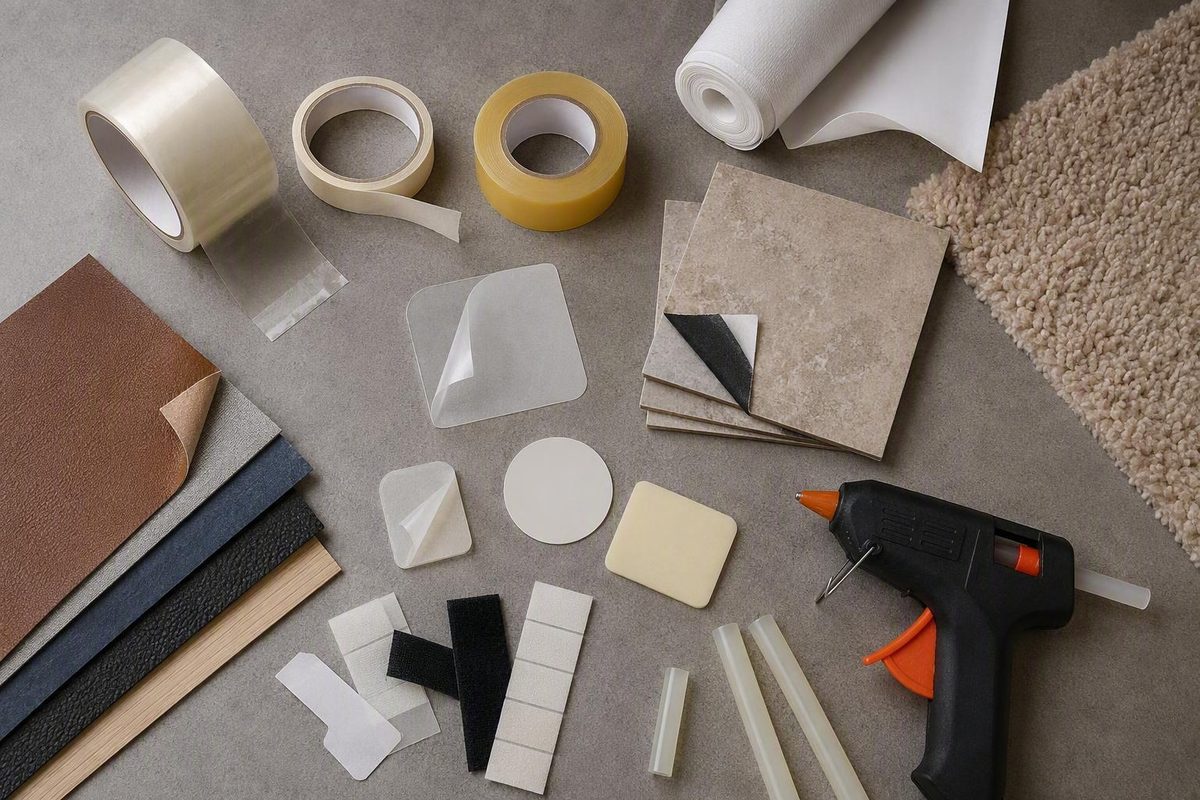
Pressure-sensitive adhesive glue is not one formula. It is a broad adhesive category that includes packing tape, removable labels, carpet-tile adhesive, transfer film, automotive trim tape, and specialized films used in electronics.
That breadth is why choosing the “stickiest” product is unreliable. A PSA can feel aggressive to the touch yet creep under sustained load, lift from a low-surface-energy plastic, leave residue after aging, or deteriorate in an unsuitable environment. Another product may have modest initial tack but develop a stronger bond after adequate pressure and dwell time.
Reliable selection starts by separating four variables:
- Chemistry: commonly rubber, acrylic, or silicone.
- Physical format: liquid, tape, transfer adhesive, sheet, film, or label stock.
- Manufacturing or coating route: water-based, solvent-based, hot-melt, or UV-curable.
- End-use behavior: pressure activation, removability, environmental resistance, peel performance, and shear capacity.
The right PSA is the complete formulation and construction that matches both substrates, the service environment, the mechanical load, the application process, and the intended method of removal.
What pressure-sensitive adhesive glue is—and is not
A pressure-sensitive adhesive is generally a nonreactive adhesive that bonds when light pressure brings it into close contact with a surface. The finished adhesive layer normally needs no heat, water, solvent activation, or in-use chemical reaction to become adhesive. Pressure helps the already tacky layer establish the close contact needed for bonding. Duracote describes PSA bonding under light pressure without heat, water, or solvent activation.
That definition concerns the bonding mechanism, not every manufacturing or application step. A pre-coated tape or label usually needs only placement and pressure at the point of use. A carrier-borne liquid PSA, however, may need water or solvent to evaporate before or during assembly. The resulting adhesive film still bonds by pressure rather than by a reactive cure.
“Pressure-sensitive adhesive glue” is common informal wording, but PSA is the more useful technical term. The category includes much more than pourable glue or material dispensed from a cartridge. PSAs may be supplied as:
- Single-coated or double-coated tape
- Transfer adhesive without a permanent carrier
- Film or sheet
- Pressure-sensitive label stock
- Liquid flooring adhesive
- Pre-cut or die-cut shapes
- Hot-melt material applied during manufacturing or dispensing
Familiar applications include packing and masking tapes, product labels, adhesive bandages, carpet-tile installations, automotive trim, and electronics assemblies. These products share a pressure-responsive bonding principle, but their formulations are not interchangeable. A packaging tape is not automatically suitable for skin contact, flooring, outdoor trim, or electronics.
PSA is also not synonymous with hot-melt glue. Hot-melt PSA is one formulation or coating route within the wider PSA category. Other PSAs are manufactured through water-based, solvent-based, or UV-curable routes. A hot-melt PSA may be heated during coating or dispensing and remain pressure-sensitive after cooling; the user of the finished tape or label does not necessarily apply heat.
Nor does “pressure-sensitive” determine whether a bond is temporary or permanent. Depending on formulation and service conditions, a PSA can be:
- Repositionable: movable during initial placement
-
Removable: designed to detach after a defined period
-
Permanent: designed to remain bonded throughout its expected service life
It means removal is not the product’s primary function.
How pressure, wet-out, and viscoelasticity create a bond
Pressure does more than make two objects touch. It helps the adhesive deform and spread across the microscopic high and low points of the substrate. This process is called wet-out.
A surface that appears smooth can still have texture, coatings, pores, contamination, or geometric irregularities. If the adhesive contacts only the highest points, the effective bonding area remains limited. Suitable pressure brings more of the adhesive into close contact with the available surface.
PSAs can do this because they are viscoelastic:
- Their viscous response lets them deform and wet the substrate.
- Their elastic response and internal cohesion help them resist splitting or flowing under stress.
Too little flow can produce poor contact and weak adhesion. Too much flow can contribute to movement or residue. A useful PSA must wet the surface while retaining enough cohesive strength for the intended load.
Once close contact is established, intermolecular attractions—including van der Waals forces—contribute to adhesion. These forces help explain why wet-out matters, but they do not independently predict field performance. Substrate chemistry, contamination, adhesive thickness, temperature, load direction, and aging still affect the result. Kuraray’s explanation connects pressure, wet-out, close contact, and van der Waals attraction.
“Strength” must also be divided into separate properties:
- Tack: how readily the adhesive grabs during brief or initial contact
A slower-wetting acrylic may feel less aggressive at first yet provide better performance after aging or outdoor exposure.
Published values are meaningful only with their test conditions. Substrate, cleaning method, dwell time, peel angle, speed, temperature, load, and test procedure can all affect the result. Even values generated under the same general type of test should not be treated as directly comparable when those conditions differ.
Many PSAs provide nearly immediate handling strength but continue developing adhesion afterward. Supplier guidance commonly describes optimum or near-maximum strength developing within approximately 24–72 hours, although that range is not a universal cure schedule. This PSA guide distinguishes immediate tack from bond development over roughly 24–72 hours.
It does not establish:
- Full wet-out
- Adequate contact with both substrates
- Sufficient adhesive transfer
- Suitable peel or shear performance
- Compatibility with coatings, additives, or plasticizers
- Long-term resistance to heat, moisture, chemicals, or ultraviolet exposure
Pressure matters, but no universal roller force, number of passes, or hand-pressure duration applies to every PSA. Use the current Technical Data Sheet (TDS) for the exact product and construction.
Rubber, acrylic, and silicone PSA compared
Rubber, acrylic, and silicone are useful starting categories, not guarantees. Additives, tackifiers, coating weight, carrier, substrate, and service conditions can substantially change performance within each family.
| Chemistry | Initial tack tendency | Bond-development tendency | Environmental resistance | Difficult-substrate fit | Cost tendency | Common applications | Principal limitations |
|---|---|---|---|---|---|---|---|
| Natural- or synthetic-rubber PSA | Commonly fast and aggressive | Often provides handling strength quickly | Frequently less resistant to heat, UV, oxidation, chemicals, and long aging than acrylic unless modified | Can work well on some low-surface-energy materials | Often lower | Packaging, masking, general indoor bonding, some foam and plastic applications | Environmental aging, heat, chemicals, and sustained load may be limiting |
| Acrylic PSA | Often lower or more gradual than rubber | Frequently builds adhesion over time | Generally a strong starting point for weather, UV, oxidation, chemicals, and temperature changes | Standard grades may struggle with polyethylene and polypropylene | Often higher than general-purpose rubber | Outdoor labels, graphics, automotive components, durable tapes, electronics | Slower development; not automatically compatible with low-surface-energy or plasticized materials |
| Silicone PSA | Commonly modest or slow | May require more dwell before evaluation | Often considered for demanding heat, chemical, and weather exposure | Common starting point for silicone and other difficult surfaces | Commonly highest | High-temperature masking, silicone bonding, aerospace, electronics | Cost, lower initial tack, limited availability, and formulation-specific handling |
These are broad, supplier-reported tendencies rather than universal rankings; the same comparisons also identify formulation-dependent differences in cost, tack, aging, and substrate compatibility. Rubber Resource compares natural rubber, synthetic rubber, acrylic, and silicone PSA families.
Rubber-based PSA
Rubber PSAs are often selected when fast initial tack and economical bonding matter. They can be useful for packaging, quick indoor assembly, and some low-surface-energy surfaces.
Their common trade-off is environmental durability. Heat, ultraviolet exposure, oxidation, chemicals, and long aging may degrade an unsuitable rubber formulation more quickly than a well-matched acrylic. Modified synthetic-rubber systems may improve particular properties, so the family name alone should not disqualify a product.
Acrylic PSA
Acrylic PSA is often the first family evaluated for outdoor labels, graphics, trim, and applications requiring resistance to weather, ultraviolet exposure, oxidation, chemicals, or temperature changes. It may develop adhesion more gradually than an aggressive rubber formulation.
Standard acrylic is not automatically suitable for every plastic. Polyethylene and polypropylene have low surface energy and can resist wet-out. A specialized low-surface-energy acrylic, compatible primer, or validated surface treatment may be necessary.
Silicone PSA
Silicone PSA is commonly evaluated for silicone surfaces, demanding temperatures, or chemical conditions that conventional rubber or acrylic products may not tolerate. It can also be considered for other difficult substrates.
Its typical trade-offs are higher cost and slower initial behavior. Published family-level temperature ranges should never be treated as universal limits. The exact adhesive, carrier, liner, substrates, and assembled construction determine usable conditions.
Choose the right format: liquid, tape, transfer adhesive, label, or hot-melt PSA
Four concepts are often confused:
- Chemistry identifies the adhesive family.
- Format describes how the adhesive reaches the joint.
- Coating or manufacturing route describes how it is produced or deposited.
- Pressure activation describes how the finished adhesive establishes its end-use bond.
An acrylic PSA, for example, might be supplied as flooring adhesive, transfer film, label stock, or tape. “Acrylic” alone does not identify the format.
Tape constructions
Single-coated tape has PSA on one side of a carrier or backing. The carrier can provide reinforcement, protection, masking, insulation, or another functional surface.
Double-coated tape has adhesive on both sides of a central carrier. The carrier helps control handling, thickness, and dimensional stability while joining two substrates.
Transfer tape supplies adhesive on a removable release liner without a permanent stabilizing carrier. After application and liner removal, the unsupported adhesive layer becomes the bonding medium.
Self-wound tape has PSA on one side of a carrier and a release treatment on the other. It winds onto itself without a separate liner. Strouse distinguishes transfer, double-coated, single-coated, and self-wound tape constructions.
Tape and film are strong candidates when the process requires:
- Controlled adhesive thickness
- Clean handling
- Repeatable placement
- Immediate assembly
- Die-cut or converted shapes
- No liquid overspray or squeeze-out
- Automated application
They still need adequate contact.
Label stock
Pressure-sensitive label stock normally combines a printable or decorative facestock, a PSA layer, and a release liner. The liner is removed before the label is applied manually or by machine.
The facestock, adhesive, liner, printing process, container, application speed, and storage environment operate as one system. Selecting only the adhesive chemistry is incomplete.
Liquid PSA
Liquid PSA can be useful for flooring, broad-area coating, porous materials, irregular shapes, or areas where preformed tape cannot establish sufficient contact. Depending on the product, application may use a roller, brush, spray system, or trowel.
Liquid format does not eliminate the need for thickness control. Coverage, application tool, open time, airing period, and assembly window must come from the product instructions.
Hot-melt PSA
A hot-melt PSA is heated so it can flow during coating or dispensing, then remains pressure-sensitive after cooling. The heat belongs to its manufacturing or application route, not necessarily to later use of the bonded part.
A former Infinity Bond cartridge system illustrates the format: the seller described it as a heat-dispensed PSA that remained tacky, but the listing is marked discontinued. It is an example, not a current product recommendation. The cartridge listing identifies the material as hot-melt PSA and marks it discontinued.
Coating routes
- Water-based: PSA components are carried or dispersed in water, which must leave after coating.
- Solvent-based: components are dissolved or dispersed in solvent, which evaporates after coating.
- Hot-melt: the material is heated until it flows, coated, and then cooled.
- UV-curable: ultraviolet energy initiates rapid conversion during manufacturing.
These routes describe processing, not a universal performance, safety, or environmental ranking. Solvent-based processing can introduce volatile-emissions, worker-exposure, ventilation, and fire concerns, so product-specific controls and the current Safety Data Sheet (SDS) are essential. Kuraray’s coating-route overview identifies VOC, worker-safety, environmental, and fire concerns associated with solvent processing.
A practical PSA selection framework
Use this sequence before asking a manufacturer or distributor for a product.
1. Define the intended bond behavior
Decide whether the bond must be repositionable during installation, removable after a defined service period, releasable for maintenance, or permanent for the assembly’s expected life.
Then define acceptable removal. It might mean no visible residue on glass, no paint lift from a wall, no distortion of plastic film, or simply that a technician can separate the parts. Those are different specifications.
2. Identify both substrates precisely
“Plastic to metal” is not enough. Record the plastic type, grade, additives, coating, and texture, along with the metal and its surface treatment.
For foam or flexible plastic, identify the polymer and any relevant additives where possible.
3. Assess surface energy and wettability
Polyethylene, polypropylene, PTFE, and silicone are frequently difficult to bond. They may require a compatible PSA, primer, or validated corona, plasma, or flame treatment. These materials and treatment options are identified in Dexerials’ discussion of wettability and surface preparation. Its comparison also explains why PSAs should not automatically be treated as substitutes for higher-strength reactive adhesives.
Do not select a product solely because it claims to “bond plastic.” Test the exact resin, surface texture, molding additives, and preparation method.
4. Examine geometry
Smooth, continuous, supported surfaces often suit tape, film, or transfer adhesive. Rough, porous, curved, recessed, or irregular surfaces may need a thicker conformable construction or liquid adhesive.
Confirm that there is enough bonding area and that pressure can reach the entire joint. Adhesive cannot wet a recessed region that the applicator or mating part never contacts.
5. Define the service environment
Record realistic exposure to:
- Indoor or outdoor conditions
- High and low temperatures
- Thermal cycling
- Moisture or immersion
- Ultraviolet light
- Cleaning agents, oils, fuels, or other chemicals
- Vibration or impact
- Plasticizers
- Dust or recurring contamination
Do not compare only headline temperature ranges. Review how peel and shear performance change at temperature and after environmental aging.
6. Define the mechanical load
“Strong” is not an engineering requirement. Identify peel, edge lifting, sustained shear, impact, vibration, movement, part weight, available bond area, and the consequences of failure.
A PSA that survives a short pull may still move under a smaller continuous load. Because PSAs generally provide lower bond strength than reactive adhesives, they should not be assumed suitable for high-load or safety-critical structural joints without qualified engineering validation. Mechanical fastening, joint redesign, or a structural adhesive may be required. The Dexerials comparison cited above supports this distinction between PSA and reactive bonding.
7. Account for installation constraints
Consider manual versus automatic placement, available rollers or presses, alignment tolerance, line speed, liner removal, coating equipment, contamination control, and allowable bond-development time.
A suitable formulation can still be a poor production choice if it cannot be placed cleanly, pressed uniformly, or protected during its required dwell period.
8. Run a representative trial
Test the exact adhesive construction on production-representative materials. Reproduce the planned cleaning, pressure, dwell, load, temperature, moisture, aging, and removal conditions.
Observe how the trial fails:
- Clean release from one surface
- Adhesive splitting
- Residue
- Coating or substrate damage
- Creep
- Edge lift
- Incomplete transfer
The decision path is:
Required removability → exact substrates and surface energy → environment → load → physical format → current TDS verification → representative trial.
PSA versus contact cement, epoxy, reactive glue, and wet-glue systems
PSA is often selected for speed, controlled application, immediate handling, thin bond lines, or later disassembly. Other adhesive families may be preferable when the joint requires structural capacity, gap filling, penetration into uneven geometry, or a cured bond.
PSA versus contact adhesive
Contact adhesive is generally applied to both surfaces and allowed to air or dry for the stated period before the surfaces are joined.
PSA uses a pressure-responsive layer that may already be coated onto tape, film, or a component. The distinction is partly procedural: coating two parts and waiting is different from exposing a protected adhesive layer and pressing it into place.
PSA versus epoxy and other reactive adhesives
Epoxy and other reactive adhesives undergo a chemical or physical change during setting or curing. They are commonly considered when an assembly needs structural capacity, gap filling, or a rigid cured bond.
PSA generally supports faster handling and may simplify service disassembly, but it should not automatically be expected to match the load capacity of a qualified reactive adhesive.
Tape controls bond-line thickness and keeps liquid away from adjacent parts. Liquid adhesive can be more suitable when material must reach uneven or confined spaces before curing. Neither format is automatically stronger; suitability depends on joint design.
Pressure-sensitive labels versus glue-applied labels
A pressure-sensitive label arrives with its adhesive layer and release liner. The liner is removed and the label is pressed onto the container manually or by machine.
A glue-applied label receives liquid adhesive during labeling. The process may require metering, rollers, drying, curing, or other equipment. Wet glue can flow into some surface gaps, while pressure-sensitive labels can favor clean operation, rapid changeovers, and immediate handling. Beontag’s comparison describes the construction and process differences between pressure-sensitive and glue-applied labels.
Neither system is universally superior. Surface texture, production volume, line equipment, storage, appearance, exposure, and removal requirements determine the better process.
Surface preparation and application by PSA format
Use this general workflow, then replace it with the exact product instructions:
- Verify compatibility with both substrates.
- Read the current TDS and SDS.
- Clean the surfaces using an approved method.
- Allow them to dry as instructed.
- Apply or place the PSA uniformly without contaminating it.
- Align the parts carefully.
- Apply the prescribed pressure across the entire bond area.
- Protect the assembly during the specified dwell period.
- Inspect or test before applying the full service load.
Contamination, moisture, low surface energy, insufficient pressure, and poor wet-out can all reduce effective contact. A cleaning method must remove the relevant contaminant without attacking the substrate or leaving incompatible residue.
Validate the treatment with the exact substrate and adhesive.
Tape and transfer adhesive
Avoid touching exposed adhesive.
Use the specified roller, squeegee, press, or application tool to create uniform contact, particularly around edges. Do not invent a roller load or number of passes; use the product’s documented procedure.
Liquid PSA
When the product permits, liquid PSA may be applied by roller, brush, spray, or trowel. Tool choice depends on the specified viscosity, substrate, coating requirement, working area, and process controls.
Apply a uniform layer within the stated coverage range. Follow the specified open time, airing period, assembly window, and recoat instructions. Do not substitute a casual “dry to the touch” judgment for the manufacturer’s defined installation condition.
Flooring PSA requires separate timing rules
Acrylic flooring PSA contains water that must leave through evaporation, absorption into the subfloor, or both. Installation timing changes with subfloor absorbency, flooring backing, temperature, humidity, and substrate moisture.
For flooring, adhesive transfer means that adhesive contacts both the subfloor and the flooring backing. A tacky surface alone does not establish adequate transfer or ultimate bond strength.
Absorbent bases and backings can shorten airing time. Cold, damp, or nonabsorbent conditions can extend it. On a truly nonabsorbent base, fuller drying may sometimes be specified to avoid trapping water, but installing over a completely dry film can reduce transfer and resistance to movement.
Trapped moisture in flooring installations can contribute to bubbles, loosening, discoloration, or rust on metal panels. Bostik’s flooring guidance explains water escape, transfer, installation timing, and trapped-moisture consequences.
Follow both the flooring manufacturer’s installation guide and the adhesive TDS when deciding whether flooring should be placed into wet, skinned, or fully dry adhesive. Do not generalize flooring timing rules to tapes, labels, medical products, or industrial films.
Troubleshooting weak bonds and evaluating product claims
Start with the observed failure rather than assuming the product was simply “not strong enough.” The following table lists investigation points, not definitive diagnoses.
| Failure mode | Questions to investigate |
|---|---|
| Adhesive releases cleanly from one surface | Was the surface correctly identified, cleaned, treated, and pressed? Is the PSA documented for that substrate? |
| Adhesive splits within itself | Did the load, temperature, chemical exposure, or dwell conditions exceed the product data? |
| Residue remains | Was the grade designed for removal under the actual dwell, aging, and environmental conditions? |
| Substrate or coating is damaged | Is the coating weaker than the bond, or was a permanent grade used where clean removal was required? |
| Edges lift | Did the edges receive full pressure and contact? Is peel stress or environmental exposure acting at the edge? |
| Bubbles form | Was air or moisture trapped, or was contact incomplete? For flooring, was the correct airing window followed? |
| Bonded item moves | Is sustained shear load, temperature, bond area, or insufficient bond-development time the controlling factor? |
Weak attachment and bubbles can involve insufficient pressure, but pressure is only one variable. Preparation, substrate compatibility, wet-out, dwell time, and environmental exposure also require investigation.
Environmental failure may appear only after service begins. Heat can reduce the holding ability of an unsuitable PSA; ultraviolet exposure and oxidation can age some formulations; moisture and chemicals can affect the adhesive or surface coating; and plasticizers can alter compatibility. Compare those exposures with product-specific data rather than relying on the chemistry name.
Do not assume “removable” means residue-free or damage-free after every dwell period. Test removability after realistic conditioning.
When comparing products, collect the current TDS and review:
- Tack test and stated method
- Peel adhesion, including substrate, angle, speed, and dwell
- Static or dynamic shear performance
- Service- and application-temperature limits
- Chemical, moisture, UV, and aging data
- Exact substrate compatibility
- Adhesive and total construction thickness
- Carrier and liner details
- Removability conditions
- Required application pressure and bond-development time
Marketing terms such as high tack, permanent, bonds most materials, and sensitive-surface safe are not substitutes for defined test data and exact-substrate trials. High tack does not establish sustained shear performance, and permanent does not define environmental durability.
Read the current SDS for product-specific ventilation, flammability, personal-protection, storage, spill-response, and disposal instructions. Do not infer safety merely from descriptions such as “water-based,” “solvent-free,” or “low odor.”
Frequently asked questions
Is pressure-sensitive adhesive glue the same as hot-melt glue?
No. PSA is a broad adhesive category; hot-melt is one possible formulation or application route.
A hot-melt PSA is heated for coating or dispensing and remains pressure-sensitive afterward. Other PSAs use water-based, solvent-based, or UV-curable production routes. Finished tapes, labels, and films generally bond through pressure at the point of use.
Does pressure-sensitive adhesive dry or cure, or does it stay tacky?
It depends on the formulation and on what “dry” means.
A pre-coated tape or label is designed to remain capable of pressure-sensitive bonding rather than curing like a two-part epoxy. A liquid water-based or solvent-based PSA must first lose its carrier. The carrier can evaporate while the resulting adhesive layer remains pressure-sensitive.
A PSA may also continue developing adhesion after assembly without undergoing a conventional reactive cure. Initial tack and ultimate bond strength are different properties.
Can a permanent pressure-sensitive adhesive still be removed?
Usually it can be physically separated, but not necessarily cleanly or without damage. “Permanent” describes intended service behavior, not an unbreakable bond.
Removal may leave residue, lift paint, tear paper, distort plastic, or delaminate a coating. If later removal matters, define the acceptable result and test it after realistic aging.
Which PSA works best on polyethylene, polypropylene, PTFE, or silicone?
There is no universal best product. All four are frequently difficult to bond because many adhesives do not wet them readily.
For polyethylene or polypropylene, evaluate products specifically documented for low-surface-energy plastics. For silicone, silicone PSA is a logical starting family. Compatible primers or validated corona, plasma, or flame treatments may also be considered.
Test the complete system after realistic temperature, moisture, chemical, and aging exposure.
How much pressure and drying time does PSA glue require?
There is no universal value. Required pressure depends on the formulation, adhesive thickness, carrier, surface roughness, surface energy, and geometry. Use the roller, press, force, and number of passes stated in the current TDS.
Timing also varies. Pre-coated tape may provide immediate handling while continuing to build adhesion. Liquid PSA may require water or solvent to leave, and flooring products may require placement into wet, skinned, or dry adhesive depending on the specified system.
The material-first rule
Identify the exact substrates and required bond behavior first. Then choose a plausible chemistry and physical format, verify the environmental and mechanical demands against current technical data, and test the complete bonded system before committing.
The best PSA is not the one that feels stickiest immediately. It is the product that develops the required peel and shear performance without unacceptable residue, movement, aging, edge lift, or substrate damage.