
5 min read ·
Best Glue for Rubber to Rubber: Match the Material and Flex
Choose rubber-to-rubber glue by rubber type, gap and flex. Compare cyanoacrylate, contact adhesive and silicone adhesive, with prep and cure guidance.
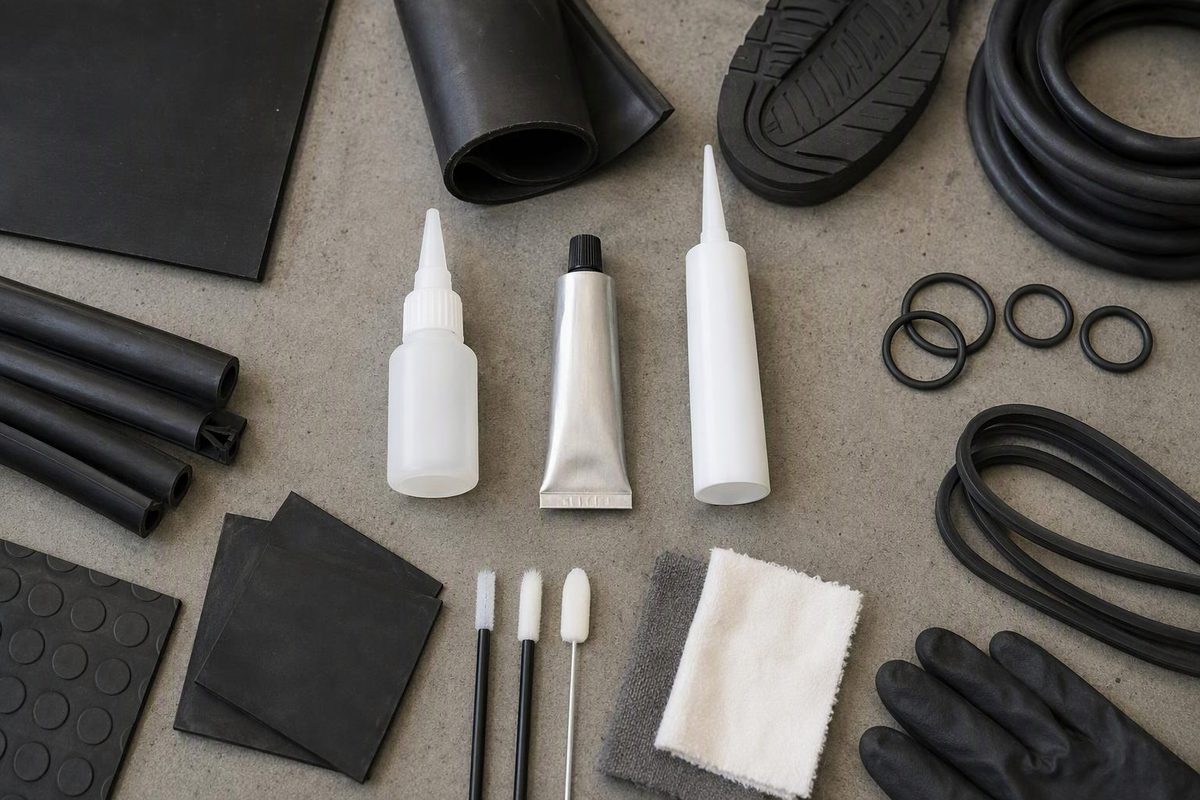
For a small, close-fitting rubber joint with limited movement, a rubber-rated cyanoacrylate (super glue) is a good starting point. For broad, flexible overlaps, consider a contact adhesive explicitly compatible with the rubber. Silicone rubber needs a silicone-bonding adhesive or a specified primer-and-cyanoacrylate system.
There is no single best glue for every rubber. Natural rubber, nitrile, EPDM, butyl and silicone require different compatibility checks—and an adhesive that grips a surface may still be wrong for a joint that repeatedly stretches or peels.
Identify the rubber and prepare the joint
Before buying glue, check the part’s markings, packaging or manufacturer’s specification. Useful identifiers include NBR for nitrile, EPDM, and silicone. Identify both pieces: two black, flexible parts are not necessarily the same material. If the rubber is unknown, test the proposed adhesive on scrap or an inconspicuous area before committing to the repair.
Check four things:
- Fit: Do the surfaces meet closely, or is material missing? A thin-film adhesive cannot substitute for a patch across a substantial gap.
- Movement: Will the joint simply hold position, or bend, stretch and peel repeatedly?
- Exposure: Specify water splash versus immersion, the actual service temperature, and any oils or cleaning chemicals. “Water resistant” alone does not establish suitability for all of these.
- Consequence of failure: Do not use this general selector to improvise repairs to tires, pressurized hoses, safety equipment or critical seals. Follow the equipment maker’s repair or replacement procedure.
Dry-fit the pieces without stretching them. Remove loose old adhesive and surface dirt without cutting away sound rubber. The final bonding surfaces must be clean, dry and grease-free; use only a cleaner compatible with the rubber and the chosen adhesive. Permabond specifies suitable solvent cleaning for its cyanoacrylates, while Smooth-On calls for clean, dry surfaces and, where possible, abrasion followed by a solvent wipe for Sil-Poxy. These are product-specific instructions, not permission to soak any rubber in acetone. (Permabond 105 datasheet, Sil-Poxy instructions)
Choose the adhesive by job
| Rubber and joint | Adhesive to consider | Main limit |
|---|---|---|
| Small, tight-fitting natural rubber, EPDM or butyl joint | Rubber-bonding cyanoacrylate, such as Permabond 105 | Maximum stated gap: 0.1 mm (0.004 in); not a bulk filler |
| Close-fitting nitrile joint needing more peel or impact resistance | Flexible/toughened cyanoacrylate, such as Permabond 2050 | Maximum stated gap: 0.2 mm (0.008 in); still requires close contact |
| Broad overlap in neoprene, SBR or butyl | Compatible rubber contact adhesive, such as 3M 1300/1300L | Both faces need coating, correct drying and firm assembly pressure |
| Compatible silicone-rubber tear or overlap | Silicone adhesive, such as Sil-Poxy | Its documented application is Smooth-On RTV moldmaking silicone; test other silicone grades |
| EPDM roofing seam | The membrane manufacturer’s seam tape and primer system | Do not substitute a general rubber repair glue |
The gap limits and rubber compatibility are documented in the 105 datasheet, 2050 datasheet, Permabond’s nitrile guidance, 3M’s rubber-adhesive datasheet and Smooth-On’s instructions. Permabond 105 and 2050 are labeled for professional or industrial use only; 3M 1300/1300L are industrial/occupational products, not consumer recommendations.
For roofing, Henry’s EPDM system specifies its seam tape with Henry Low VOC Primer to join membrane sheets. Use the system specified for your membrane. (Henry seam tape)
Small joints: rubber-rated super glue
With Permabond 105, apply sparingly to one face, align immediately and hold with enough pressure to spread a thin film. Its typical handling time is 5–10 seconds on Buna-N rubber and under 20 seconds on EPDM, but full strength takes 24 hours. Temperature, humidity and the particular surfaces affect setting. (105 datasheet)
For nitrile needing more flexibility, Permabond recommends grades including 2050. Its datasheet reports improved peel strength compared with other grades, plus excellent impact and vibration resistance; “flexible” does not mean it can accommodate unlimited rubber stretch. (Nitrile guidance, 2050 datasheet)
Broad overlaps: compatible contact adhesive
Contact adhesive suits a joint you can coat on both faces and press together accurately. With 3M 1300/1300L, apply thin, uniform coatings, allow them to become no longer wet, then assemble within the stated bonding window—up to 12 minutes for 1300 or 8 minutes for 1300L. Bonding is immediate on contact, so position carefully and apply firm pressure across the overlap. For best results, adhesive and surfaces should be at least 65°F (18°C). Immediate handling does not mean final strength: 3M’s test data show strength developing after assembly. (3M datasheet)
For household contact cement, check the exact formula rather than relying on the word “rubber.” DAP Weldwood Original lists rubber, but recommends at least one porous surface for best results—a reason to test dense rubber-to-rubber joints. Its instructions specify 15–20 minutes drying, maximum holding strength in 7 days, and at least 72 hours curing before direct sunlight or temperatures above 150°F (66°C). Those timings are not interchangeable with 3M’s. (DAP datasheet)
Read the chosen product’s safety instructions before opening it. Solvent contact cements require adequate ventilation and specified protective equipment. Eliminate ignition sources, including pilot lights, during use and until all vapors are gone, not merely until the bond feels dry. (DAP safety datasheet)
Silicone rubber: use a dedicated system
Sil-Poxy forms a flexible bond between compatible silicone parts. Smooth-On specifies use at 73°F (23°C). Apply and mate the pieces; curing begins in about 5 minutes, handling is possible after roughly 1 hour, depending on temperature and humidity, and full cure takes 24 hours. Use ventilation, safety glasses and the protective clothing and gloves specified in the instructions. (Smooth-On instructions)
For a close-fitting silicone joint, Permabond offers another route: isopropanol cleaning, POP primer, drying, then 105 or 2050. POP is an adhesion primer for cyanoacrylates—not an accelerator or a universal primer for other glue families. (Permabond silicone guidance)
Keep the repair immobilized through its specified cure before testing it under the intended movement and exposure. For a lifted shoe edge, use the more specific rubber-sole repair guide, rather than assuming the whole sole assembly is rubber-to-rubber.