
4 min read ·
Thinset Is a Mortar—But Not Every Mortar Sets Tile
Thinset is a tile-setting mortar, while masonry mortar lays brick, block or stone. Compare modified, unmodified, LHT and premixed options.
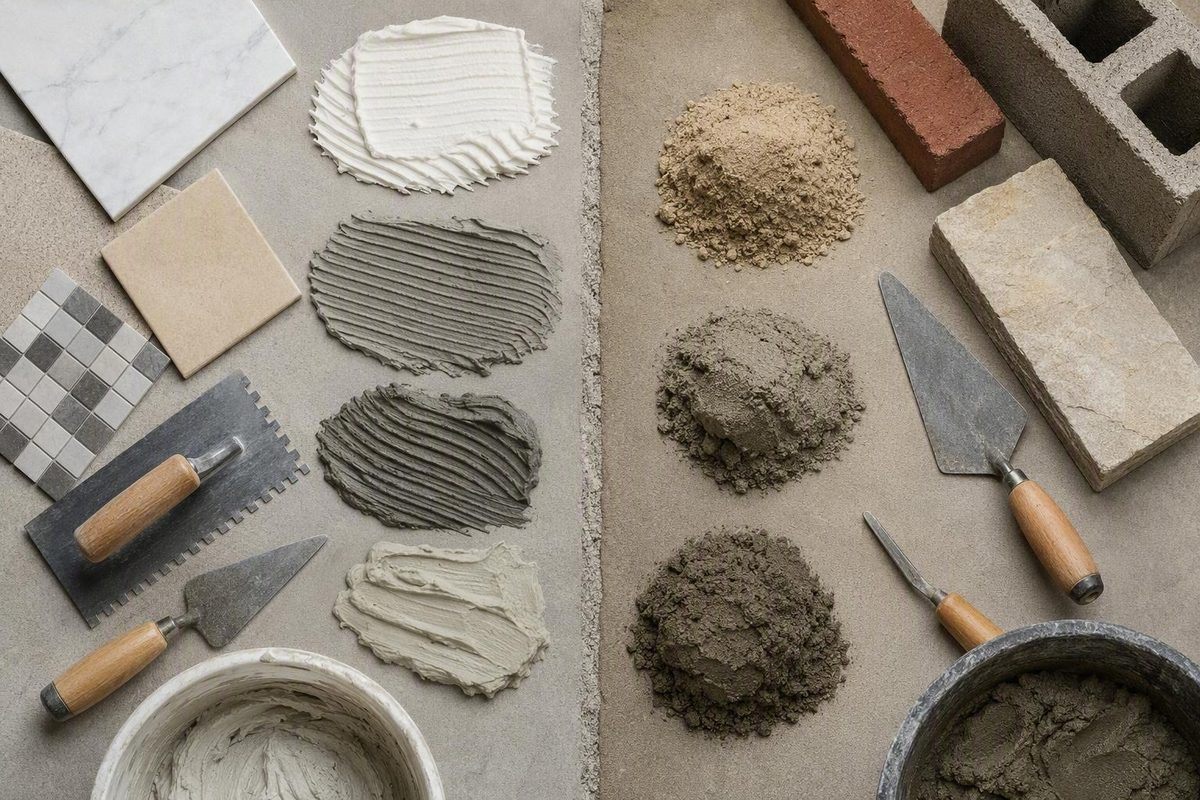
Thinset is a type of mortar used to bond tile or stone in a relatively thin layer. “Mortar” is the broader term: it also includes masonry mixes made for laying brick, block and stone. The practical choice is therefore not thinset or mortar, but tile-setting mortar or masonry mortar, followed by the correct tile-mortar formulation for the assembly.
Quick comparison
| Material | Designed for | Typical standards or label clues | Do not assume |
|---|---|---|---|
| Unmodified thinset (dry-set mortar) | Bonding compatible tile to approved substrates | ANSI A118.1 | That it is approved over every membrane or tile type |
| Polymer-modified thinset | Tile installations needing the product’s specified enhanced bond or other properties | ANSI A118.4, A118.11 or A118.15 | That every modified mortar suits plywood, exterior work or submerged service |
| Large-and-heavy-tile (LHT) mortar | Supporting qualifying large or heavy tile at a greater permitted thickness | Look for the manufacturer’s LHT designation and thickness limits | That ordinary thinset can be built up to level a floor |
| Premixed “thin-set mortar” | Limited tile applications explicitly listed on the pail | May be an ANSI A136.1 adhesive rather than a cement mortar | That “premixed” is interchangeable with bagged cement thinset |
| Masonry mortar, such as Type N | Laying brick, concrete masonry units and stone | ASTM C270/C1714 and a masonry type such as N, S or M | That it is a substitute for tile-setting mortar |
Schluter describes unmodified thinset as Portland cement, sand and water-retention agents mixed with water; modified versions add polymers in the powder or through a liquid additive. It identifies ANSI A118.1 for unmodified mortar and A118.4, A118.11 and A118.15 among the standards for modified products (Schluter).
By contrast, a representative Type N masonry mortar is specified for laying brick, concrete masonry units and stone and is placed in a bed about 1/2–3/4 in. (13–19 mm) thick (Quikrete). That is a different product and application from notched-trowel tile bonding. For adhered stone assemblies, use the mortar or adhesive required by that veneer system rather than selecting by the word “mortar” alone; see our stone veneer adhesive guide.
Which tile mortar should you choose?
Start with the complete assembly: tile or stone type and size, substrate, membrane, interior or exterior exposure, water exposure and required bed thickness. Then verify every component against the current mortar technical data sheet and the membrane or backer-board instructions.
- Use unmodified mortar only where the assembly permits it. The useful package clue is ANSI A118.1, sometimes accompanied by “dry-set mortar.”
- Use a compatible modified mortar where specified. Do not choose solely because “modified” sounds stronger; standards and approvals differ, and individual products exclude substrates or uses. One current modified mortar, for example, lists concrete, masonry, approved backer board and certain membranes but excludes direct bonding to metal, plastic and OSB (Custom Building Products).
- Use an LHT mortar when tile size, weight, substrate variation or tile bow requires a thicker supported bond coat. MAPEI explains that ordinary thinset is intended for a thin layer, typically no more than 3/16 in., while LHT mortars are formulated for thicker application with reduced shrinkage (MAPEI). The product data sheet—not the nickname “medium-bed”—sets the actual limit.
- Treat premixed products as a separate category. A pail labeled “premixed thin-set mortar” may meet ANSI A136.1 as a ready-to-use tile adhesive and have narrower limits. One current example excludes shower floors, prolonged water or steam exposure, waterproofing membranes and tiles larger than its stated limits (Custom Building Products).
Natural stone, resin-backed tile, glass and moisture-sensitive materials can require a specialty mortar or epoxy system. Confirm both the tile producer’s requirements and the setting-material data sheet before installation.
Application matters as much as the label
The substrate must be sound, clean and within the flatness required by the tile system. Do not use extra ordinary thinset to correct a floor or wall beyond the mortar’s published thickness.
Mix bagged mortar with the specified water or additive, at the stated speed and time. Observe any slake time, then remix without adding extra water unless the instructions expressly allow it. Spread only what can be covered before the mortar skins over.
Comb ridges in one direction, move the tile across them to collapse the ridges and periodically lift a tile to inspect coverage. A representative tile-mortar data sheet requires at least 80% coverage in dry areas and 95% in wet areas and exteriors, with tile edges supported; the exact trowel and any back-troweling needed depend on tile size, back pattern and substrate (Custom Building Products). TCNA likewise calls for better than 95% mortar contact in typical exterior work and says the setting material must be exterior-rated (Tile Council of North America).
Finally, use the product’s stated times for adjustment, grouting, light traffic and full service. Temperature, humidity, tile density and substrate porosity can change drying or curing time, so “24 hours” is not a universal loading rule.