
21 min read ·
Choose the Right Way to Bond ABS Without Damaging the Plastic
Gap-bearing or structural joints may call for documented two-part epoxy or structural acrylic/MMA. Movement or sealing may favor polyurethane or MS polymer.
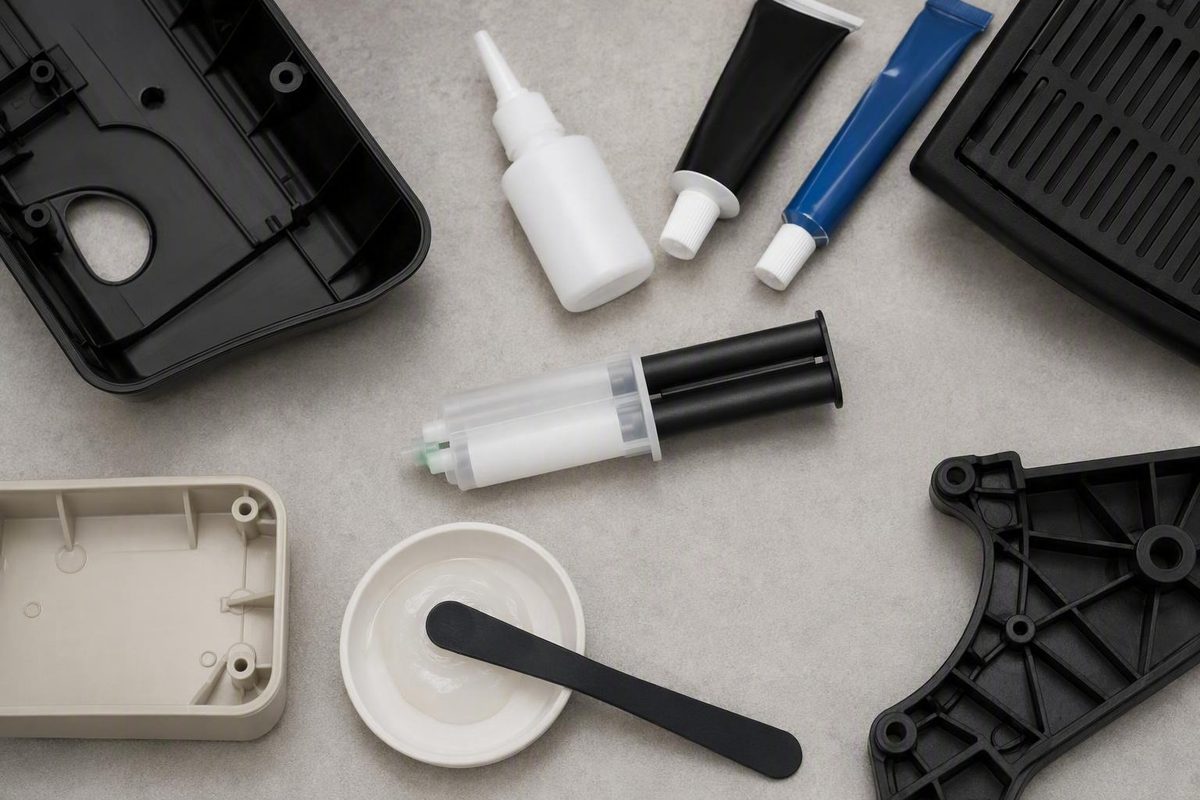
The quick answer: match the adhesive to the ABS job
ABS—acrylonitrile butadiene styrene—is a thermoplastic generally considered easier to bond than low-surface-energy plastics such as polyethylene and polypropylene. That does not mean every “plastic glue” will bond it, or that an adhesive suitable for ABS will also work on the material joined to it. Selection still depends on the application, environment, production process, and exact product instructions (ABS adhesive selection guidance).
There is no universally best ABS bonding adhesive. Start with the second substrate and the physical fit of the joint. Then consider load direction, movement, impact, environmental exposure, appearance, working time, fixture time, full cure, and the equipment required for application.
Use this matrix as a chemistry-level screening tool, not as approval of every product within a family. This article cannot supply a universal gap, peel, fatigue, or weathering threshold; those values must come from the current technical datasheet for the named product.
| ABS job | Chemistry to investigate first | Why it may fit | Main qualification |
|---|---|---|---|
| Close-fitting ABS-to-ABS seam | ABS-compatible solvent cement | A thin cement can enter a precisely fitted seam and produce a low-profile joint | It must be documented for ABS-to-ABS; thin cement does not compensate for a large gap |
| Small, precise repair | Cyanoacrylate | Offers rapid handling and controlled application | Match viscosity to the fit; evaluate blooming, rigidity, peel, impact, and movement |
| Uneven or gap-bearing repair | Two-part epoxy, bodied solvent cement, or documented gap-filling acrylic | Can maintain a useful bond line where parts do not meet perfectly | Verify the permitted gap, bond-line thickness, cure requirements, and ABS compatibility |
| Structural assembly | Two-part epoxy or structural acrylic/MMA | Available in formulations intended for load-bearing joints | Compare toughness and rigidity, not merely advertised strength |
| Vibration-prone or impact-loaded part | Toughened structural acrylic, polyurethane, or MS polymer | May accommodate impact or movement better than a brittle, rigid product | Confirm fatigue, peel, temperature, and substrate data for the exact formulation |
| Sealing or outdoor joint | ABS-compatible polyurethane or MS polymer | Flexible adhesive-sealants may accommodate movement while sealing the joint | Weather, UV, water, and chemical resistance must be documented |
| Vertical work | Non-sag cyanoacrylate gel, bodied acrylic, epoxy, polyurethane, or MS polymer | Resists draining before fixture | Non-sag behavior does not prove gap capacity or structural performance |
| Transparent, light-accessible joint | UV-curable adhesive | Provides controlled curing when suitable light reaches the adhesive | Confirm wavelength transmission through the ABS and light access to the entire bond line |
These categories overlap. A flexible adhesive is not automatically weak, and a structural adhesive is not automatically too rigid. Formulation matters within each family.
Before buying, confirm that the current technical datasheet explicitly covers:
- ABS, including any restrictions on grade or surface condition
- The second substrate
- The proposed joint geometry and gap
- Required rigidity or flexibility
- Expected loads and environmental exposure
- Application temperature and curing conditions
- Required equipment, primer, or activator
- Bond-line thickness and appearance
Do not rank candidates by the largest strength number on a label. Suppliers may use different ABS grades, surface preparation, overlap dimensions, test methods, cure conditions, and aging schedules. A very rigid or much stronger adhesive can also transfer damaging stress into the ABS. The durable choice is the product that distributes the real loads without overstressing the part.
Define the joint before choosing the glue
The phrase “gluing ABS” leaves out most of the information required to select an adhesive. Define the complete joint before comparing products.
Confirm that the material is ABS. Look for a molded material marking, engineering drawing, supplier record, bill of materials, or other reliable documentation. Do not identify unknown plastic with a burn test or uncontrolled solvent exposure. Coatings can conceal the substrate, and plastic blends may respond differently from standard ABS.
Identify both substrates. An ABS-to-ABS cement is not automatically suitable for ABS-to-PVC, ABS-to-styrene, ABS-to-metal, ABS-to-fiberglass, ABS-to-polycarbonate, or ABS-to-polypropylene. The adhesive must bond both surfaces and tolerate the way they move relative to each other.
Classify the joint fit.
- A close-fitting joint has broad, consistent contact with little or no visible gap.
- An uneven joint has local high and low spots.
- A gap-bearing joint relies on adhesive to occupy measurable space.
- A vertical joint needs a product that remains in place before fixture.
- A broad lap joint may retain a thicker adhesive layer and restrict access to air, moisture, or curing light.
Viscosity must match that geometry. A gel or bodied adhesive stays where it is placed, but its gap capacity must still be documented. “Thick,” “non-sag,” and “gap filling” are not interchangeable claims.
Identify the dominant load. Note whether the joint will experience:
- Tension or shear
- Peel or prying at an edge
- Flexing
- Impact
- Vibration
- Repeated loading
- Thermal expansion and contraction
A rigid adhesive may work in a supported lap joint but fail at the end of a flexible crack.
Record the service environment. List anticipated contact with water, outdoor weather, sunlight, cleaners, fuels, oils, or other chemicals. Define normal and exceptional temperatures, exposure duration, and whether the joint will be loaded during exposure. Do not extend a family-wide marketing claim to an individual formulation.
Separate process requirements from service requirements. Working time is not the same as fixture time, and neither is the same as full cure. Record:
- Time available to mix and apply
- Open time before the parts must be joined
- Time until clamps or tape can be removed
- Time before the assembly can be loaded
- Required applicator, mixing nozzle, lamp, or heating equipment
- Acceptable bond-line color and squeeze-out
- Whether the job is a one-off repair or repeat production
Finally, examine the ABS surface. Bonding to a coating is not the same as bonding to the ABS beneath it. Test representative parts whenever the formulation or surface history is uncertain.
ABS solvent cement versus a reactive adhesive
ABS solvent cement and reactive adhesive are not interchangeable terms.
A solvent cement softens or mobilizes compatible plastic surfaces so they can join as solvent leaves the bond area. Depending on its formulation, it may also contain dissolved resin or bodying ingredients. This approach is most attractive when compatible plastic parts fit accurately and a narrow, unobtrusive seam is required.
A reactive adhesive—such as epoxy, structural acrylic, MMA, polyurethane, or cyanoacrylate—develops its own adhesive layer through a curing reaction. Depending on the formulation, that layer may provide gap capacity, mixed-material capability, toughness, flexibility, or controlled bond-line thickness.
Retail descriptions of the Weld-On range illustrate the selection logic:
- Weld-On 2354 is marketed for small, close-fitting ABS-to-ABS parts where a water-thin, quick-drying product is wanted.
- Weld-On 16 is described as a bodied product for certain ABS-to-PVC or ABS-to-styrene joints, imperfect fits, flat surfaces, and lap joints.
- Weld-On 4707 is positioned for imperfect ABS-to-ABS fits and box seams where a clear or bubble-free appearance is unnecessary.
These are retailer-reported product descriptions, not independent comparisons or substitutes for current manufacturer documentation. They do not establish measured strength, a validated gap limit, a complete cure schedule, long-term water resistance, or suitability for a reader’s repair (retailer overview of Weld-On ABS products).
Choose a thin ABS solvent cement as a starting point only when:
- Both substrates are confirmed compatible with that cement.
- The parts fit closely and consistently.
- The joint can be assembled and held accurately.
- The appearance produced by the solvent is acceptable.
- Current instructions cover the application and service conditions.
Consider a reactive or bodied product when the joint contains a meaningful gap, joins dissimilar materials, must accommodate movement, requires a controlled adhesive thickness, or cannot be assembled quickly enough for a water-thin fast-setting cement.
Do not substitute generic PVC cement or an arbitrary solvent. A label that says “plastic cement” does not establish compatibility with ABS, and an ABS-to-ABS product does not automatically cover ABS-to-PVC. Where a multipurpose product is promoted for a mixed-plastic pair, current manufacturer instructions should govern preparation, permitted uses, application, and cure.
Solvent-based products introduce practical constraints beyond bond performance. Obtain the current technical datasheet, safety data sheet, and application instructions before use. Check ventilation, ignition controls, storage, disposal, shipping classification, VOC requirements, and regional sales or use restrictions. Availability and compliance can change, and retailer listings should not be treated as permanent regulatory guidance.
Fast and rigid options: cyanoacrylate, epoxy, and structural acrylic
Cyanoacrylate, two-part epoxy, and structural acrylic or MMA can all be candidates for ABS, but they solve different problems.
Cyanoacrylate
Cyanoacrylate—often called super glue—is a logical starting point for a small, accurately fitted repair where precise application and rapid handling matter. Thin grades can enter narrow joints; more viscous liquids and gels provide greater placement control. A non-sag gel may be useful on a vertical surface.
Viscosity is only one selection criterion. It is also too broad to say that all cyanoacrylates are brittle: toughened and application-specific formulations exist. The relevant question is whether the selected grade has documented ABS compatibility and sufficient peel, impact, and environmental performance.
Watch for cosmetic effects. Test visible parts before committing to the repair.
Two-part epoxy
It may also suit a mixed-material joint if both substrates are documented.
Some epoxy formulations are promoted for mechanical, chemical, moisture, and impact resistance, but those properties cannot be assumed for the entire family. A rigid grade may become brittle in a moving assembly or concentrate stress at the end of a crack. A toughened formulation and load-distributing joint may be more valuable than the highest advertised strength.
For example, Loctite markets its two-part Epoxy Plastic product as compatible with ABS and states that it reaches full cure in approximately 24 hours. That is a manufacturer claim for one named formulation, not proof that it outperforms other epoxies or ABS bonding chemistries (Loctite plastic adhesive guidance).
When evaluating epoxy, check:
- Exact mix ratio and dispensing method
- Working time after mixing
- Maximum documented gap
- Recommended bond-line thickness
- Fixture time and full cure under actual shop conditions
- Toughness under peel, impact, and vibration
- Water and chemical resistance after full cure
- Bond color and visibility
- Whether the cured rigidity suits the ABS part
Do not assume a part is ready for service as soon as the epoxy feels hard.
Structural acrylic and MMA
Structural acrylic and methyl methacrylate adhesive can be fast structural options. Toughened formulations may tolerate impact and distribute stress better than a brittle, rigid adhesive in some assemblies. They can also suit mixed-material joints when compatibility with both surfaces is documented.
Their speed creates process demands. A short working time leaves little room to correct alignment or change the dispensed quantity. Review cartridge ratio, mixing-nozzle requirements, bond-line thickness, fixture method, and application waste.
For MMA, evaluate:
- Working time and the transition from workable to set
- Odor and handling controls specified by the safety data sheet
- Heat generated during cure
- Total adhesive quantity in the joint
- Possible cosmetic marking or distortion on visible ABS
Supplier guidance warns that MMA cure exotherm may produce visible marking on ABS, particularly where larger adhesive quantities are used (ABS adhesive comparison and MMA exotherm warning). Test the intended adhesive volume and wall thickness on representative material.
Do not compare broad strength figures from cyanoacrylate, epoxy, and acrylic sales literature as if they came from one controlled test. Unless candidates were evaluated using the same ABS grade, preparation, joint design, bond thickness, cure schedule, test standard, temperature, and aging protocol, the numbers do not establish a ranking.
Flexible and special-purpose options: polyurethane, MS polymer, PUR, and UV cure
When an ABS assembly moves, vibrates, seals, or uses a specialized production process, a flexible or differently cured adhesive may be more appropriate.
Polyurethane
Polyurethane adhesives are candidates for impact, vibration, and movement where flexibility is beneficial. Formulations vary considerably, so do not infer cure speed, UV stability, solvent content, preparation, or water resistance from the word “polyurethane.”
Surface preparation is product-specific. Supplier guidance also warns that solvents in some one-component polyurethane formulations may attack ABS, so explicit compatibility and representative testing are essential (polyurethane and MS-polymer guidance for ABS).
A flexible joint still requires adequate cohesive strength and adhesion to both surfaces. Flexibility alone will not prevent failure if the bond line is outside the product’s specified thickness or the joint is poorly supported.
MS polymer
MS polymer, modified-silyl-polymer, and related hybrid adhesive-sealants are commonly considered where movement accommodation, sealing, vibration resistance, or impact tolerance matters.
Many products in this category rely on moisture for cure. An enclosed bond line with restricted moisture access may cure more slowly than an exposed bead. Confirm skin time, through-cure behavior, permitted bead dimensions, and whether the joint geometry supports the stated cure mechanism.
Do not interpret “adhesive-sealant” as proof of permanent immersion, fuel resistance, or outdoor durability. Those remain product-level performance questions.
Polyurethane-reactive hot melt
Polyurethane-reactive hot melt, commonly abbreviated PUR, is commercially presented as an option for bonding ABS.
Limit conclusions to the named product’s documentation. Confirm its required equipment, application conditions, storage, open time, cure process, substrate compatibility, and environmental limits with the product and equipment suppliers.
UV-curable adhesive
UV-curable adhesive is viable only when suitable curing light reaches the entire bond line. It may suit a transparent, precisely assembled joint where controlled exposure is available, but it is a poor choice if an opaque flange, pigment, coating, or geometry shadows part of the adhesive.
Visual transparency is not enough. Clear ABS may contain UV stabilizers and may not transmit the wavelength required for cure, so transmission must be verified rather than inferred from appearance (Permabond’s ABS and UV-cure guidance).
For any flexible or special-purpose chemistry, verify the named product’s resistance to:
- Water or immersion, as applicable
- Outdoor weather and UV exposure
- Cleaners, fuels, oils, and other relevant chemicals
- Minimum and maximum service temperatures
- Thermal cycling
- Continuous movement and vibration
No adhesive family supplies all these properties automatically.
Prepare and bond ABS without damaging the surface
The following workflow is a planning framework, not a replacement for product-specific technical and safety instructions.
-
Verify the material and substrate pair. Confirm that the part is ABS and identify the material on the other side of the joint.
-
Inspect the surfaces. Look for paint, plating, coatings, grease, mold-release residue, old adhesive, texture, cracks, and heat damage. Decide whether the proposed bond would attach to ABS or merely to a surface layer.
-
Dry-fit the parts. Check alignment, overlap, gap consistency, fixture access, and whether adhesive can be applied without flooding a visible surface. Dry fitting is especially important with water-thin cements and fast reactive products because repositioning time may be short.
-
Read the current product documents. Confirm substrate compatibility, preparation, application temperature, mix ratio, working time, open time, bond-line thickness, fixture method, full cure, and required safety controls.
-
Test first. Use scrap from the same material where possible. Otherwise, test a hidden area for discoloration, whitening, softening, distortion, coating damage, and cure behavior. A hidden-area cosmetic test does not replace a representative strength trial.
-
Clean using an approved method. Clean, dry, uncontaminated ABS may sometimes be bonded as received. If cleaning is required, isopropyl alcohol is identified as one possible option in manufacturer guidance, but it must still be tested on an inconspicuous area and permitted by the selected adhesive’s instructions.
-
Do not use acetone as a routine ABS cleaner. Manufacturer guidance warns that acetone can be too aggressive and attack ABS. The same guidance reports an ABS softening temperature near 100°C, reinforcing the need to control both solvent exposure and process heat (ABS preparation and material-property guidance).
-
Dry the surfaces fully. Allow approved cleaners to evaporate as directed, then prevent fresh contamination from fingers, dust, rags, or nearby work.
-
Abrade only if instructed. Abrasion is conditional, not universal. If required, use controlled, light abrasion and remove debris by an approved method. Avoid thinning an already damaged part, cutting through a coating unintentionally, or marring a cosmetic surface.
-
Prepare the adhesive. Install the correct applicator or mixing nozzle, condition the product as specified, and mix two-part materials in the prescribed ratio. Do not estimate a mix ratio by eye unless the instructions expressly allow it.
-
Apply the specified quantity. Maintain the required coverage and bond-line thickness. Do not try to fill a large gap with a thin capillary product unless the datasheet permits it. Control squeeze-out before it reaches visible faces, electrical contacts, or moving features.
-
Assemble within the permitted time. Distinguish working time from open time and join the pieces while the adhesive remains suitable for assembly.
-
Fixture without starving the joint. Clamps, jigs, or tape should maintain alignment without forcing all adhesive out of a joint that requires a defined layer. Avoid distorting thin ABS with excessive pressure.
-
Allow full cure. Do not load, immerse, heat, clean, paint, or expose the assembly prematurely.
-
Validate before service. Inspect cure and appearance, then test the assembly in a way appropriate to its intended environment and consequences of failure.
Four timing terms deserve separate attention:
- Working time: the usable period after mixing or activation begins.
- Open time: the interval during which applied adhesive can remain exposed before assembly.
- Fixture time: the point at which the joint can remain aligned without its original support under stated conditions.
- Full cure: the stated time or condition for developing final properties.
Use the current datasheet rather than transferring a timing value from another product in the same family.
Check temperature, environment, and safety claims before use
The adhesive and ABS substrate impose separate limits. A high-temperature adhesive cannot make the plastic tolerate unlimited heat.
As noted above, one manufacturer reports an ABS softening temperature near 100°C. That is general material guidance, not a universal safe service temperature for every ABS grade or assembly. Actual performance depends on formulation, load, exposure duration, joint design, and environment.
An adhesive rated above that temperature does not establish that the complete ABS assembly is suitable there. Brief exposure without meaningful load is not equivalent to continuous loaded service.
Treat terms such as “waterproof,” “heat resistant,” “weatherproof,” and “chemical resistant” as screening language until technical documentation defines the test conditions. Determine whether a claim covers occasional splashes, continuous immersion, outdoor aging, a particular chemical concentration, or a specified temperature and duration.
Technical datasheet checklist
Before approving a product, check for:
- Explicit compatibility with ABS
- Explicit compatibility with the second substrate
- Limits on ABS grade, coating, or surface finish
- Test method and specimen preparation behind reported properties
- Recommended cleaning and abrasion procedure
- Primer or activator requirements
- Mix ratio and application equipment
- Working time and open time
- Fixture time and full cure
- Recommended bond-line thickness
- Maximum documented gap
- Service-temperature range
- Water, weather, UV, fuel, cleaner, and chemical resistance
- Storage conditions
- Shelf life and expiration controls
A strength value has limited predictive value if the document does not identify the substrate, preparation, joint, cure, and test method.
Safety-document checklist
Obtain the current safety data sheet and application instructions, then check:
- Required ventilation and engineering controls
- Ignition and flammability precautions
- Skin and eye precautions
- Product-specific protective equipment
- Safe storage and incompatible materials
- Spill response
- Disposal requirements
- Shipping classification or restrictions
- Regional sales or use restrictions
- First-aid instructions
Do not rely on a generic recommendation for a respirator, glove, or ventilation arrangement.
Pressurized, potable-water, electrical, structural, automotive-safety, and other critical components should be referred for standards-based product approval, qualified procedures, and appropriate engineering review. A workshop handling test is not sufficient approval for safety-critical service.
Test the bond and diagnose common failures
The most useful trial reproduces the real application. Use the exact ABS grade and second substrate, including coatings, texture, age, and contamination history where practical. Reproduce the overlap, gap, adhesive quantity, preparation, fixture, cure schedule, and environmental exposure.
For a noncritical repair, use a bounded validation sequence:
- Hidden-area appearance check: Look for whitening, staining, swelling, softening, distortion, or coating damage.
- Cure check: Confirm that exposed and enclosed adhesive has cured as expected without damaging the actual bond for inspection.
- Moderate handling test: Apply only loads appropriate to a noncritical trial and check for edge lifting, cracking, movement, or noise.
- Relevant exposure test: If the part will encounter water, heat, cleaners, sunlight, or vibration, expose a representative sample before trusting the repair.
Production and critical assemblies require documented acceptance criteria. Depending on service, representative testing may include shear, peel, tensile, impact, fatigue, vibration, water exposure, thermal cycling, UV aging, and chemical resistance. Test aged specimens as well as newly cured ones.
| Symptom | Likely causes to investigate | Next checks |
|---|---|---|
| Adhesive peels cleanly from the ABS | Contamination, wrong plastic identification, incompatible adhesive, insufficient cure, conflicting preparation, or bonding to a weak coating | Verify the material record; inspect the failed surface; repeat with approved preparation and full cure; test the exact product on representative ABS |
| Adhesive remains on both sides but cracks through the bond line | Excessive rigidity, impact, peel stress, movement, incorrect thickness, voids, or premature loading | Review load direction and joint design; check specified thickness; investigate a toughened or flexible formulation |
| ABS tears next to the joint | Stress concentration, inadequate overlap, substrate damage, excessive rigidity, or a bond stronger than the local plastic section | Reduce peel, distribute the load, increase support, and assess whether the part itself is adequate |
| Adhesive stays soft or incompletely cured | Wrong mix ratio, poor mixing, expired material, low temperature, incorrect schedule, restricted moisture, or blocked curing light | Check batch and shelf life; verify ratio, temperature, moisture or light access, and full-cure requirements |
| Joint opens at one edge | Peel loading, poor fit, insufficient coverage, clamp distortion, or adhesive squeezed out | Check dry fit, overlap, pressure, gap capacity, and whether a fillet or added support is permitted |
| White haze appears | Possible cyanoacrylate blooming, contamination, excess adhesive, or interaction with the finish | Test a lower quantity or different documented formulation on scrap; improve application control |
| ABS becomes soft, crazed, swollen, or distorted | Solvent attack, excessive adhesive, incompatible cleaner, cure heat, or local stress | Stop the process; identify every liquid used; repeat only with approved materials on representative scrap |
| A sink, ripple, or surface mark develops | Possible solvent action, MMA cure heat, excessive adhesive volume, pressure, or a thin cosmetic wall | Keep quantity within specification; test a slower or lower-exotherm option; support the surface appropriately |
| Bond cures at the edge but not in the center | Restricted moisture, inadequate light penetration, excessive bond width, wrong thickness, or incomplete mixing | Check the cure mechanism, geometry, through-cure data, wavelength transmission, and application instructions |
| Repair fails repeatedly at the same crack | Concentrated stress, ongoing flex, vibration, missing support, or damage beyond the visible crack | Evaluate reinforcement, plastic welding, hot staples, redesign, a backing strip, or mechanical support |
Failure location is useful evidence. Torn ABS may indicate strong adhesion, but it can also show that stress was transferred into an inadequate or previously damaged part.
Highly loaded or safety-related parts require qualified evaluation before repair.
Frequently asked questions
What is the best adhesive for bonding ABS plastic?
There is no universal best adhesive for ABS. For a close-fitting ABS-to-ABS seam, investigate an ABS-compatible solvent cement. For a small, precise repair, cyanoacrylate may suit. Gap-bearing or structural joints may call for a documented two-part epoxy or structural acrylic/MMA, while moving or sealing joints may favor polyurethane or MS polymer. UV-curable products are candidates only when suitable light reaches the complete bond line.
The final product must explicitly cover ABS, the second substrate, the joint gap, expected loads, curing conditions, and service environment. Do not choose from family reputation or advertised strength alone.
Can super glue be used on ABS?
Yes. An ABS-compatible cyanoacrylate can be considered for a small, close-fitting repair where rapid handling and precise application matter. Select viscosity for the geometry: a thin liquid suits a narrow fitted seam, while a gel or non-sag grade offers more control on vertical work.
Check whether the formulation can tolerate peel, flexing, vibration, and impact. Also test visible ABS for whitening, uncontrolled squeeze-out, or other surface effects. “Super glue” is a broad product category, so compatibility and cure instructions must be confirmed for the named formulation.
Should I use ABS solvent cement or epoxy for an ABS-to-ABS repair?
Use solvent cement as a starting point when both pieces are confirmed ABS, the seam fits accurately, and the selected cement is documented for that joint. It can produce a narrow joint but may offer little tolerance for gaps or slow alignment.
Consider an ABS-compatible two-part epoxy when the repair requires documented gap filling, a controlled adhesive layer, or structural performance that a thin cement cannot provide. Balance gap capacity against rigidity: a hard epoxy may concentrate stress in a flexible or vibration-prone part. Test cosmetic areas because either chemistry can affect appearance if misapplied.
Do I need to sand ABS before applying adhesive?
Not always. Clean, dry, uncontaminated ABS may be bondable as received with some products. Other products call for light abrasion.
Follow the selected adhesive’s current instructions. If abrasion is required, keep it controlled, avoid damaging thin or coated ABS, and remove debris by an approved method. Sanding cannot correct an incompatible adhesive or an incorrectly identified plastic.
Can PVC glue bond ABS to PVC?
Do not assume that any PVC glue will bond ABS to PVC. Some products are specifically marketed for particular ABS-to-PVC combinations, but compatibility depends on the formulation and application. An ABS-only cement may be unsuitable, and generic PVC cement is not an automatic substitute.
Select a product whose current manufacturer documentation explicitly approves both ABS and PVC in the proposed joint. Verify fit, gap, preparation, cure, service exposure, and any applicable plumbing or regulatory requirements before use.
The final selection sequence is straightforward:
- Verify the plastic and the second substrate.
- Classify the fit, gap, load, and movement.
- Choose a potentially compatible chemistry.
- Confirm performance and safety requirements in current manufacturer documentation.
- Prepare, apply, and fixture the joint exactly as directed.
- Allow full cure rather than stopping at handling strength.
- Test the bond under realistic conditions.
The best ABS bond is not the one with the largest advertised strength number. It is the one whose rigidity, cure process, gap capacity, appearance, and environmental resistance match the actual part.