
26 min read ·
How to Bond Polypropylene Without Guessing at the Glue
The short answer: which adhesive should you use for polypropylene?
Choose an adhesive whose current manufacturer documentation explicitly lists polypropylene (PP) or low-surface-energy polyolefins. A package that says only “plastic glue” is not enough. Polypropylene is difficult for many liquids to wet, so an adhesive may cure into a hard mass yet remain poorly attached to the part.
Related: Does Epoxy Stick to Plastic? The Type Decides.
There is no evidence-backed universal winner. The right adhesive for PP depends on:
- The exact PP formulation
- The other substrate
- Whether the joint is structural or cosmetic
- Bond area and gap
- Shear, peel, impact, and sustained loads
- Flexing and vibration
- Temperature, moisture, chemicals, and UV exposure
- Required working, fixture, handling, and full-cure times
- Available dispensing or surface-treatment equipment
- Production volume and required approvals
Use this shortlist as a starting point:
- Durable or load-bearing joint: consider an LSE-rated two-part structural acrylic or methacrylate explicitly documented for PP.
- Small, rigid, close-fitting repair: consider a PP-rated cyanoacrylate system used with its specified polyolefin primer or activator.
- Rapid PP-to-PP assembly: consider a PP-specific hot melt if its applicator, application temperature, mating procedure, and service limits fit the job.
Each route belongs to one of three process types:
- Formulated for untreated PP: the exact adhesive is designed to bond PP without flame, plasma, or corona activation. Cleaning, controlled application, and testing are still required.
- Primer- or activator-dependent: the system works only when its specified primer or activator is applied as directed.
- Surface-treatment-dependent: the PP must receive controlled flame, plasma, corona, or another validated treatment before adhesive application.
Do not assume that generic epoxy, ordinary super glue, standard craft hot melt, or general construction adhesive will bond untreated PP.
A compact PP adhesive decision tree
Begin with four questions:
-
Is the part definitely PP? Check for a molded resin code, drawing, material certificate, or manufacturer confirmation. Appearance, feel, or a “waxy” surface is not enough.
-
What is the other substrate? PP-to-PP, PP-to-metal, and PP-to-another plastic are separate compatibility problems.
-
Is the joint structural or cosmetic? A trim repair and a load-bearing bracket require different levels of evidence and validation.
-
Can the surface be primed or treated? If not, restrict the search to products explicitly documented for untreated PP.
Then follow the appropriate branch:
- Unknown plastic: stop and confirm the material or conduct cautious, noncritical process trials. Do not buy from appearance alone.
- Structural PP joint, treatment prohibited: shortlist untreated-PP structural acrylic or methacrylate formulations.
- Structural PP joint, controlled treatment available: compare untreated-PP products with adhesive systems validated after flame, plasma, corona, or a specified primer.
- Small, rigid repair with tight-fitting edges: shortlist a matched PP-rated cyanoacrylate-and-primer kit.
- Flexible, vibrating, peeled, immersed, hot, or chemically exposed joint: require product-level peel, impact, fatigue, and environmental data; fixture speed alone is not a selection criterion.
- High-speed PP-to-PP production: compare PP-specific hot melt, structural acrylic or methacrylate, LSE-compatible tape, and—where light reaches the adhesive—a specialized UV-curable system.
- PP-to-metal or another material: verify compatibility with both substrates and account for movement between them.
- No adhesive process fits: assess plastic welding, mechanical fastening, or a hybrid joint.
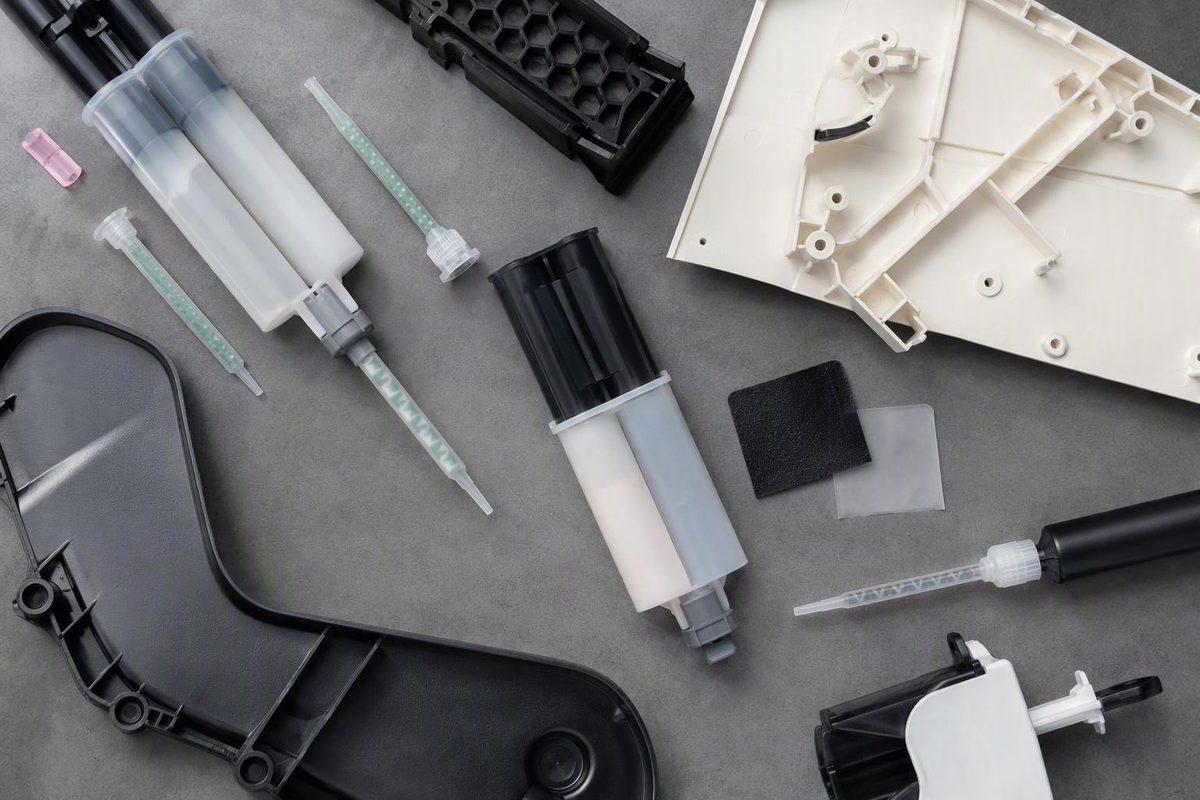
Consumer repair kits are not interchangeable with industrial cartridge products. A consumer system may combine a small primer applicator with cyanoacrylate. Industrial two-part products may require a matched gun, static mixer, controlled bead, fixturing, ventilation, and management of purge and nozzle waste. Permabond, for example, identifies several TA4600-series structural acrylics for untreated polyolefins while stating that its products are not labeled for consumer use in its manufacturer guidance on bonding polypropylene.
All named products below are examples reported by manufacturers or sellers, not winners established by independent comparative testing. Product names, formulations, availability, instructions, and restrictions can change. Before purchasing, obtain the current official technical data sheet and safety data sheet. If those documents do not confirm the intended PP grade, second substrate, process, and service conditions, treat the product as unverified for the job.
Why ordinary glue often fails on PP
Polypropylene is a non-polar, low-surface-energy plastic. In practical terms, many liquid adhesives pull together into beads instead of spreading evenly across it.
That spreading behavior is called wetting. Good wetting allows an adhesive to make intimate contact with the surface. If the liquid beads, retreats from an edge, or leaves areas uncovered, it cannot form a dependable interface—even if the adhesive later becomes hard and dry.
Commercial technical guides commonly place untreated PP surface energy at approximately 29–31 mN/m, but that is an approximate range rather than a specification for every grade or molded component. Incure reports the range while explaining PP’s non-polar surface and wetting difficulty in its polypropylene adhesive overview.
Cure and adhesion are different events
An adhesive can cure normally and still fail to adhere.
Consider a hardened blob that peels cleanly from a PP lid. The blob may be fully polymerized and internally sound.
- Incompatible adhesive chemistry
- Poor wetting
- Oil, dust, fingerprints, or mold-release contamination
- Missing, incorrect, contaminated, or expired primer
- Inadequate surface activation
- Excessive delay between activation and bonding
- Preparation that does not match the selected formulation
“Polypropylene” is only the start of the specification
Two components labeled PP may bond differently. Relevant variables include:
- Homopolymer or copolymer composition
- Fillers and reinforcement
- Impact modifiers and other additives
- Pigments
- Recycled content
- Mold-release residue
- Surface texture and gloss
- Weathering or prior chemical exposure
- Internal molding stresses
- Contamination from handling
- Printing, coatings, or other surface layers
A successful trial on a storage tub therefore does not validate an automotive component, appliance part, medical housing, or proprietary molded grade. Testing should use the actual production material whenever possible.
Polyethylene and polypropylene are both low-surface-energy polyolefins, so suppliers frequently discuss them together. They are not identical. Evidence for PE should not automatically be treated as proof of equal performance on PP, or vice versa.
The failure surface provides an initial diagnostic:
- Clean separation from PP: investigate wetting, contamination, compatibility, primer coverage, and activation.
- Adhesive torn within itself: the failure was cohesive in that test; adhesive thickness, cure, formulation, or load may be limiting.
- PP stretched, whitened, or broke: the substrate was limiting under that particular geometry and load.
- Failure started at one edge: investigate peel stress, coverage, alignment, and joint design.
These observations are clues, not complete proof of long-term performance.
Comparing adhesive families for polypropylene
The table below describes practical starting categories, not universal rankings. “Untreated-PP capability” always means selected formulations, never every adhesive in the family. Family names also overlap in commercial usage: suppliers may use terms such as structural acrylic, methacrylate, and MMA differently. Select from the exact product documentation, not the family label alone.
| Adhesive family | Untreated-PP capability | Primer or treatment requirement | Relative speed | Gap capability | Flexibility | Equipment | Suitable use cases | Major limitations |
|---|---|---|---|---|---|---|---|---|
| LSE structural acrylic | Available in selected formulations | None only where the exact product is rated for untreated PP | Moderate | Often greater than thin instant adhesive; verify limits | Product-specific; some grades are intended for impact or movement | Commonly a two-part cartridge, gun, and static mixer | Structural PP-to-PP and PP-to-dissimilar-material joints | Mixing, odor, waste, fixture time, and environmental limits vary |
| Methacrylate or MMA | Available in selected formulations | Product-specific; some are marketed as primerless | Moderate | Often intended for controlled gaps; verify the data sheet | Product-specific | Cartridge gun and static mixer are common | Durable assembly, repair, and production bonding | Work life, cure, exotherm, odor, gap, and compatibility vary |
| Cyanoacrylate | Do not assume for ordinary grades | Usually requires the specified polyolefin primer or activator | Very fast fixture | Generally best for close-fitting joints | Commonly relatively brittle | Small bottle plus primer or activator applicator | Small, rigid repairs and small components | Weak gap filling; peel, flexing, heat, and moisture can be limiting |
| PP-specific hot melt | Available in selected formulations | Product-specific | Sets rapidly as it cools | Can form a bead, but geometry must be controlled | Formulation-dependent | Correct heated applicator and adhesive format | Rapid PP-to-PP production assembly | Short mating window, heated-equipment risk, creep, and temperature limits |
| Pressure-sensitive tape | Available in selected LSE-compatible products | Some systems require primer; others are designed for LSE surfaces | Immediate handling | Suits thin, uniform interfaces rather than irregular gaps | Often useful for vibration damping | Clean assembly area and controlled pressure | Trim, panels, labels, and nonstructural assemblies | Lower structural capacity than suitable structural liquids; edges and exposure matter |
| Specialized UV-curable adhesive | Available in narrower compatible formulations | Product- and surface-specific | Potentially very fast | Product-specific | Product-specific | UV source, shielding, and accessible light path | Controlled production with exposed or transparent cure paths | Shadowed adhesive may not cure; equipment and formulation are critical |
| Polyurethane | Not established as a generic untreated-PP solution | Usually requires a validated primer or treatment route | Often slower | Frequently used where gaps or movement matter | Can be compliant, depending on grade | One- or two-part dispensing | Treated PP in flexible or dissimilar-material assemblies | Longer fixture; some systems are moisture-sensitive; no blanket PP capability |
| Epoxy | Not established for untreated PP generally | Requires a specialized, validated preparation route if used | Slow to moderate | Often useful for gaps | Commonly more rigid, though grades vary | Accurate metering and mixing | Treated PP where exact process data support it | Ordinary epoxy should not be presumed to adhere to untreated PP |
| General construction adhesive | Do not assume | Product-specific | Usually slower | Often bead-filling | Varies | Caulking gun | Only where exact documentation includes PP and the service conditions | “Bonds plastic” is insufficient; a heavy bead cannot correct poor wetting |
These are general tendencies rather than comparative test results. Exact peel resistance, fatigue, creep, gap limits, service temperature, chemical resistance, and cure performance must come from current product-level data.
LSE structural acrylics
Selected low-surface-energy structural acrylics are a leading category for durable PP bonding because some are designed for untreated polyolefins. Avoiding flame, plasma, or corona treatment can simplify the process, but it does not eliminate cleaning, dispensing control, suitable joint design, complete cure, or representative testing.
Permabond identifies TA4605, TA4610, TA4611, and TA4631 as 1:1 structural acrylic products for untreated polyolefin surfaces. It also shows an application example in which PP stretched before a TA4610 bond broke. Both are manufacturer claims for specific products and conditions, not proof that every PP grade or joint will behave the same way.
Seller guides also identify 3M DP-8005 and DP-8010 as two-component acrylate options for PP. Such secondary listings can create a shortlist, but they are not substitutes for current 3M documentation confirming substrate pairing, cartridge equipment, gap, preparation, cure, and environmental limits.
Methacrylate systems
Methacrylates provide another two-part route for low-surface-energy plastics. Terminology overlaps with “structural acrylic,” so do not assume the commercial family name predicts the process or performance.
Hotmelt.com markets Infinity Bond MMA 500 as a 1:1 low-surface-energy-plastic adhesive dispensed through a cartridge gun and static mixer. The seller reports a four-to-five-minute open time and development of the stated permanent bond over 24 hours in its MMA 500 product guide.
Those figures are retailer-reported, not independently verified specifications. Confirm them in current official documentation before making a purchasing or production decision. Another MMA product may use a different ratio, work life, fixture time, cure schedule, maximum gap, or service range.
Cyanoacrylate with a polyolefin primer
Cyanoacrylate—commonly called super glue—is attractive because it fixtures quickly and is easy to dispense. Ordinary cyanoacrylate should not be assumed to bond untreated PP. The practical route is a PP-rated adhesive system used with its specified polyolefin primer or activator.
This category is best suited to small, rigid, close-fitting parts. Typical concerns include brittleness, edge peel, impact, repeated flexing, heat, prolonged moisture, and weak gap filling. A part that survives a brief squeeze has not necessarily reached full cure or demonstrated useful service life.
Primer compatibility is narrow. Permabond states that its POP polyolefin primer is intended for cyanoacrylate only, not as a universal pretreatment for structural acrylic, epoxy, polyurethane, hot melt, or tape.
Loctite markets consumer plastic-bonding systems for difficult plastics, while industrial suppliers offer separate primer-and-cyanoacrylate combinations. Use the exact matched system. Do not combine a primer and adhesive merely because both packages mention plastic.
PP-specific hot melt
A PP-specific hot melt is not equivalent to a craft glue stick. The adhesive formulation and dimensions, gun, operating temperature, output, bead size, mating speed, and compression procedure all affect the process.
Glue Guns Direct identifies Tecbond 263/12 and 267/43 as products created for PP and assigns them to different applicator formats. It also lists Tecbond 271-PL for higher-volume work in its PP-to-PP hot-melt guidance.
Hot melt can support rapid assembly because it sets as heat dissipates. Check each issue for the exact adhesive rather than applying a family-wide assumption.
Tape and UV-curable options
LSE-compatible pressure-sensitive tape can provide immediate handling and vibration damping in suitable nonstructural assemblies. It may work well for trim, panels, labels, or broad smooth interfaces, but it should not be represented as structurally equivalent to a suitable two-part liquid adhesive.
Specialized UV-curable systems are a narrower production option. They require both a formulation compatible with the intended PP and a path through which the specified UV dose can reach the adhesive. An opaque PP-to-PP overlap may shadow the bond, making a light-cure-only process unsuitable unless the assembly is designed around that limitation.
Polyurethane and epoxy
Treat polyurethane and epoxy cautiously.
Some polyurethane grades accommodate movement, and selected epoxies perform well on many plastics. Neither observation establishes generic versions as dependable adhesives for untreated PP. Either chemistry becomes a candidate only when the exact adhesive, approved primer or treatment, joint design, and service data support it.
Before ordering any named example—Permabond TA4600-series products, Infinity Bond MMA 500, Tecbond PP hot melts, a Loctite plastic-bonding system, or 3M DP-8005/DP-8010—obtain the current official technical and safety documents. If only seller guidance is available, do not treat its timings or performance descriptions as purchasing-grade specifications.
Match the adhesive to the actual joint
The product label is only one input. Define the joint first:
- Exact identity of both substrates
- Structural, cosmetic, sealing, or temporary function
- Bonded area
- Minimum and maximum gap
- Shear, tensile, peel, cleavage, impact, and sustained loads
- Movement, flexing, and vibration
- Indoor or outdoor exposure
- Temperature range and thermal cycling
- Moisture, immersion, cleaners, fuels, oils, acids, or bases
- UV exposure
- Appearance requirements
- Working, fixture, handling, and full-cure times
- Manual repair or repeated production
- Available dispensing and treatment equipment
- Regulatory or customer specifications
PP to PP
For a structural PP-to-PP joint, prioritize a system explicitly rated for PP. Establish whether the exact product is:
- Approved for untreated PP
- Dependent on a specified primer
- Dependent on controlled flame, plasma, or corona treatment
A PP-specific hot melt may suit rapid assembly. An LSE structural acrylic or methacrylate may be more appropriate where structural capacity, impact tolerance, or environmental durability is the priority. The answer depends on product-level evidence for the actual grade, geometry, loading, and exposures.
PP to metal or another material
“Bonds PP” covers only half the joint. The adhesive must also be suitable for the metal, composite, rubber, wood, glass, coating, or second plastic.
Dissimilar materials can move differently as temperature changes. A more compliant adhesive, segmented bond areas, a different overlap, or a mechanical feature may be needed. Do not infer compatibility with every second substrate from an untreated-PP claim.
Small household repair
For a small, rigid, close-fitting repair, a consumer PP-rated primer-and-cyanoacrylate kit is a practical starting category. It is less convincing for:
- Hinges or living-hinge regions
- Flexible tabs
- Thick or irregular gaps
- Unsupported butt joints
- Parts loaded in peel
- Hot appliances or engine-bay locations
- Repeated immersion
- Safety-critical components
If the broken edges no longer fit, restoring the geometry or adding a suitable reinforcing overlap may matter more than selecting a faster adhesive.
Fast production assembly
For cycle-time-sensitive assembly, compare:
- PP-specific hot melt
- LSE structural acrylic
- Methacrylate
- LSE-compatible tape
- Specialized UV-curable adhesive
Hot melt may set quickly but demands controlled temperature and rapid mating. Two-part adhesives introduce metering, mixing, fixture, and cure constraints. Tape provides immediate handling but needs suitable surfaces and controlled pressure. UV curing can be fast in an engineered process, but only where the required light reaches the adhesive.
Flexible or vibrating parts
Do not select by fixture time alone. A fast adhesive may be too brittle for edge peel, repeated flexing, impact, or vibration. Request product-level peel, impact, fatigue, and environmental data rather than relying solely on a lap-shear value.
Demanding or regulated service
Outdoor, chemical, high-temperature, medical, food-contact, aquarium, and potable-water applications require exact product- and application-level documentation. Basic PP compatibility does not establish UV durability, immersion resistance, biocompatibility, or regulatory suitability.
Compare process cost, not cartridge price
Total process cost may include:
- Primer and primer application
- Dispensing gun
- Static mixers and purge waste
- Surface-treatment equipment
- Ventilation and protective equipment
- Fixturing
- Labor and cycle time
- Scrap caused by short working time
- Mixed adhesive left in the nozzle
- Inspection and testing
- Storage and shelf-life controls
Pre-purchase checklist
Before buying an adhesive for PP, answer:
- [ ] Is the material confirmed as polypropylene?
- [ ] What is the exact second substrate?
- [ ] What bonded area is available?
- [ ] What are the minimum and maximum gaps?
- [ ] Will loading be mainly shear, tensile, peel, cleavage, impact, or sustained?
- [ ] Will the part flex or vibrate?
- [ ] What heat, cold, water, UV, and chemicals will it encounter?
- [ ] How long can the assembly remain fixtured?
- [ ] Is primer or energetic treatment acceptable?
- [ ] Is the correct gun, mixer, UV source, or hot-melt applicator available?
- [ ] Are appearance and cleanup important?
- [ ] Are food-contact, medical, potable-water, fire, or other approvals required?
- [ ] Can representative bonded parts be tested before rollout?
Prepare polypropylene: cleaning, primers, and surface activation
Use a preparation ladder rather than automatically sanding or flaming every PP part:
- Confirm the material.
- Remove loose dirt and obvious contamination.
- Clean by the adhesive manufacturer’s approved method.
- Abrade only if the product instructions allow or require it.
- Apply the specified primer or controlled energetic treatment if required.
- Bond within the validated process window.
Cleaning is not activation
These operations perform different functions:
- Cleaning removes oils, dust, mold release, fingerprints, and residue.
- Abrasion changes the texture and may remove a weak surface layer or improve mechanical interlocking.
- Primer or activator creates a chemistry-specific bridge or changes how the adhesive interacts with PP.
- Flame, plasma, and corona treatment modify the surface to make it more receptive to wetting and bonding.
A clean PP surface can still have low surface energy. An activated surface can also be compromised by touching it, storing it too long, or allowing contamination to settle on it.
Use only a plastic-compatible cleaner approved for the exact PP part and neighboring paint, print, coating, seal, or material. Do not present isopropyl alcohol, acetone, or any other solvent as universally safe. Master Bond cautions that preparation and solvent selection depend on the plastic and applicable environmental, health, and safety requirements in its plastic surface-preparation guide.
Sanding: sometimes useful, but not a cure for low surface energy
Sanding may remove residue, reduce gloss, or improve mechanical interlocking. It does not reliably transform PP into a high-surface-energy material. It can also:
- Thin or gouge a part
- Damage a visible finish
- Create dust contamination
- Expose fillers
- Add stress to a molded component
- Weaken a thin wall or stressed clip
If abrasion is approved, use the specified abrasive and method, then remove debris as directed. Do not improvise a coarse sanding process because ordinary glue failed.
Primer specificity matters
A polyolefin primer must be compatible with the adhesive chemistry. A primer intended for cyanoacrylate should not automatically be combined with acrylic, epoxy, polyurethane, hot melt, or tape.
Treat only the surfaces specified in the instructions. Some systems direct primer to the PP side only; another process may require preparation of both mating surfaces.
Controlled flame treatment
Flame treatment can oxidize the PP surface and raise its surface energy, but it is an industrial process—not simply waving a torch over the plastic.
Important variables include:
- Burner design and fuel mixture
- Flame intensity
- Distance between flame and part
- Travel speed
- Exposure time
- Part geometry
- Treatment uniformity
- Time from treatment to bonding
Insufficient treatment may not activate the surface. Excessive or repeated exposure may overtreat, melt, warp, or deform it. Permabond warns that manual flame treatment can be inconsistent and that overtreatment may produce results similar to leaving the surface untreated in its industrial PP treatment guidance.
Plasma and corona treatment
Plasma and corona use controlled electrical discharge to make the surface more receptive to bonding. They can suit production processes and complex parts, but equipment cost, maintenance, geometry, treatment uniformity, and validation matter.
Activation is not necessarily permanent. Its effect can decay, and treated parts can become contaminated during storage or handling. Bond within the treatment or adhesive supplier’s validated window rather than treating a large batch and assuming it will remain unchanged.
Apply, fixture, and cure the adhesive correctly
Once the system has been selected, process consistency matters as much as chemistry.
Step-by-step assembly workflow
- Dry-fit the parts. Confirm that they meet correctly and mark alignment where necessary.
- Plan the sequence. Determine which surface receives cleaner, abrasion, primer, activator, or energetic treatment.
- Prepare the surfaces. Follow the approved process and avoid touching the prepared bond area.
- Ready the applicator. Install the correct cartridge, gun, static mixer, hot-melt gun, UV equipment, or primer applicator.
- Dispense or activate as directed. For two-part systems, follow the specified purge and mix-verification procedure.
- Apply the specified quantity. Aim for intended coverage and bond-line thickness, not the thickest possible bead.
- Mate within the working time. Align the parts without repeatedly separating and rejoining them unless instructions permit it.
- Immobilize the joint. Clamp, jig, tape, or fixture it without squeezing out excessive adhesive.
- Remove excess only by an approved method. An unsuitable cleaner may damage the PP or smear partially cured adhesive.
- Observe the cure schedule. Avoid service loading before full cure unless the current technical data sheet explicitly permits a defined earlier handling or loading condition.
Understand the timing terms
- Open or working time: the period available to dispense, apply, position, and assemble.
- Fixture time: the point at which the joint can usually remain aligned without its original support.
- Handling strength: limited early strength sufficient for specified handling, not necessarily service loading.
- Full cure: the product-specific point at which final performance is expected under the stated conditions.
A seconds-to-fixture claim or immediate hand pull does not establish full cure, structural capacity, fatigue life, or environmental durability.
Many two-part PP systems use a 1:1 cartridge, compatible gun, and static mixer, but that arrangement is not universal. Verify the ratio, mixer, purge procedure, bead size, working time, fixture time, and cure temperature for the exact product.
Seller-reported examples illustrate why the terms must remain product-specific:
- Hotmelt.com reports a four-to-five-minute open time and a 24-hour bond-development period for Infinity Bond MMA 500.
- Polyestershoppen says the cited 3M DP-8005 and DP-8010 products should be assembled within three minutes and reports full cure after 24 hours in its retailer guide to bonding PP and PE.
- A Phillips Vision demonstration of a Loctite plastic-bonding system primes the mating surfaces, waits 60 seconds, applies adhesive sparingly, presses for 30 seconds, and states 12–24 hours for full cure. This is an informal demonstration, not a standardized strength test or official specification (video).
Confirm all such timings in current official instructions before use.
Manage the gap
Thin cyanoacrylate systems generally suit close-fitting joints. A large gap may reduce useful strength or leave a brittle mass. Structural two-part systems may tolerate a larger controlled gap, but only within the exact product’s documented limits.
More adhesive is not automatically better.
Apply PP hot melt as a timed thermal process
For a PP-specific hot melt:
- Use the specified adhesive format and gun.
- Operate within the stated temperature range.
- Apply a consistent quantity.
- Mate the parts quickly.
- Compress them promptly.
- Hold the geometry while the adhesive cools and develops handling strength.
Do not generalize that hotter is always stronger.
Design and test the joint before trusting it
Adhesive selection cannot rescue fundamentally poor geometry.
Whenever possible:
- Increase bonded area.
- Use lap joints rather than unsupported butt joints.
- Load the adhesive mainly in shear.
- Avoid sharp edges that initiate peel.
- Add radii, flanges, ribs, or mechanical features where practical.
- Keep the bond-line thickness within the specified range.
- Support flexible parts so one edge does not repeatedly pry the bond open.
Lap shear, peel, cleavage, impact, vibration, repeated flexing, and creep under sustained load are different demands. A simple hand pull or a single lap-shear figure does not represent them all.
Test the real PP, not a convenient substitute
Use representative parts made from the intended PP formulation and production process. A random PP coupon may differ in fillers, texture, contamination, mold release, weathering, and residual stress.
A practical validation protocol is:
- Prepare multiple specimens using the same documented method.
- Use the intended geometry, overlap, and bond gap.
- Record cleaner, abrasion, primer, or treatment settings.
- Record the delay between activation and adhesive application.
- Record material batches, adhesive batch, mixing method, room conditions, and fixture time.
- Allow the complete specified cure.
- Retain an untreated or alternative-process control where practical.
- Apply a repeatable load rather than a one-off hand pull.
- Expose additional specimens to realistic service conditions.
- Inspect and record the failure mode.
Service exposure may include:
- Expected heat and cold
- Thermal cycling
- Humidity or immersion
- Cleaners, oils, fuels, acids, or bases
- Outdoor UV and weather
- Vibration and impact
- Repeated flexing
- Sustained static load
Read the failure surface
Failure mode helps direct the next trial:
- Clean release from PP: investigate compatibility, wetting, contamination, primer coverage, activation, and treatment-to-bond delay.
- Adhesive split within itself: investigate adhesive thickness, cure, formulation, and applied load.
- PP stretched, whitened, or broke: the substrate was limiting in that test.
- Failure started at an edge: investigate peel, bond-line termination, coverage, clamping, and joint design.
- Mixed adhesive remained soft or streaky: investigate ratio, mixer, purge, temperature, shelf life, and contamination.
Manufacturer photographs showing PP stretching and seller-reported strength figures are application-specific evidence. They do not prove that a product is universally stronger than polypropylene.
Before approving an industrial process, request current lap-shear, peel, fatigue, aging, and environmental data for the closest available PP grade and joint configuration. Critical or safety-related assemblies require qualified engineering review and formal validation rather than reliance on a general article or informal demonstration.
Troubleshooting failures, safety, and alternatives to glue
| Symptom | Likely causes | Corrective actions |
|---|---|---|
| Adhesive beads or pulls away | Low surface energy, contamination, incompatible chemistry, inadequate treatment | Verify explicit PP compatibility; improve contamination control; use the specified primer or validated activation |
| Adhesive cures but releases cleanly | Poor wetting, mold release, incorrect or expired primer, excessive delay after activation | Recheck cleaning; replace primer; verify coverage; shorten the treatment-to-bond delay |
| Weak edges or peeling from one side | Incomplete coverage, edge peel, uneven pressure, poor geometry, excessive gap | Increase overlap; improve bead placement; control gap and pressure; redesign the edge |
| Joint moves during cure | Inadequate fixture, premature handling, excessive gap, slow cure at actual conditions | Use a jig or clamp; extend fixture time; verify cure temperature and bond-line thickness |
| Two-part adhesive remains soft or streaky | Wrong ratio, incompatible mixer, inadequate purge, blocked passage, expired material, low temperature | Confirm ratio and mixer; purge as directed; check shelf life and storage; control temperature |
| Joint fails during early handling | Fixture strength confused with full cure, disturbed alignment, inadequate coverage | Extend fixture or handling time; prevent movement; verify coverage and cure schedule |
| Joint fails after heat or moisture | Inadequate product resistance, movement-induced stress, incomplete cure | Obtain product-level environmental data; complete the cure; redesign for movement; select a validated alternative |
| Hot melt detaches after assembly | Wrong formulation, incorrect temperature, slow mating, inadequate compression, unsuitable service heat | Confirm PP-specific adhesive and gun; control temperature, mating time, and pressure; reassess service limits |
Safety and process control
Read the current safety data sheet and product instructions before use. Follow the specified ventilation, personal protective equipment, storage, spill-response, and disposal requirements. Prevent skin and eye contact as directed by the product documentation.
Treat solvents cautiously. A cleaner may damage the PP formulation, printed label, paint, coating, seal, or neighboring material. Test compatibility in a noncritical area and use only an approved process.
Hot-melt systems use heated applicators and molten adhesive. Treat them as burn hazards, use the specified gun and nozzle, remain within the documented operating range, and provide stable stands and appropriate protective equipment.
Flame activation presents fire, heat, deformation, and process-consistency risks. It should be treated as a validated production process, not routine preparation with an improvised handheld torch.
When not to glue
For PP-to-PP joints, plastic welding may be a better candidate when:
- The joint is heavily loaded in peel
- Service conditions exceed available adhesive data
- Surface preparation cannot be controlled
- A continuous fused seam is preferable
- Suitable welding equipment is already available
- Adhesive cure or consumables create unacceptable constraints
Potential methods include friction, ultrasonic, laser, and other thermoplastic-welding processes. Welding is less straightforward when PP must be joined to metal, glass, rubber, wood, or an incompatible plastic.
Mechanical fastening is another option where disassembly, inspection, high peel loads, contamination, or uncertain exposure makes adhesive bonding unattractive. Screws, rivets, clips, inserts, snap fits, and hybrid adhesive-mechanical joints each introduce their own stress, sealing, appearance, and manufacturing considerations.
No joining method is automatically best. Choose among adhesive, welding, fastening, and hybrid construction according to geometry, materials, equipment, appearance, production volume, and service requirements.
Frequently asked questions
Can super glue bond polypropylene?
Yes, but ordinary super glue should not be assumed to bond untreated PP. Use a cyanoacrylate system whose current documentation explicitly lists polypropylene, normally with its specified polyolefin primer or activator.
This route is most practical for small, rigid, close-fitting parts. It is generally a weaker fit for thick gaps, flexing, peel, sustained impact, heat, or prolonged moisture unless product-level data support those conditions. Primer and adhesive must be treated as one matched system.
Will epoxy stick to polypropylene?
Generic epoxy should not be assumed to adhere reliably to untreated polypropylene. PP’s low surface energy can prevent adequate wetting and interfacial adhesion even when the epoxy cures hard.
Epoxy may become a candidate in a validated system using suitable surface activation or a compatible primer. The exact epoxy, PP grade, preparation, geometry, and environment still require testing. The defensible conclusion is neither “epoxy always works” nor “epoxy can never work,” but that ordinary epoxy has not been established as a dependable untreated-PP solution.
Do I need to sand polypropylene before gluing it?
Not necessarily. Follow the adhesive manufacturer’s preparation instructions.
Sanding may remove residue or improve mechanical interlocking, but it does not reliably correct PP’s low surface energy. Some adhesives are formulated for cleaned, untreated PP; others require primer, flame, plasma, or corona activation. Abrasion can also damage thin, stressed, textured, or finished parts.
If sanding is approved, use the specified abrasive, prevent contamination, remove the debris by the approved method, and complete the remaining preparation and bonding steps as directed.
How long should PP adhesive cure before the joint is loaded?
Follow the exact product’s stated loading and full-cure schedule under the actual temperature, bond gap, and assembly conditions. Do not confuse fixture time with permission for unrestricted service loading.
As secondary examples, Hotmelt.com reports 24 hours for Infinity Bond MMA 500, Polyestershoppen reports 24 hours for the cited 3M DP-8005/DP-8010 systems, and the Phillips Vision Loctite demonstration states 12–24 hours. These are attributed product-specific reports, not a universal PP cure time.
Avoid service loading, flexing, immersion, heat cycling, or durability testing before full cure unless current official documentation explicitly permits an earlier defined condition.
Is plastic welding better than adhesive for PP?
Sometimes. It may be attractive where part geometry and production equipment support a controlled process.
Adhesive may be preferable when joining PP to a dissimilar material, spreading load across a broad area, avoiding visible fasteners, or using geometry that is difficult to weld. Welding introduces its own heat, access, tooling, appearance, and equipment constraints. Neither method is universally stronger, cheaper, or more reliable.
A five-step rule for choosing an adhesive for PP
- Confirm that the part is polypropylene.
- Define the second substrate, joint geometry, loading, and service environment.
- Choose a system explicitly documented for PP and identify whether it is untreated-PP, primer-dependent, or treatment-dependent.
- Follow that exact system’s cleaning, preparation, dispensing, fixturing, and cure instructions.
- Validate fully cured representative joints under realistic loads and exposures.
A modest, controlled test on the real parts is more useful than a universal “best glue” claim—especially when much of the available product evidence comes from manufacturers and retailers rather than independent comparative testing.