
5 min read ·
Bonding HDPE to HDPE: Choose a Polyolefin Adhesive
Bond HDPE to HDPE with a documented polyolefin adhesive. Compare joint fit, preparation, mix ratios, clamping and full-cure times.
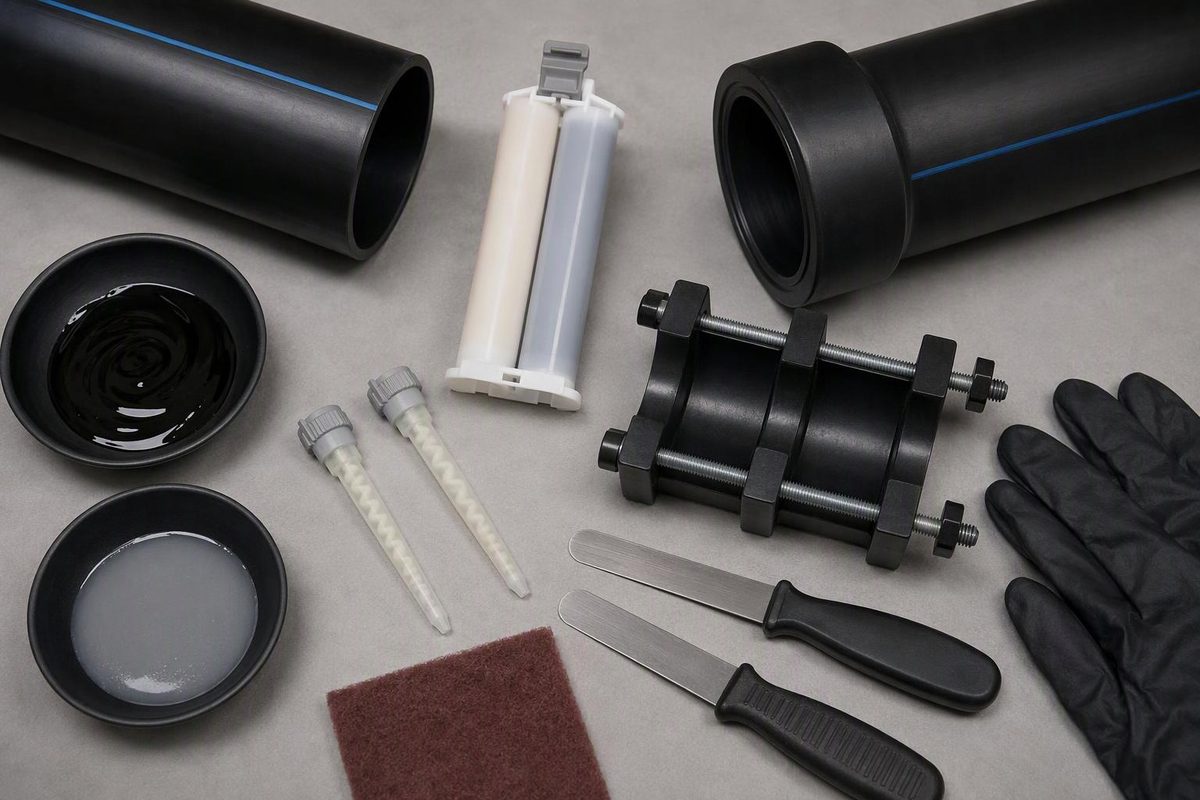
HDPE can be bonded to HDPE, but the adhesive must explicitly support polyethylene or low-surface-energy polyolefins. For an overlapping joint, a purpose-formulated two-part structural acrylic is a practical starting point. For small, tight-fitting parts, a compatible cyanoacrylate-plus-polyolefin-primer system is another option. HDPE’s low surface energy makes it difficult to bond; these are specific adhesive systems, not a property shared by every “plastic glue.” Permabond’s polyethylene guidance documents both routes.
If the job is an HDPE pressure pipe connection, use the pipe manufacturer’s joining procedure instead of this general adhesive method. The Plastics Pipe Institute describes fusion and mechanical fittings for joining PE pipe and recommends qualified installers and professional engineering services for PE piping systems. PPI Handbook
Check the material, joint and exposure first
Confirm that both parts are HDPE from their markings or supplier documentation. Then establish:
- Joint fit: Is there room for an overlap, or only a narrow broken edge? Can the parts maintain the adhesive’s specified gap without being forced into position?
- Load: Will the joint mainly resist sliding, or will an edge be pulled away in peel? Prefer an overlap or suitably designed patch over a narrow edge-to-edge glue joint where practical.
- Exposure: Record water contact, chemicals, minimum and maximum temperatures, sunlight and repeated flexing. Request compatibility data for those conditions—not just room-temperature strength.
- Consequences of failure: For pressure containment, overhead loads or safety-critical parts, require an approved repair or engineered joining method.
Test the actual HDPE grade before committing to the assembly. Plastic additives and process aids can affect adhesion; 3M specifically reports inconsistent DP8005 results with substrates containing oils or antistatic additives and lists mold-release-contaminated surfaces as unsuitable. DP8005 technical data
Prepare and assemble the bond
“No surface treatment required” does not mean “glue over dirt.” It means the specified adhesive can bond the polyolefin without a separate activation process such as plasma or flame treatment.
For an untreated-HDPE structural acrylic, follow this sequence:
- Dry-fit the parts and prepare the clamps. Check alignment and bond-line clearance before mixing. The usable working period may be only a few minutes.
- Clean both bonding faces. Remove grease, dust and mold release. Both 3M DP8005 and Permabond TA4610 specify isopropyl alcohol cleaning for polyolefin surfaces. Allow it to evaporate completely; surfaces should be clean and dry. Keep solvent away from ignition sources.
- Follow the grade’s preparation instructions. Do not assume sanding converts HDPE into an easy-to-bond plastic. If using an ordinary epoxy with surface activation, obtain a documented treatment-and-adhesive procedure. Permabond identifies certain epoxy grades as options after flame, plasma or corona treatment—not as interchangeable alternatives for untreated PE. Polyethylene adhesive guidance
- Dispense at the correct ratio through the specified static mixer. Follow cartridge-purging instructions. DP8005 requires a 10:1 ratio by volume; 3M advises against hand mixing. TA4610 uses 1:1.
- Assemble promptly and preserve the bond line. Clamp to hold alignment, not to squeeze the joint dry. DP8005’s technical sheet calls for mating within 2–2.5 minutes or sooner for one-sided applications and a joint designed for approximately 0.13–0.20 mm (0.005–0.008 in) adhesive thickness. It contains 0.20 mm (0.008 in) spacer beads. TA4610 contains gap-control particles and permits a maximum 1 mm (0.04 in) gap.
- Keep the assembly immobilized through the specified handling period, then allow full cure before service. Handling strength is not full strength.
These application details come from the DP8005 technical sheet, February 2016 and TA4610 technical sheet, September 2021. Check the current label and safety data sheets for storage, ventilation and protective-equipment requirements.
Documented adhesive options
These are selection examples, not a universal ranking. Choose by assembly time and gap as well as material compatibility. Times are typical values, not guarantees for every joint.
| System | Where it fits | Working and curing information |
|---|---|---|
| 3M Scotch-Weld DP8005 structural acrylic | HDPE overlaps that can be assembled quickly; no separate polyolefin primer required | 10:1 mix by volume; advertised 3-minute work life, approximately 3 hours to handling strength and 24 hours to full cure at about 22°C (72°F). Observe the shorter one-sided mating deadline above. |
| Permabond TA4610 toughened acrylic | A longer-pot-life alternative; maximum gap 1 mm (0.04 in) | 1:1 mix; 5–8 minutes pot life for a 4 g mixed sample, 40–50 minutes handling time and 24–36 hours full cure at 23°C (73°F) |
| LOCTITE 406 with SF 770 primer | Small, accurately aligned, tight-fitting parts where high peel strength is not required | Clean the surfaces; apply primer sparingly to both HDPE bond areas and let it dry. Apply adhesive to one face, assemble immediately and hold until fixtured. Allow the adhesive’s specified strength-development period before loading. |
Sources: 3M’s DP8005 product information, TA4610 TDS, Henkel’s LOCTITE 406 instructions and SF 770 TDS, May 2021. Henkel expressly does not recommend SF 770 assemblies requiring high peel strength and warns that the primer is highly flammable. Pot life measured in a mixed sample is not automatically the available assembly time after spreading the adhesive.
A polyolefin primer is also not merely a generic super-glue accelerator. Use the primer specified for the adhesive. For broader chemistry differences, see why plastic type determines epoxy compatibility.
If the bond fails
Adhesive releases cleanly from the HDPE: Recheck material identity, contamination, grade compatibility and assembly timing. Do not simply add a thicker layer of the same undocumented glue.
The joint holds initially but peels apart: Reconsider overlap, edge loading and flexing. Fast fixture or a high lap-shear value does not establish that a joint will resist peel in service.
TA4610 squeeze-out remains soft: Its technical sheet notes that exposed excess adhesive cures more slowly and may feel soft from air contact while adhesive inside the closed joint cures solid. Do not judge the internal cure from squeeze-out alone. TA4610 directions
Before loading the real assembly, fully cure a representative trial joint and test it under the expected loading and exposure conditions. A successful dry-room trial alone is not qualification for immersion, hot service or chemical containment.