
8 min read ·
Use the Recall, Not Glue, for Loose Mach-E Trim
Loose Mach-E quarter-window trim may fall under recall 26V487. See why DIY glue is not the approved fix and what to document before dealer service.
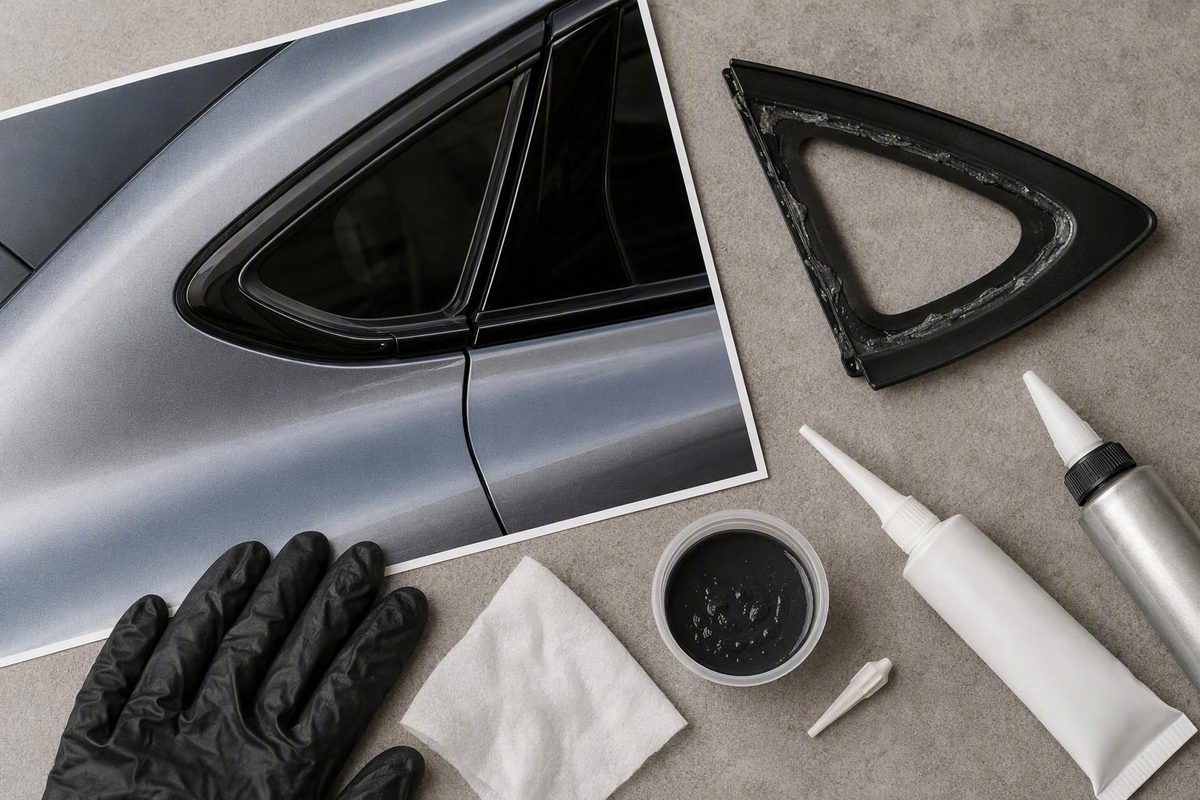
Do not reglue loose Mustang Mach-E quarter-window trim before a Ford dealer checks it. A retained piece may be physically reattachable, but no Ford-approved owner adhesive, primer, preparation method, or cure schedule appears in the available evidence. For affected vehicles, the reported remedy under Ford recall 26S56 and NHTSA campaign 26V487000 is dealer inspection and replacement as necessary at no charge.
Before touching the trim, photograph its condition, note any wind noise or movement, and check the 17-character VIN. Do not pry, heat, repeatedly press, or pull on a marginally attached piece. If it is wobbling or flapping, avoid driving until Ford or a qualified automotive professional advises how the vehicle can be made safe.
Choose the trim condition, recall status, adhesive family, and temperature; the tool shows the documented next step and whether a cure time can actually be calculated.
This tool distinguishes a calculable adhesive cure from the documented recall response. It does not invent missing Ford specifications.
Result: Photograph the lifting edge and arrange dealer inspection before applying adhesive.
Check the VIN for Ford recall 26S56 / NHTSA campaign 26V487000. Do not press, pull, heat, or pry the trim.
No product-specific handling or full-cure figures are supplied in the available Ford recall information. Temperature cannot produce a safe loading time without an approved adhesive, primer, substrate, bond-line, pressure, and cure specification.
| Adhesive Family | Handling Time | Full Cure | Missing Information |
|---|---|---|---|
| Urethane | — | — | Product, primer, moisture conditions, bond geometry, and Ford approval |
| Structural acrylic | — | — | Exact chemistry, mix system, substrates, gap, temperature curve, and Ford approval |
| VHB-style tape | — | — | Tape grade, primer, surface energy, pressure, dwell schedule, loads, and Ford approval |
| Cyanoacrylate | — | — | Grade, plastic compatibility, gap, humidity, durability data, and Ford approval |
| Observed Condition | Primary Action | Trim Handling | Coverage Step |
|---|---|---|---|
| Edge lifting, no movement | Photograph and schedule prompt inspection | Do not press or pry | Check VIN |
| Wobbling or flapping | Higher concern Ask how to make the vehicle safe | Do not tape or glue | Contact Ford or dealer |
| Detached and retained | Protect and photograph the piece | Do not clean, sand, bend, or heat | Ask whether to bring it |
| Detached and missing | Photograph the exposed area | Do not fit a generic cap first | Ask what Ford supplies for the VIN |
| Cracked, torn, or distorted | Obtain professional inspection | Do not attempt to reshape it | Ask what must be replaced |
Source note: Ford recall 26S56 / NHTSA campaign 26V487000 and the recall reporting cited in the accompanying article. Handling time, full cure, and earliest safe loading are unknown because no Ford-approved owner adhesive specification is provided.
The calculator deliberately returns a dash rather than an invented cure time. Neither Ford nor the cited recall reporting supplies owner-use handling times, full-cure times, temperature adjustments, or an earliest safe loading time for urethane, structural acrylic, VHB tape, or cyanoacrylate on this assembly. Temperature alone cannot fill in the missing product, substrate, primer, bond-line, pressure, and service specifications.
Recall 26V487 Covers Certain 2023–2025 Mach-Es
Ford filed the recall on July 30, 2026. It covers 86,543 certain 2023–2025 Mustang Mach-E vehicles reportedly built from February 17, 2023, through October 8, 2024. Owner notification letters are scheduled to mail beginning September 10, 2026.
Reporting identifies 219 cases of loose or detached trim and says Ford knew of no related crashes or injuries at the time. Those figures describe the campaign population, not the eligibility of an individual vehicle. Autoblog’s recall summary reports the population, production window, case count, warning signs, and road-hazard rationale.
Model year and build date cannot replace a VIN check. Not every 2023, 2024, or 2025 Mach-E is necessarily included, and a similar defect can occur on a vehicle outside the campaign for another reason.
Enter the VIN or license-plate information in NHTSA’s recall lookup, then confirm the result with Ford or a Ford dealer. NHTSA says recently announced campaigns may not immediately display every affected VIN as records are added. A result showing zero unrepaired recalls also does not display recalls that were previously completed.
Save a screenshot of the result. If the trim is visibly loose but the campaign does not appear, give the dealer the VIN and both identifiers:
- Ford recall: 26S56
- NHTSA campaign: 26V487000
Ford customer service has been reported as 1-888-436-7332. Electrek’s coverage describes the contact number and the no-charge dealer inspection and replacement process.
Early Movement Can Leave a Weak Factory Bond
The reported manufacturing cause explains why adding a stronger glue is not the appropriate first response. Coverage attributes the defect to insufficient drying or curing in the supplier’s assembly process. A new jig reportedly shortened the available curing period, allowing parts to be moved before the bonding system was ready.
InsideEVs’ account describes reduced primer-curing time and says dealers will inspect affected vehicles and replace trim as necessary at no charge. AOL’s syndicated report describes the manufacturing issue and the risk that detached trim could enter traffic.
An adhesive joint can appear seated before it has enough handling strength to tolerate movement. Moving the assembly early can disturb contact, bond-line geometry, or the interaction between primer, adhesive, and substrate. A later application of glue around an exposed edge does not reconstruct the controlled factory process or prove that the remaining bond is sound.
A durable repair would require confirmed information about:
- The exact trim, glass, coating, and adjacent body materials
- The factory primer and its condition
- Remaining adhesive and contamination
- Whether the trim has warped or changed shape
- Compatible cleaners and surface treatments
- Bond-line thickness and contact area
- Application temperature and humidity
- Required pressure and fixture time
- Handling strength and full cure before road loading
- Ford’s inspection and reuse criteria
The evidence provides none of those owner specifications. That is why naming a tube of urethane, structural acrylic, cyanoacrylate, or automotive double-sided tape would create a procedure that Ford has not supplied.
Loose Trim Can Become a Road Hazard
The defect is not solely cosmetic. Rear quarter-window trim can detach while the vehicle is moving and enter traffic, increasing risk to other road users.
Inspect visually without testing the bond. Warning signs include a lifting edge, a widening gap, visible movement, flapping, tapping against the glass or body, new wind noise, or a missing piece. Noise alone does not identify the cause, but it warrants inspection.
Use the trim’s present condition to decide what to do:
| Condition | Immediate Action | Driving Guidance |
|---|---|---|
| Slight lifting | Photograph and book inspection | Ask the dealer promptly |
| Wobbling or flapping | Do not touch or tape it | Avoid driving pending advice |
| Detached and retained | Protect the piece | Contact the dealer |
| Missing or damaged | Photograph the area | Obtain professional assessment |
If a piece separates while driving, do not stop somewhere unsafe to retrieve it. Recover it only when doing so is safe and lawful.
Reports said Ford knew of no related crashes or injuries when they were published. That describes known incidents at that time; it does not establish that visibly moving trim is safe to ignore.
Preserve the Trim and Its Bonding Surfaces
If the piece remains partly attached, do not pull it off to inspect the underside. Do not repeatedly press it back into place, heat it, insert adhesive under an edge, or add tape over the exterior. Testing a marginal bond can worsen the condition.
If the trim has detached and you retained it, store it somewhere clean and dry without bending it. Photograph both sides, the exposed mounting area, remaining residue, and any cracks or distortion. Do not scrape, sand, solvent-clean, or heat the bonding surfaces unless the dealer gives specific instructions.
If the piece is missing, photograph the complete quarter-window area and report whether it separated while driving or was already absent when discovered. Ask what Ford currently supplies for the VIN. Available reports do not establish whether every repair uses an individual trim piece or a larger quarter-window assembly.
Cracked, torn, or warped trim may require replacement regardless of adhesive choice. Glue cannot replace missing material or restore a part that no longer follows the window contour.
Useful records include the date and mileage when the problem appeared, close and wide photographs, safely recorded video of movement, VIN-lookup results, Ford case numbers, appointment details, recall notices, repair orders, and invoices.
DIY Adhesive Does Not Equal the Recall Remedy
Owners have reported attaching retained pieces with glue or automotive mounting tape. Those accounts establish only that a part can sometimes be made to stick again. They do not demonstrate Ford approval, highway-speed security, compatibility with the factory primer, or durability through heat, cold, rain, washing, vibration, and material movement.
No available owner report establishes all of the following:
- Confirmed Mach-E substrates and surface treatments
- A validated adhesive and primer combination
- Controlled preparation and bond-line thickness
- Measured pressure and fixture time
- Temperature-specific handling and cure limits
- Long-term environmental and road-load testing
- Compliance with Ford’s recall inspection criteria
Aftermarket caps and salvage parts present the same limitation. A seller’s fitment or mounting-tape claim does not establish equivalence to the recall remedy. For a vehicle outside recall and warranty coverage, those parts may be options to discuss after professional inspection, but they are not Ford-verified substitutes for campaign service.
The strongest readily available adhesive is not automatically the correct one. An incompatible adhesive can attack plastic, fail to bond to weathered primer, create an excessively rigid joint, leave an uncontrolled gap, or obscure the original failure. The cited evidence supplies no basis for selecting among those systems for owner installation.
Follow the Dealer Path That Matches the VIN
For a covered vehicle, the reported path is no-charge dealer inspection and replacement as necessary. The current Ford procedure and the condition found during inspection determine whether the dealer replaces trim, a quarter-window assembly, or another component. Secondary descriptions are not a promise of the exact parts used on every vehicle.
When arranging service, ask:
- Is this VIN included in Ford recall 26S56 or NHTSA campaign 26V487000?
- Given the visible movement, should the vehicle be driven before service?
- Is the remedy available for this VIN now?
- Which component will inspection determine must be replaced?
- Should a detached piece be brought to the appointment?
- Has Ford authorized any temporary stabilization method?
- Should washing or weather exposure be avoided before inspection?
If the VIN is excluded, ask the dealer to document the defect and review any applicable warranty. Ford may also consider goodwill assistance, but that is discretionary. If neither applies, request a written customer-paid repair estimate after the trim and mounting area have been inspected.
A negative recall result does not make loose trim secure, and visible damage does not by itself create campaign eligibility. Keep the physical safety issue and the coverage decision separate.
Disclose Any Glue or Tape Already Applied
If adhesive or tape is already on the vehicle, do not conceal it or add another product over it. Tell the dealer what was used, when it was applied, whether cleaners or heat were involved, and whether residue was scraped or sanded away.
The available evidence does not establish that a previous DIY attempt will void coverage, preserve it, qualify for reimbursement, or have no effect. It may obscure the original surfaces or alter the repair the dealer must perform, so the effect has to be assessed for the individual vehicle.
Until Ford provides a product-specific owner procedure, there is no supportable handling time, full-cure time, or earliest safe moment to load a reglued Mach-E quarter-window joint. Document the defect, leave the bonding surfaces unchanged, check the VIN, and use the dealer recall process rather than experimenting with an unverified adhesive.