
4 min read ·
Choose Anaerobic Thread Sealant by Thread, Metal and Fluid
Select and apply anaerobic thread sealant by thread form, metal, fluid, clearance, cure time and approvals; troubleshoot leaks without overtightening.
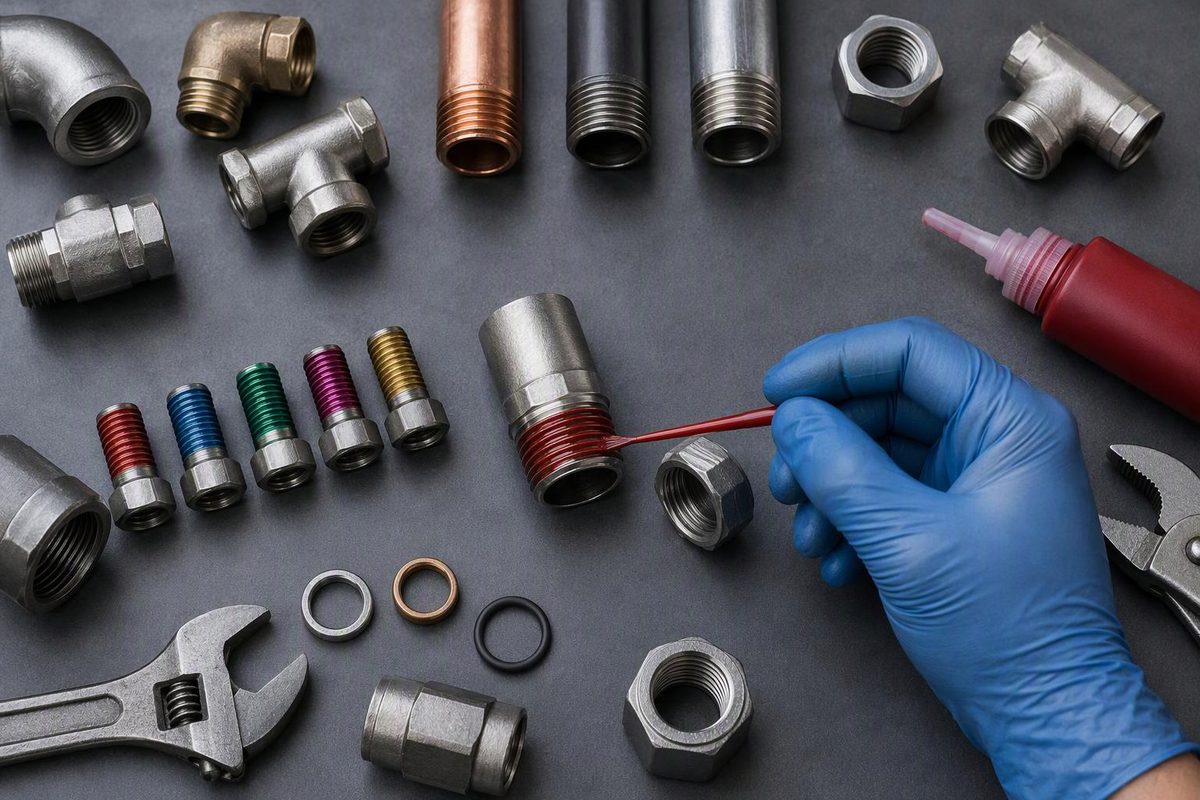
Use anaerobic thread sealant on compatible, close-fitting metal pipe threads—not automatically on every threaded connection. First identify the thread and where the fitting actually seals. Then match the sealant to the metal, thread size and clearance, system fluid, pressure, temperature, required approvals and future disassembly.
Anaerobic sealant cures when confined between sufficiently reactive metal surfaces, filling the leakage paths between the threads. It can also resist loosening, but do not automatically substitute an ordinary bolt threadlocker: threadlockers and pipe sealants differ in viscosity, gap-filling ability, strength, cure behavior and approvals (Permabond).
Check the sealing geometry first
| Connection | Where it seals | Anaerobic sealant on threads? |
|---|---|---|
| Tapered pipe thread, such as NPT | Mating threads | Commonly appropriate when the product and service are compatible |
| Straight thread with an O-ring or gasket | O-ring, gasket or sealing washer | Normally no; sealant on the threads does not repair the sealing surface |
| Flared, coned or compression tube fitting | Metal seat or ferrules | No, unless the fitting manufacturer explicitly instructs otherwise |
| Pipe joint specifically designed to seal at straight-to-straight or straight-to-taper threads | Thread interface | Only with a sealant documented for that connection design |
Swagelok explains that common straight-thread connections generally rely on an O-ring, gasket or metal-to-metal contact, while tapered threads need sealing and lubrication at the threads. It also warns that mating threads must have the same diameter and pitch (Swagelok). Do not use paste to compensate for mismatched NPT, BSPT, BSPP or metric threads, badly damaged threads or an absent seal.
Choose by fitting, not color
Color is not a universal grade system. Compare the current technical data sheet instead.
- Fine hydraulic and pneumatic fittings: Favor a medium-viscosity, particle-free grade intended for fine threads. LOCTITE 545, for example, is specified for fine metal threads and contains no fillers that could foul valves, filters or screens (Henkel).
- Coarse tapered pipe threads: Use a higher-viscosity paste whose documented gap capability covers the joint. LOCTITE 567 is a high-viscosity grade for coarse tapered metal threads, with an operating range of −55 to 250°C (−65 to 482°F) (Henkel). That range belongs to this grade, not anaerobic sealants generally.
- General metal pipe work: Check the specified thread designs, active and passive metals, gap and removal strength. LOCTITE 577 is a medium-strength paste documented for straight-to-straight and straight-to-taper fittings, with gap performance to 0.25 mm (0.01 in.) and an operating range of −55 to 150°C (−65 to 300°F) (Henkel).
Verify chemical compatibility and the exact approval required for potable water, fuel gas, oxygen, food equipment or other controlled service. An approval on one formulation does not transfer to another. For example, Swagelok excludes pure oxygen, ozone, halogens and several other media from its SWAK anaerobic sealant. Its catalog also requires a minimum 24-hour room-temperature cure before pressurizing (Swagelok product catalog). A claim of an “instant low-pressure seal” is not permission to apply full working pressure immediately.
Anaerobic grades are primarily for metal. Some formulations can stress-crack sensitive plastics, so use a sealant expressly approved for the specific polymer when either fitting is plastic (Henkel).
Apply it correctly
- Isolate and depressurize the system. Confirm the fluid and fitting materials before opening the sealant.
- Remove old sealant and inspect the threads. Replace cracked, crossed, deformed or badly corroded fittings rather than trying to fill the damage.
- Clean and degrease. Minor oil tolerance is product-specific, not a substitute for preparation. Paint, coatings and PTFE tape can prevent the sealant from contacting the metal needed for cure.
- Use activator only when directed. Stainless steel, aluminum and plated metals are relatively passive and may cure more slowly. Temperatures below 5°C (41°F) can also slow the cited Henkel grades. Use the compatible activator and drying procedure named by the manufacturer, not an improvised primer (Henkel).
- Apply a continuous 360° band to the male threads. Follow the grade’s placement instructions. The cited LOCTITE 545 and 567 directions start one or two threads back and cover at least three thread roots; larger threads may require sealant on both halves.
- Assemble once to the fitting maker’s torque or engagement instruction. The sealant lubricates the joint, so do not substitute an arbitrary extra turn. Avoid backing off a tapered fitting merely to align it unless the fitting and sealant instructions permit repositioning.
- Wipe off external excess and wait for the specified cure. Exposed residue may remain wet because oxygen inhibits cure; this does not reveal whether the confined material has cured. Fixture time is not necessarily the time at which the joint can withstand service pressure (Permabond).
- Leak-test by the system manufacturer’s approved method. Never use your hand to search for a leak on a pressurized hydraulic or gas line.
If the joint still leaks
An immediate leak can indicate incomplete 360° coverage, incorrect engagement or torque, damaged or mismatched threads, excessive clearance or the wrong sealing geometry. Slow or weak cure more often points to low temperature, passive metal, contamination, a coating between the sealant and metal, or a gap beyond the product limit.
Do not wrap PTFE tape beneath anaerobic sealant unless the manufacturer explicitly specifies that combination. Tape can block contact with the metal and prevent cure (Permabond).
Disassemble the joint, remove the old material, inspect both components and start again with the correct grade. Adding more sealant externally or tightening a defective fitting harder can damage the joint without correcting the cause.