
6 min read ·
Choose the Right 2-Part Polyurethane for the Joint
Compare 2-part polyurethane work and cure times, substrate fit, bond-line limits, application steps and isocyanate controls before choosing a grade.
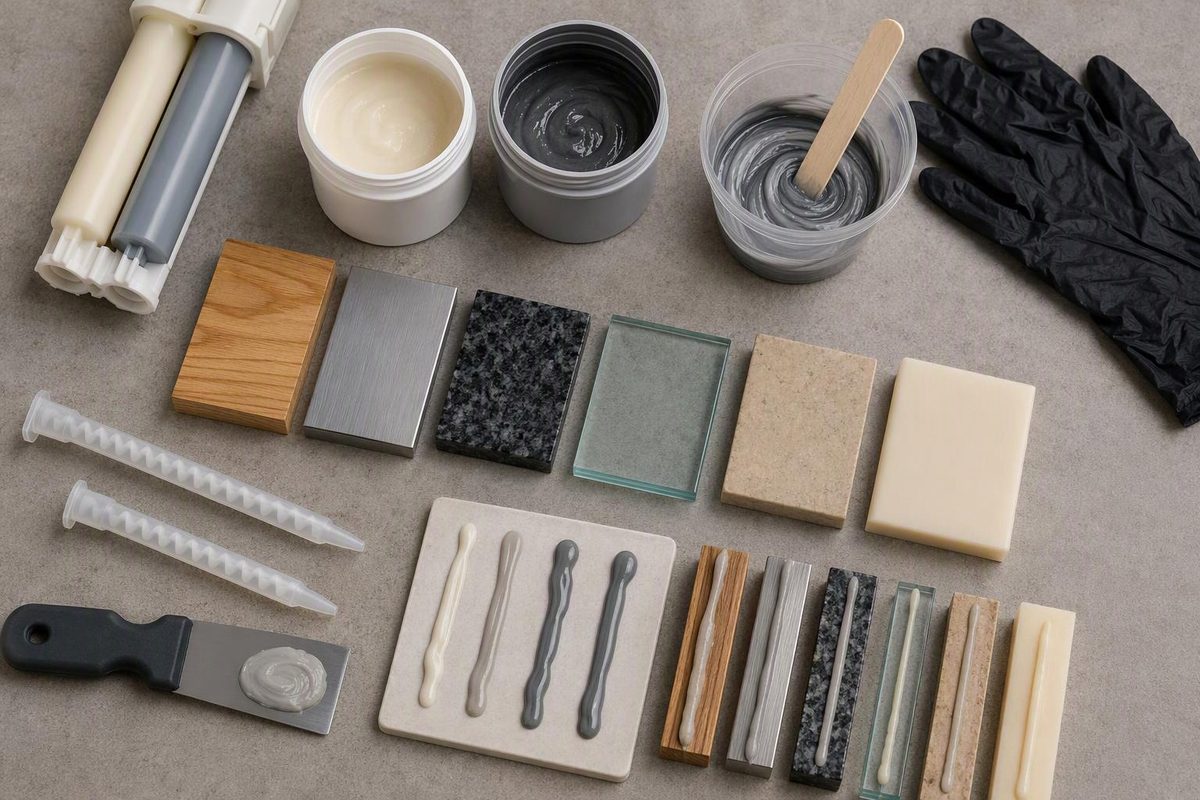
Choose a 2-part polyurethane adhesive only when its technical data sheet (TDS) confirms both substrates, the required bond-line thickness, service exposure and cure schedule. It is a strong candidate for tough, somewhat flexible bonds between composites, metals, wood, rubber and certain plastics, particularly where dissimilar materials experience vibration, impact or different rates of thermal movement.
A 2-part, or 2K, polyurethane keeps a polyol-containing component separate from an isocyanate-containing component. Mixing them at the specified ratio starts a chemical cure throughout the bond line. This differs from the moisture-cured product commonly sold as polyurethane wood glue. Two-part urethanes therefore do not rely on atmospheric moisture to cure through the joint (3M).
Enter the time needed to apply and assemble the joint; the comparison shows which documented timing windows are long enough.
Timing-Window Check
Documented matches
2 products provide at least 20 minutes of open time: SikaForce-710 L100 and 3M DP6330NS.
| Product | Pot/work | Open | Press/handle |
|---|---|---|---|
| SikaForce-712 L3 Too short | 3 min | 5 min | 12 min |
| Values listed at 23°C (73°F); the final cure figure is not provided in this comparison. | |||
| SikaForce-710 L100 Long enough | 100 min | 135 min | 210 min |
| Values listed at 23°C (73°F); the final cure figure is not provided in this comparison. | |||
| 3M DP6330NS Long enough | 15 min | 30 min | 120 min |
| Full strength: 168 hours under the TDS conditions. Handling strength is not full cure. | |||
Source: manufacturer technical data sheets cited in the article. Times apply only to these product models and stated test conditions.
Where 2-Part Polyurethane Fits
| Joint Requirement | Starting Point | What to Verify |
|---|---|---|
| Metal to composite, wood or rigid plastic | Often suitable | Both exact materials, any coating and primer requirements |
| Impact, vibration or differing thermal movement | Often suitable | Elongation, hardness, peel data and service-temperature range |
| Vertical joint or moderate gap | Possibly suitable | Non-sag rating and permitted bond-line thickness |
| PE, PP, PTFE or silicone | Only with explicit documentation | Compatibility and required treatment; see the PP adhesive guide |
| Outdoor, immersed or chemically exposed joint | Product-dependent | Water, weathering, UV, chemical and temperature data for the exact grade |
| Sustained high temperature or strong solvent exposure | Compare alternatives | 3M describes urethanes as tending to have lower solvent and high-temperature resistance than epoxies (3M selection guide) |
| Safety-critical or overhead assembly | Only as an engineered system | Tested joint design, process controls and any required mechanical restraint |
“Flexible” does not mean every cured polyurethane behaves like rubber. One structural 2K polyurethane lists Shore D 70 hardness and 40% elongation at break; another lists Shore D 72 and 25% elongation (SikaForce-712 L3, SikaForce-710 L100). Use the cured properties of the named product rather than assuming behavior from the chemistry family.
Polyethylene, polypropylene, PTFE and silicone are not safe assumptions for a general-purpose 2K polyurethane. Select an adhesive that names the exact plastic grade or surface treatment. Coatings, mold-release residue and plasticizers can also change the result even when the base material appears on a compatibility list.
Work Life, Open Time and Cure Time Are Different
The timing values on a TDS are related but not interchangeable:
- Pot life or work life is the usable interval after mixing. The test may refer to a quantity in a container or adhesive inside a static mixer, so use the manufacturer’s definition.
- Open time is the maximum interval between applying the adhesive and closing and fixing the joint.
- Handling, fixture or press time is how long the assembly must remain supported before reaching the stated early strength.
- Full cure or full strength is when the manufacturer expects the stated final properties under the specified conditions.
The differences between products can be large. At 23°C (73°F), SikaForce-712 L3 lists a 3-minute pot life, 5-minute open time and 12-minute press time. SikaForce-710 L100 lists 100, 135 and 210 minutes, respectively, under its test conditions.
Cartridge-dispensed 3M DP6330NS lists a 15-minute work life, 30-minute open time, 2 hours to handling strength and 168 hours to full strength (3M DP6330NS TDS). These figures belong to the named products and test conditions; they are not general timing ranges for all 2K polyurethane adhesives.
Higher temperature generally accelerates cure, while lower temperature slows it. A larger mixed mass can also shorten usable time as the reaction generates heat. Dry-fit and prepare every part before mixing rather than treating the published work life as time available for cleaning, measuring or finding clamps.
Match the Mixing Method to the Product
A volume ratio is not necessarily the weight ratio. SikaForce-710 L100 specifies 100:25 by volume but 100:19 by weight. Substituting one ratio for the other changes the proportion of the components and can prevent the adhesive from reaching its intended properties.
Use the matched cartridge, applicator and static mixer when the manufacturer specifies them. Before attaching the nozzle, dispense as the product instructions direct to confirm that both cartridge chambers flow. Fit the specified mixer and discard the initial material if instructed.
Bulk products require measurement by the method stated on the TDS. Do not estimate the ratio visually, and do not assume that extra hardener produces a faster or stronger cure.
Prepare Each Substrate Separately
Remove oil, dust, corrosion, mold release and weak paint from both bonding surfaces. Abrasion followed by another cleaning step is common, but the solvent, primer and abrasion method must suit each substrate.
The preparation procedure for bare metal may not be appropriate for a coated composite, plastic or rubber part. For example, the DP6330NS TDS gives cleaning, abrasion and recleaning procedures for several materials and specifies a silane adhesion promoter for glass.
A successful test on an uncoated material does not establish compatibility with painted, plated, anodized or otherwise treated versions. The coating becomes part of the bonded joint and can fail before the adhesive does.
Control the Bond Line and Fixture the Assembly
Apply a continuous, controlled bead over enough area to carry the load without starving the joint. A deeper adhesive layer is not automatically stronger.
For DP6330NS specifically, 3M gives an optimum bond-line range of 0.005–0.020 in (0.13–0.51 mm), with thinner lines favoring shear and thicker lines favoring peel. That range must not be transferred to another polyurethane grade unless its own documentation supports it.
Close the joint within the stated open time. Apply enough pressure to establish continuous contact without forcing out all the adhesive. If the design requires a controlled thickness, use the product’s approved spacers, glass beads or joint geometry rather than relying on clamp pressure alone.
Fixture the assembly for the stated handling, fixture or press interval. The support must prevent sliding, peel and spring-back. Handling strength is not full cure, so do not apply the final service load merely because the assembly can be moved.
Clean up as directed while the adhesive is uncured. Cured polyurethane commonly requires mechanical removal. Do not clean skin with solvent; Sika directs users to a suitable hand cleaner and water.
Treat Isocyanate Controls as a Selection Requirement
The isocyanate-side component requires controlled handling. NIOSH identifies isocyanates as eye, skin and respiratory irritants and warns that respiratory or skin exposure can cause sensitization, potentially leading to severe asthma after later exposure. For workplaces, it recommends controlling exposure principally through closed systems and ventilation, with suitable protective clothing or respiratory protection where necessary (NIOSH).
Read the current safety data sheet for both components before opening them, then follow its ventilation, glove, eye-protection, spill and disposal requirements. A general-purpose dust mask is not a substitute for the respiratory protection identified by a workplace hazard assessment and the SDS. If those controls cannot be met, do not use the product.
Some 2K polyurethane adhesives are restricted to trained industrial or occupational users. 3M states this explicitly for DP6310NS, for example. That restriction makes it unsuitable as a general consumer recommendation despite its useful technical data.
Choose a grade with enough documented work and open time to coat, align and fixture the actual parts. Prefer packaging that meters the specified ratio, and test a representative prepared joint before committing the full assembly.