
5 min read ·
Best Glue for Fiberglass to Metal: Choose by Joint and Load
Choose fiberglass-to-metal glue by load, gap and movement. Compare toughened epoxy, structural acrylic and flexible sealants, with prep and cure guidance.
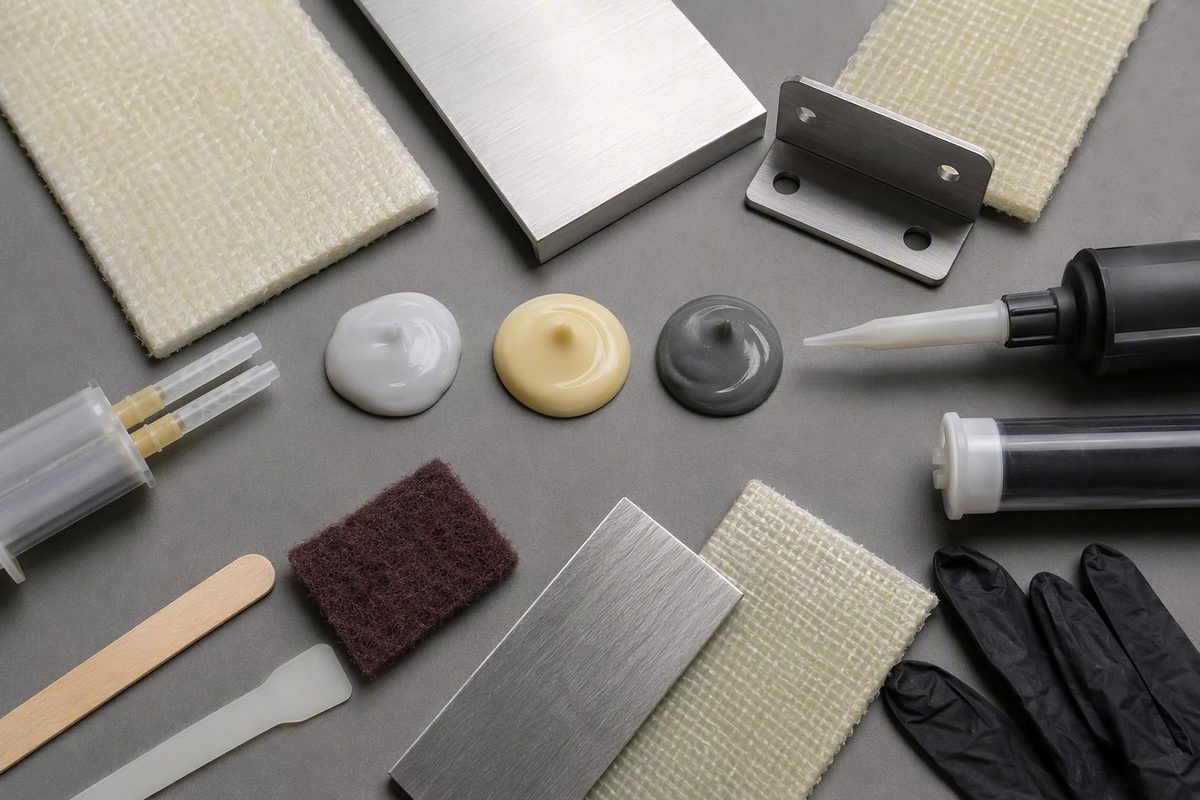
For a small, permanent fiberglass-to-metal attachment, a toughened two-part epoxy explicitly listed for both materials is a practical starting choice. Choose a thickened grade if the joint needs gap filling or must stay in place vertically. WEST SYSTEM’s G/flex 655, for example, accommodates some expansion, contraction, shock and vibration while remaining much stiffer than an adhesive sealant. G/flex 655 product guidance.
For structural composite assemblies, also consider a substrate-matched methacrylate adhesive. For flexible sealing or bedding around mechanically secured fittings, consider a compatible polyurethane adhesive sealant instead. These are different jobs—not interchangeable versions of “strong glue.”
Match the adhesive to the joint
Here, fiberglass means cured glass-reinforced plastic (GRP/FRP), not loose glass cloth or fiberglass insulation. Identify whether you are bonding to exposed laminate, gelcoat or paint, and whether the metal is bare, painted, plated or powder-coated.
| Joint requirement | Adhesive to investigate | Main selection limit |
|---|---|---|
| Permanent attachment with modest movement, vibration or an uneven fit | Toughened, thickened two-part epoxy, such as G/flex 655 | Confirm the specific metal, gap and loaded service temperature |
| Structural composite-to-metal assembly | Two-part structural methacrylate/acrylic, such as Plexus MA300 | Check metal primer requirements, permitted gap and assembly time |
| Elastic seal or bedding around mechanically secured hardware | Polyurethane adhesive sealant listed for GRP and metal, such as Sikaflex-291i | Do not treat a sealing product as an approved structural attachment |
Before buying, establish:
- Load and geometry: Is this a broad bonded pad or a narrow bracket that can pry away at an edge? A stronger adhesive is not a substitute for adequate overlap. WEST SYSTEM’s joint guidance explains how adhesive strength, adhesion and joint area affect load transfer.
- Gap: Measure the actual clearance. Use the product’s permitted bond-line thickness rather than assuming any paste can fill any void.
- Exposure: Check rain, immersion, saltwater, fuel and cleaners separately. Also check the temperature reached by the metal in service—not just the temperature during application.
For overhead attachments, load-bearing brackets, vehicle safety components or critical boat hardware, use the component maker’s approved attachment method or an engineered joint. A general adhesive recommendation cannot establish a safe load rating.
Prepare the fiberglass and metal
For an epoxy joint, the useful sequence is clean, dry, abrade, remove dust, bond. Cleaning must come before sanding so contaminants are not worked into the surface.
- Check that both surfaces are sound. Remove loose rust and flaking, chalking or blistered coatings. If you leave paint or gelcoat in the joint, you are relying on that layer and its attachment to the underlying material.
- Remove wax, oil and release agents. Use a cleaner appropriate for the substrate and adhesive. WEST SYSTEM specifies silicone/wax remover for polyester laminates. Where solvent cleaning is needed, use fresh plain paper towels and wipe the contamination away before the solvent dries. Do not apply acetone indiscriminately to an unknown finish.
- Abrade the fiberglass bonding area. For WEST SYSTEM epoxy on polyester laminate, the guidance is 80-grit abrasive to a dull finish. If the surface is cured epoxy with amine blush, wash it with clean water and an abrasive pad before sanding; solvent is not the prescribed blush remover.
- Prepare the particular metal. WEST SYSTEM specifies dry sanding aluminum with 80-grit. For steel, it specifies cleaning, sanding or grinding to bright metal, then sanding fresh epoxy into the surface. Recoat or bond after that first epoxy coat gels. Do not assume this preparation also covers stainless steel, galvanized metal or every coating.
- Remove dust and keep the surfaces dry. Avoid touching the prepared area with bare hands and check for condensation.
These are WEST SYSTEM’s epoxy preparation instructions, not a universal procedure for acrylics or sealants. Follow the chosen product’s pretreatment and primer instructions.
Wear suitable gloves and eye protection, control sanding dust and provide ventilation according to the product’s safety data sheet. WEST SYSTEM’s safety guidance warns against using solvents to clean epoxy from skin. MA300’s components are flammable; keep them away from heat, sparks and open flames, as its datasheet directs.
Apply and allow the joint to cure
Dry-fit the parts and arrange supports before mixing. Measure resin and hardener exactly as specified; volume and weight ratios may differ. Fill the intended bond line and immobilize the assembly. For epoxy, use enough clamp pressure to establish contact and a little squeeze-out—not enough to squeeze the adhesive out of the joint. Bonding and clamping guidance.
Working time, fixture time and full cure are different. Fixture time is not permission to apply the final load. Keep the assembly supported through the prescribed cure, using the schedule for the actual temperature.
Practical product choices
For a small permanent repair: WEST SYSTEM G/flex 655 is a well-documented candidate. It is a non-sagging, pre-thickened epoxy listed for fiberglass and metals. Its product page lists a 1:1 mix ratio by volume, 45-minute pot life, 75-minute working time and 24-hour full cure at 72°F (22°C). It cures amber, so it is not a colorless repair. These properties make it a useful starting choice, not proof that any bracket bonded with it is safe. G/flex 655 specifications.
For a structural assembly: investigate a substrate-matched methacrylate such as Plexus MA300. ITW’s hosted Rev. 07 datasheet, dated September 2015, lists FRP, gelcoat, aluminum, carbon steel and stainless steel, with metal primer suggested. It gives 3–6 minutes working time at 74°F (23°C) and a 0.75–3.2 mm gap-filling range. That short assembly window may be unsuitable for a large DIY panel. The sheet also requires oxidation-inhibiting coatings or primers for exterior metal applications. Confirm the current instructions for the product supplied before specifying it. MA300 technical data.
For flexible sealing: select a marine sealant system, not simply a softer structural glue. Sikaflex-291i lists GRP and metals and cures through atmospheric moisture; cold conditions slow curing. Sika specifies experienced professional users and testing on the actual substrates. Use its current local product data and pretreatment chart rather than borrowing an epoxy’s 24-hour schedule. Sikaflex-291i product data.