
4 min read ·
Core Material: Identify the Core Before Choosing the Adhesive
Identify foam, balsa or honeycomb core material, check skin compatibility, and plan preparation, bond-line thickness and cure for sandwich panels.
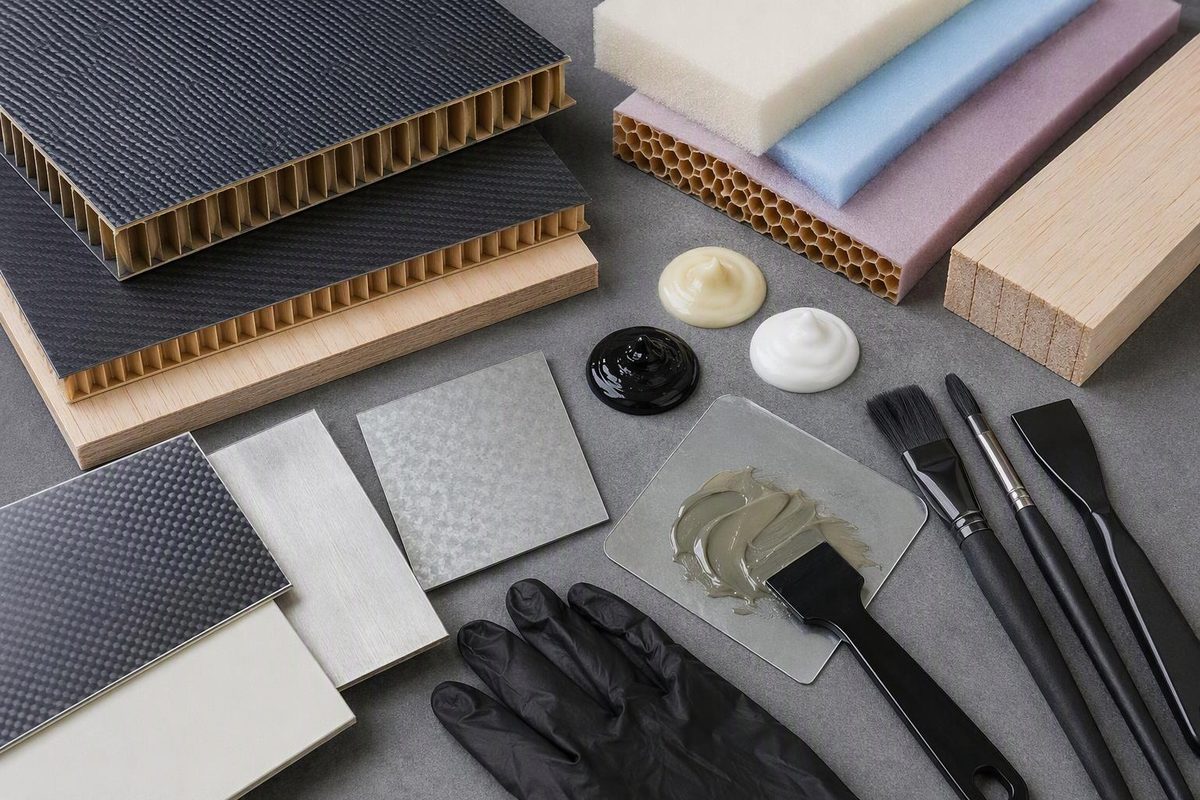
Core material is the lightweight middle layer of a sandwich panel, bonded between two outer skins. Common structural cores include foam, end-grain balsa and honeycomb. Their purpose is to produce a light, stiff panel—but that depends on a sound bond between the core and skins. Gurit’s structural-core guide explains this relationship.
For adhesive selection, “foam core” or “honeycomb” is not a sufficient identification. Specify the core chemistry and grade, skin material, joint gap, loading and exposure, then check the bonding process. A resin suitable for making a new laminate is not automatically the right adhesive for bonding core to an already-cured skin.
Identify the core and its compatibility limits
The foam and balsa compatibility entries below apply to the named Gurit products, not every material sharing the same chemical name. They describe laminating and infusion resin compatibility in Gurit’s December 2025 processing guide.
| Core material | What to identify | Bonding consideration |
|---|---|---|
| End-grain balsa | Grade, thickness, moisture and whether the surface is sealed | Gurit Balsaflex is compatible with epoxy, polyester and vinyl ester laminating resins. Moisture can cause adhesion and curing problems. |
| SAN structural foam | Exact grade and processing-temperature limits | Gurit Corecell is compatible with those three resin families. That does not establish compatibility with every adhesive formulation. |
| PET structural foam | Grade, density and surface format | Gurit Kerdyn is compatible with those three resin families. Grooves and cuts increase resin demand. |
| Cross-linked PVC foam | Grade and exact resin system | Gurit PVC is epoxy-compatible, but some polyester and vinyl ester systems can cause styrene attack. Representative testing is important. |
| Honeycomb | Cell-wall material, cell size, density, orientation and any coating | Aluminum, aramid and fiberglass honeycombs are distinct bonding substrates; “honeycomb” describes the structure, not a single material. |
Hexcel’s honeycomb guide identifies those honeycomb materials and includes the facing material, adhesive, bonding conditions and operating environment among the selection criteria. Do not transfer a foam-bonding procedure to honeycomb without documented suitability.
Choose by the assembly process
For a new wet-laminated panel, check compatibility between the core and laminating resin, and provide enough resin at the interface. Even closed-cell foam has open surface cells that take up resin. Gurit describes surface priming as a way to control uptake during wet lamination; use the procedure specified for your material system rather than a universal filler recipe.
For bonding core to a cured skin, look for a dedicated core-bonding adhesive documented for both surfaces. Gurit describes this as a separate bonding operation and recommends its Spabond 568 paste in its core-processing guide. Weights or vacuum bagging can hold the core against the mould shape while bonding. Source: core bonding and resin uptake guidance.
Before selecting a grade, establish:
- Skin: cured fiberglass/epoxy, polyester laminate, metal or another documented substrate.
- Fit: actual bond-line thickness, curvature and open kerfs—not just nominal panel thickness.
- Load: bending, shear, peel, impact and any concentrated attachment loads.
- Exposure: moisture, chemicals, and both processing and service temperatures.
- Assembly: time needed to mix, spread, position and consolidate the entire panel.
For carbon-fiber skins, also consult the carbon-fiber adhesive selection and preparation guide. Core compatibility does not replace preparation of the skin.
Prepare for continuous contact
For structural foam used with Spabond 568, Gurit specifies clean, dry, dust-free surfaces. Remove dust with a vacuum cleaner and clean soft brush, and handle the foam with clean gloves. Long-term sunlight exposure can degrade the surface; the damaged layer should be removed by sanding. The paste is first worked firmly into surface cells and kerfs, then additional material is applied for the bond line. Do not apply the datasheet’s acetone-wiping instructions for other substrates indiscriminately to foam.
For polyester or vinyl ester skins, the same datasheet requires fully cured laminates before abrasion, dust removal and acetone wiping. For epoxy skins, it recommends a suitable peel ply during manufacture; peel-ply suitability may need trials. These are Spabond 568 instructions, not a universal preparation method for every adhesive. Follow the materials’ safety data sheets, avoid skin contact with resin and hardener, and provide ventilation and dust extraction as appropriate. Source: Spabond 568 application and safety instructions.
For Gurit Balsaflex, the processing guide recommends moisture below 12% in its storage guidance; its heated prepreg process calls for pre-drying below 8%. These are different process requirements, not interchangeable universal limits. Source: balsa handling and processing.
Dry-fit the core before mixing. Resolve poor conformity rather than expecting extra adhesive to compensate for it. During infusion, large gaps between core sheets can cause premature resin flow, dry spots and localized heat from curing resin, according to the same guide.
Check cure requirements before buying
Spabond 568 illustrates why an adhesive’s intended use is only part of the decision. Its datasheet revision PDS-SPABOND 568-1-0224 specifies:
- 2:1 resin-to-hardener by volume, but 100:44 by weight.
- Application optimized for 15–25°C, with maximum relative humidity of 70%.
- A required post-cure, with recommended minimum schedules of 5 hours at 70°C or 16 hours at 50°C; the latter performance data use an initial 24 hours at 21°C.
The instructions explicitly say ambient-temperature cure alone is not recommended because it does not generate adequate mechanical properties. If your panel cannot tolerate or receive the required heated cure, choose another documented system. Confirm the current datasheet and complete cure sequence before use. Source: Spabond 568 datasheet.
Make a representative test panel using the intended materials and cure conditions before committing to a large assembly. Foam remaining on a peeled skin can indicate failure within the core rather than at the interface, but this screening observation does not establish the panel’s safe load capacity. Load-bearing repairs need a validated repair specification, not merely an adhesive that sticks. Source: Gurit’s test-panel and core-adhesion guidance.