
22 min read ·
How to Choose a Reliable Glue for an Aluminum Joint
For rigid, high-strength joints, start with toughened structural epoxy; consider aluminum-qualified MMA or toughened acrylic for dynamic loads.
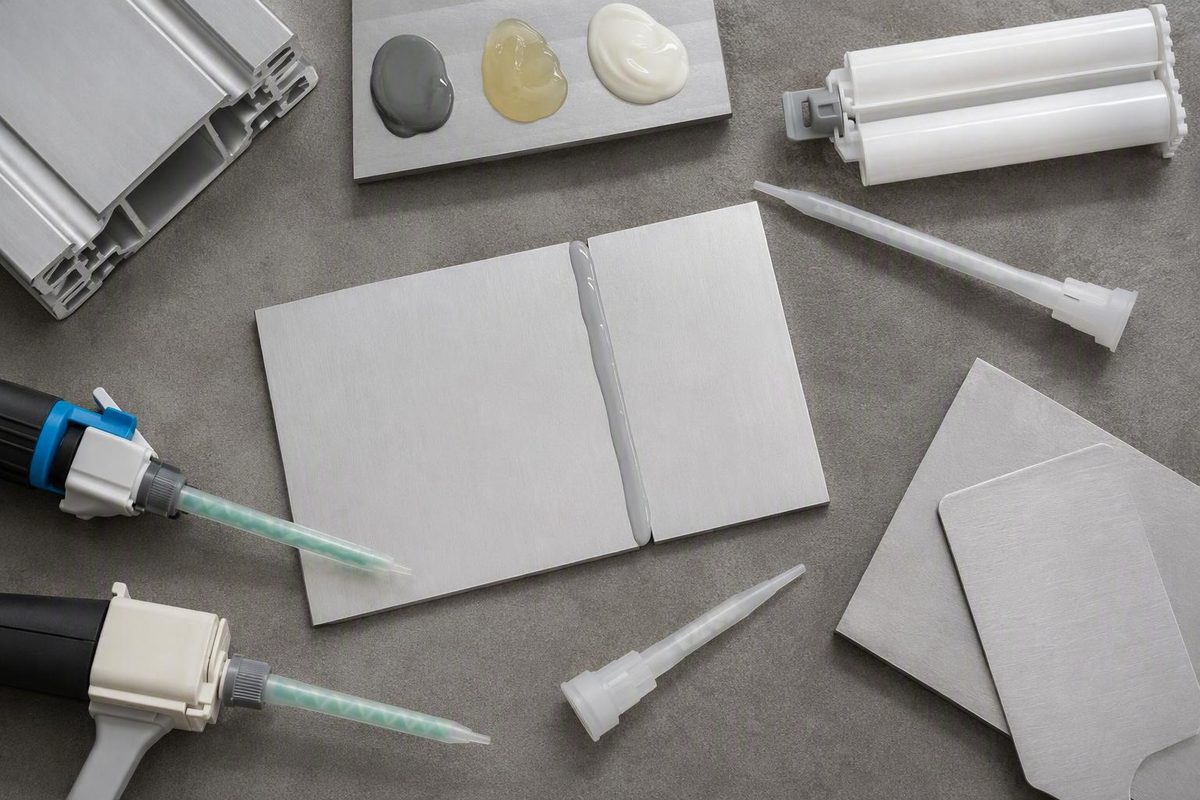
Choosing an adhesive for aluminum to aluminum is not a matter of finding one universally “best” glue. The reliable choice depends on structural demand, load direction, available bond area, joint geometry, aluminum finish, service exposure, allowable movement, and assembly constraints.
For a rigid, high-strength joint that must tolerate water or chemicals, a toughened two-part structural epoxy is a sensible first candidate. When rapid assembly, impact, vibration, cyclic loading, or thermal movement is more important, an aluminum-qualified methyl methacrylate adhesive (MMA) or toughened structural acrylic may be more suitable.
Chemistry is only one part of the joint. Surface preparation, overlap geometry, bond-line thickness, mixing, fixturing, full cure, and representative testing can determine whether an apparently suitable adhesive succeeds or fails.
Quick answer: match the adhesive to the aluminum joint
Start with the joint requirements, not a product ranking. A structural bracket, weatherproof enclosure seam, cosmetic trim piece, and retained cylindrical assembly need different adhesive properties.
| Adhesive family | Consider it when | Main limitation |
|---|---|---|
| Toughened two-part structural epoxy | The joint is rigid, highly loaded, and needs good chemical resistance | Usually requires accurate mixing, controlled preparation, and longer curing |
| MMA or toughened structural acrylic | Fast assembly, impact, vibration, cyclic loading, or thermal movement matters | Odor, exotherm, work time, and preparation requirements vary by product |
| Polyurethane or MS polymer | A large-area joint needs flexibility, weather resistance, sealing, or movement accommodation | Structural capacity cannot be assumed without product-specific validation |
| Cyanoacrylate | Parts are small, close-fitting, lightly loaded, and require rapid fixture | Usually unsuitable for large gaps, peel-heavy joints, or repeated impact |
| Anaerobic adhesive | Close-fitting metal components must be retained or sealed without air in the joint | Passive aluminum may require a compatible activator and can cure slowly |
| UV-curing adhesive | Curing light can reach the complete bond area | Two opaque aluminum parts normally block the light |
| Heat-cured one-part epoxy | Production equipment can heat the assembly and high structural strength is required | Generally impractical for field repairs and many DIY projects |
For many rigid fabrication jobs, evaluate a toughened two-part structural epoxy first. “Toughened” matters: a brittle general-purpose repair epoxy may not tolerate impact, edge peel, or movement as well as a formulation designed for structural metal bonding.
When production speed and dynamic loading matter, consider a qualified MMA or toughened structural acrylic. ITW Performance Polymers’ manufacturer-authored comparison generally positions epoxy for high ultimate strength and chemical resistance, and MMA acrylic for faster cure, impact absorption, vibration, and cyclic loads. These are family-level tendencies, not guarantees for every formulation.
Polyurethane and MS-polymer adhesives are better framed as flexible bonding and sealing options. They can be useful over large areas or where weather and movement matter, but flexibility alone does not establish suitability for a structural aluminum joint.
Cyanoacrylate is primarily an instant-fixture option for small, accurately mating parts. Anaerobic products have specialized roles in retained or sealed close-fitting metal assemblies; because aluminum can behave as a passive metal, a product-approved activator may be necessary. UV adhesives are usually unsuitable between two aluminum sheets unless the system has another cure mechanism or light can reach the adhesive through an edge or transparent mating substrate, as explained in Permabond’s overview of aluminum adhesive cure mechanisms.
If the component is overhead, externally mounted on a vehicle, part of a transportation structure, regulated, or capable of injuring someone if it detaches, do not select it from a consumer-style “strongest glue” list. Use qualified engineering review, representative testing, and mechanical reinforcement where appropriate.
Define the load, exposure, and production requirements first
Before buying adhesive, write down what the joint must do. This prevents a common mistake: choosing by a headline lap-shear value while overlooking peel, cure access, weather, or the actual aluminum finish.
Joint function and load
Identify:
- Whether the bond is structural, cosmetic, positioning, sealing, or a combination
- Expected shear, tension, peel, cleavage, impact, and vibration
- Repeated or cyclic loading
- Sustained load and leverage from an offset component
- Available overlap area
- Minimum and maximum gap
- Intended bond-line thickness
- Acceptable deflection or movement
- Consequences if the bond fails
A high lap-shear result does not rescue a tiny bonded patch being pried from one edge. Likewise, a more flexible adhesive may outperform a stiffer, nominally stronger one when vibration or impact concentrates stress at the joint edge.
Aluminum condition
Determine whether each surface is:
- Bare mill-finish aluminum
- Anodized
- Painted
- Powder-coated
- Brushed or polished
- Oily or treated with forming lubricant
- Chemically etched or conversion-coated
- Weathered, corroded, or previously bonded
When bonding to paint, powder coating, or anodizing, the adhesive is not necessarily bonded directly to the base metal. The coating and its attachment to the aluminum become part of the load path. An adhesive can remain firmly attached to paint while the paint separates from the metal.
Also establish whether altering the finish is permitted. Abrading a cosmetic anodized panel may be unacceptable, while leaving a weak or contaminated layer in a structural bond area may also be unacceptable.
Service exposure
List the expected:
- Normal, minimum, and maximum operating temperatures
- Thermal cycles and uneven heating
- Water, condensation, humidity, or immersion
- Outdoor UV exposure
- Salt or coastal exposure
- Fuels, lubricants, cleaners, solvents, and process chemicals
- Duration and frequency of each exposure
Even two aluminum parts can move differently if they have different thicknesses, temperatures, constraints, or finishes. A dark outer sheet in sunlight, for example, may heat faster than an internal reinforcement. Toughened or more flexible formulations can reduce stress from that movement even if a rigid adhesive posts a higher value in an isolated test.
Assembly constraints
Define what the process permits:
- Required work life and open time
- Maximum fixture time
- Time available before handling
- Time available before full service
- Whether parts can be clamped or weighted
- Whether the assembly can be heated
- Whether primer is practical
- Cartridge size and likely waste
- Required dispensing gun and static mixer
- Required mixing ratio
- Access for applying and inspecting the adhesive
- Manual versus production-volume mixing
- Paintability and appearance
- Repairability and eventual disassembly
Do not confuse rapid fixture with readiness for service. An assembly may be stable enough to move while still far below its final properties.
A short decision path is:
- Rigid, high-strength, chemically exposed joint: start with a toughened structural epoxy.
- Fast production or dynamic loading: evaluate an aluminum-qualified MMA or toughened acrylic.
- Flexible weatherproof bond or seal: evaluate polyurethane or MS polymer, subject to structural validation where required.
- Small, close-fitting, lightly loaded repair: consider an aluminum-compatible cyanoacrylate.
Compare the main adhesive families for aluminum
Adhesive families provide a useful first filter, but formulation matters more than the family name alone. Two products described as “epoxy” can differ substantially in viscosity, toughness, cure speed, gap capability, and environmental resistance.
| Family | Likely strength category | Flexibility | Typical cure profile | Preparation sensitivity | Gap suitability | Preferred scale | Principal limitation |
|---|---|---|---|---|---|---|---|
| Toughened two-part epoxy | High structural | Low to moderate | Mixed, then room-temperature or accelerated cure | Usually moderate to high | Often good within specified limits | Small repairs to structural overlaps | Mixing accuracy and cure time |
| One-part structural epoxy | High structural | Product-dependent | Heat cure | Process-dependent | Product-dependent | Controlled production | Requires heating |
| MMA/toughened structural acrylic | High structural | Moderate | Often fast after mixing | Often more tolerant, but not preparation-free | Usually useful for controlled gaps | Production and panel assemblies | Exotherm and short work window |
| Polyurethane | Moderate to structural, product-specific | Moderate to high | Often moisture or two-part cure | Product-specific | Often good | Large areas and moving joints | Structural performance cannot be assumed |
| MS polymer | Usually flexible bonding/sealing | High | Commonly moisture cure from the outside inward | Product-specific | Often good | Large seams and panels | Lower stiffness and potentially slow through-cure |
| Cyanoacrylate | High on small, fitted parts; limited structural scope | Low | Very rapid, moisture-triggered | Clean fit is important | Poor unless specially formulated | Small parts | Limited gap, peel, and impact tolerance |
| Anaerobic | Specialized retaining/sealing | Low to moderate | Cures without oxygen between suitable metal surfaces | Aluminum may require activator | Close fits only | Cylindrical or flanged assemblies | Not a general panel adhesive |
| UV curing | Product-specific | Product-specific | Rapid where correctly illuminated | Cleanliness and light access matter | Product-specific | Accessible, often transparent assemblies | Opaque aluminum blocks curing light |
Two-part structural epoxy
Two-part epoxy cures after resin and hardener are mixed. Structural grades are commonly considered when a rigid aluminum joint needs high strength and resistance to water or chemicals. Toughened grades incorporate modifications intended to improve tolerance of impact, movement, or peel compared with a conventional rigid epoxy.
That distinction is important. A generic five-minute epoxy may be convenient, but convenience does not establish fatigue life, environmental durability, or suitability for a consequential structural assembly.
One-part structural epoxy
A one-part epoxy avoids field proportioning because the reactive components are supplied together, but it generally requires heat to cure. That can work well in controlled manufacturing and poorly in a repair where the assembled part cannot safely or evenly be heated.
MMA and toughened structural acrylic
MMA and related structural acrylic products are generally two-part systems. They are commonly promoted for rapid cure, energy absorption, impact resistance, vibration tolerance, and cyclic loading, sometimes with greater tolerance of imperfect preparation than epoxy. ITW’s manufacturer-authored comparison of epoxy and methacrylate for aluminum describes these broad trade-offs but does not establish that every acrylic outperforms every epoxy under dynamic load.
Preparation tolerance should not be confused with durable bonding through arbitrary contamination. A product may produce acceptable initial adhesion on an as-received surface yet still require abrasion, cleaning, or primer to meet long-term environmental requirements.
MMA cure can generate enough heat to damage substrates when the adhesive is used in a large mass. Follow the selected product’s limits and instructions rather than extrapolating behavior from a thin bond line (Forgeway’s aluminum adhesive guide).
Polyurethane and MS polymer
These families are useful when a joint needs flexibility, sealing, and movement accommodation. They often suit broad panel areas better than tiny, highly leveraged patches. Moisture-curing products also need a realistic path and sufficient time for cure throughout the joint.
Do not infer structural suitability from words such as “heavy duty,” “construction,” or “exterior.” Required strength, stiffness, cure depth, and durability must be verified for the particular product and aluminum condition.
Cyanoacrylate
Cyanoacrylate spreads into a thin bond line and fixtures rapidly when surfaces fit closely. It can be effective for small locating features, trim, and lightly loaded repairs. It is generally a poor default for large gaps, flexible sheet-metal joints, impact-heavy service, or assemblies with pronounced peel loads.
Anaerobic and UV-curing adhesives
Anaerobic products cure in close-fitting metal interfaces where oxygen is excluded. They are most relevant to retaining, threadlocking, flange sealing, and similar assemblies—not broad open panel bonds. Passive aluminum may slow cure unless the chosen formulation and activator are designed for it.
UV adhesive needs the specified wavelength and intensity to reach the entire joint. Two opaque aluminum parts normally make that impossible. A dual-cure product may provide another mechanism, but it must be selected and applied according to its technical documentation.
Do not rank these families by collecting their largest advertised strength numbers. Results from different alloys, pretreatments, overlap dimensions, test standards, cure schedules, temperatures, and aging conditions are not directly comparable.
Prepare aluminum without leaving contamination or weak oxide behind
Aluminum exposed to air develops an oxide layer. The native oxide is not automatically loose or weak, but contaminated, hydrated, weathered, corroded, damaged, or otherwise uncontrolled surface layers can create weak boundaries beneath an adhesive. Oil, polishing compound, fingerprints, corrosion products, and shop dust add further failure paths.
A solvent cleaner can remove oil and contamination, but it does not by itself manage or remove aluminum oxide. Permabond’s manufacturer guidance specifically distinguishes solvent cleaning from oxide removal and recommends preparation matched to the required durability (Permabond’s guide to bonding aluminum).
Unless the selected adhesive specifies another process, a recurring general workflow is:
- Identify the alloy and finish. Determine whether the bond is to bare metal, anodizing, paint, powder coating, or another treatment.
- Clean and degrease first. This reduces the chance of driving oil and dirt into the surface during abrasion.
- Abrade or grit-blast if permitted and required. Use the method and abrasive condition specified for the product and finish.
- Remove all debris. Loose abrasive and aluminum dust should not remain in the joint.
- Perform the specified final cleaning. Use only a cleaner approved for the adhesive and surface.
- Allow the surfaces to dry completely.
- Bond promptly. Minimize recontamination and uncontrolled surface change.
- Control assembly and cure.
The second cleaning has a different purpose from the first: it removes debris produced by abrasion. Use clean, low-lint materials and avoid touching the prepared bond area.
This is not a universal command to sand every aluminum surface. Abrasion can destroy anodizing, remove corrosion-protective treatments, expose a visible cosmetic area, or weaken adhesion if it merely scuffs an unstable coating. Painted and powder-coated parts require evidence that the coating itself is adequately attached and compatible with the adhesive. Weathered metal may need a more rigorous, qualified restoration process.
A primer can improve adhesion or limit re-oxidation for some systems, but primers are not interchangeable. Use only a primer approved for the particular adhesive, alloy, finish, preparation method, and cure process.
Do not treat acid etching or chemical conversion as a casual DIY upgrade. Permabond notes health, safety, and regulatory concerns associated with acid etching; any specialized chemical treatment should be performed only under an approved, controlled process (Permabond’s manufacturer guide).
Preparation affects durability, not merely initial strength. A peer-reviewed 2024 study tested a particular epoxy-bonded, treated AlMg3 single-lap joint. The best reported treatment produced an initial result of 22.5 ± 0.5 MPa, falling to 18.1 ± 0.2 MPa after four weeks at 70°C and 100% relative humidity. Those results apply only to the tested alloy, adhesive system, treatment, geometry, and aging conditions. The paper describes the reduction as 10%, but the reported values imply a decrease of roughly 20%, an apparent internal inconsistency (2024 AlMg3 surface-treatment and aging study).
The lesson is not that the study’s treatment or strength will transfer to another project. It is that surface process and environmental aging can materially change measured performance, so initial adhesion on a clean workshop bench is not enough.
Design the joint to favor shear and control the bond line
Joint geometry can matter as much as chemistry. Adhesives are generally used most effectively across broad overlapping surfaces with the load distributed through the bond. They are less forgiving when a force lifts one edge, cleaves the joint open, or acts through a long lever arm.
A useful design hierarchy is:
- Prefer an overlap to a butt joint where possible.
- Increase effective bonded area without creating an impractical cure path.
- Arrange the load so the adhesive works mainly in shear.
- Reduce eccentric loading and edge peel.
- Use fillets only where the product and design call for them.
- Stiffen flexible parts when bending would pry up a bond edge.
Smearing extra adhesive around the outside does not necessarily repair poor geometry. The added material may not transfer load effectively, and a large exposed mass may cure differently from the controlled bond line.
Follow product instructions for bond-line thickness and permitted gap. Excessive clamping can squeeze out too much adhesive, leaving a starved joint. Too little pressure can leave a thick, uneven line, trapped voids, or poor wetting. Some systems use calibrated spacers, glass beads, shims, or designed stops to maintain thickness; use them only as specified.
Thermal movement is not limited to dissimilar materials. Two aluminum components can reach different temperatures or resist expansion differently because of thickness, shape, fastening, or surface color. A toughened or otherwise movement-tolerant formulation may be preferable to a highly rigid system in that situation.
Redesign or mechanical reinforcement should be considered when:
- Peel or cleavage cannot be reduced
- The load is highly leveraged
- Fatigue or impact dominates
- The joint requires inspection under a code or standard
- Environmental durability is uncertain
- Failure would create a serious hazard
- The adhesive lacks relevant qualification data
If adhesive is combined with rivets, screws, or bolts, do not simply add the advertised capacities of both methods. Examine how load is shared as the adhesive cures and deforms, whether drilling damages protective finishes, whether trapped moisture can collect, and whether the assembly creates a corrosion risk.
Online discussions about campers, vehicle panels, and similar projects can highlight practical concerns such as torsional movement, vibration, and leverage. They are anecdotes, however, not qualification data. A forum discussion about an externally mounted automotive part illustrates how the final application can be much more demanding than the phrase “bond aluminum sheet” initially suggests.
Mix, apply, fixture, and cure the adhesive correctly
A suitable adhesive can still fail through incorrect proportioning, incomplete mixing, delayed assembly, excessive clamping, or premature loading.
First, distinguish the timing terms:
- Work life: the useful time after mixing, often measured for a stated quantity and temperature.
- Open time: the period after application during which parts can be assembled with acceptable wetting.
- Fixture time: the point at which the assembly can usually remain aligned without the original support.
- Handling strength: sufficient strength for specified handling or a later process step.
- Full cure: the stated point at which the product develops its intended cured properties under specified conditions.
These terms are not interchangeable. Reaching fixture or handling strength does not authorize the design load.
For a two-part adhesive, use the specified ratio and compatible dispensing method. A matched cartridge and static mixer can improve proportioning, but only if the cartridge is correctly seated, both components flow, and the mixer is approved. For manual mixing, measure as directed and blend thoroughly without guessing the ratio. Discard suspect or visibly streaked material in accordance with the product documentation.
A controlled assembly sequence is:
- Dry-fit the parts.
- Confirm overlap, spacers, alignment, clamps, and access.
- Prepare both surfaces.
- Bring the adhesive and parts within the permitted application conditions.
- Dispense and mix correctly.
- Apply enough adhesive to wet the intended bond area.
- Assemble within the stated open or work time.
- Fixture evenly without squeezing the joint dry.
- Leave the assembly undisturbed for the specified cure.
- Delay proof testing, finishing, or service loading until permitted.
Cure can be influenced by temperature, humidity, adhesive mass, bond-line thickness, and substrate conditions. The direction and magnitude of the effect depend on chemistry. A moisture-curing adhesive and a two-part epoxy do not respond identically, so generic “leave it overnight” advice is unreliable.
Published products illustrate the range rather than creating a rule. A commercial seller describes Infinity Bond EP 420 with a 120-minute fixture time and says it requires a compatible cartridge gun (Gluegun.com aluminum bonding guide). Vibra-Tite lists a 30-minute work life and 60-minute fixture time for its 923 epoxy (Vibra-Tite 923 product specifications). Neither figure alone states when a particular assembled joint can safely receive its full service load.
Before use, verify the current technical data sheet for:
- Full-cure schedule
- Application and service-temperature ranges
- Storage and shelf life
- Cartridge, gun, and mixer
- Surface preparation and primer
- Gap and bond-line limits
- Fixturing requirements
- Loading restrictions
- Post-cure, if any
If a cured joint is weak, check:
- Oil, fingerprints, residue, or moisture
- Inadequate oxide management where required
- Recontamination after preparation
- Wrong mix ratio
- Incomplete mixing or unmixed cartridge discharge
- Expired or improperly stored material
- Assembly after the open-time limit
- Movement during cure
- Loading at fixture time instead of full cure
- Gap outside the specified range
- Starvation from excessive clamp pressure
- Peel-heavy geometry
- Failure within paint, powder coating, or another finish
How to evaluate named products and performance numbers
Named products should be treated as candidates for verification, not winners. Examples encountered in the market include Vibra-Tite 923, Infinity Bond EP 420, Infinity Bond MMA 420, Loctite AA H8100, Plexus MMA products, and Permabond aluminum-bonding systems. Their descriptions come from manufacturers or sellers rather than one independent head-to-head test.
Use a product name to locate the current technical and safety documents, then determine whether its data fit the actual joint.
Vibra-Tite 923 provides a useful example of bounded interpretation. The manufacturer lists a 2:1 mix ratio, 30-minute work life, 60-minute fixture time, 300°F maximum temperature, and 3,000 psi shear strength on etched aluminum (Vibra-Tite 923 product specifications). The 3,000 psi figure should not be generalized to untreated, anodized, painted, oily, oxidized, or weathered aluminum. The page also omits several details needed for a rigorous comparison, including the test standard, bond-line thickness, complete cure schedule, and environmental conditioning.
Similarly, Plexus is an MMA product family, not one universal specification. ITW’s manufacturer marketing describes the family as impact-modified and suitable for metal bonding, but a particular grade still needs to be selected and validated for the aluminum surfaces and service environment (ITW’s Plexus aluminum-bonding overview).
A nominal psi or MPa value is comparable only when enough context aligns:
- Aluminum alloy and temper
- Bare, etched, anodized, or coated condition
- Cleaning and abrasion process
- Primer
- Joint geometry and overlap
- Bond-line thickness
- Adhesive cure and post-cure
- Test method and pull rate
- Test temperature
- Environmental conditioning
- Sample count and variability
A useful technical-data-sheet checklist is:
- Explicit aluminum-to-aluminum compatibility
- Permitted aluminum finishes and preparation
- Relevant lap-shear data
- Peel, impact, fatigue, or creep data where those loads matter
- Tested alloy and surface condition
- Work life, open time, and fixture time
- Full-cure schedule
- Minimum and maximum gap
- Recommended bond-line thickness
- Application and service temperatures
- Water and chemical resistance
- Heat/humidity or other aging data
- Cartridge, static mixer, and dispensing-gun requirements
- Primer and cleaner compatibility
- Storage conditions and shelf life
Retail categories and customer ratings do not fill these gaps. A retailer may group polyurethane, latex, and polymer construction adhesives under an aluminum filter, but category placement does not demonstrate direct aluminum-to-aluminum structural performance. The individual product data—not the filter or star rating—must govern selection.
Avoid superlatives such as “strongest,” “ideal,” or “unmatched” unless comparable testing supports them under relevant conditions. Commercial claims can identify candidates, but they cannot replace an application-specific comparison.
Test the real assembly and know when adhesive alone is not enough
For any important joint, make test coupons from the real materials rather than relying only on a generic product value. Match:
- Alloy and temper
- Sheet or extrusion thickness
- Anodizing, paint, powder coating, or other finish
- Cleaning and abrasion tools
- Primer, if used
- Adhesive batch and dispensing equipment
- Bond-line thickness and overlap
- Clamp pressure
- Cure temperature, humidity, and time
- Production access and operator method
Begin with an initial test, then condition additional samples for relevant exposures. Depending on service, that may include heat, cold, thermal cycling, humidity, immersion, UV, salt, fuel, cleaner, or solvent. Retest after conditioning.
Look beyond the peak force. Failure mode can reveal what to correct:
- Failure through contamination: improve cleaning and handling.
- Failure within paint or powder coating: qualify or remove the coating in the bond area.
- Failure beneath an unstable or contaminated surface layer: revise preparation and time-to-bond.
- Clean separation at the adhesive interface: investigate compatibility, wetting, cure, or primer.
- Cohesive failure inside the adhesive: adhesion may be satisfactory, but geometry, bond line, or adhesive properties may still need improvement.
- Aluminum deformation or tearing: the substrate or specimen geometry may be governing the test.
A room-temperature pull test demonstrates only that the tested specimen survived that loading event. It does not establish fatigue life, sustained-load creep, edge-peel resistance, crash loading, or years of outdoor durability.
Obtain the current technical data sheet and safety data sheet before use. Follow those documents and applicable workplace requirements for storage, handling, protection, ventilation, cleanup, and disposal. General online guidance is not a substitute for the selected product’s safety instructions.
Pay particular attention to MMA exotherm: large mixed masses can generate more heat than a thin bond line. Stay within the product’s approved application conditions and obtain manufacturer guidance for dispensing, purge material, cleanup, and disposal (Forgeway’s aluminum adhesive guide).
Qualified engineering review, validated testing, and mechanical retention are appropriate for transportation structures, automotive exterior parts, overhead assemblies, regulated products, heavily loaded joints, and any application where detachment could injure someone. Adhesive may still be part of the design, but it should not be assumed sufficient by itself.
Before committing, confirm:
- Function: structural, cosmetic, sealing, or combined
- Load: shear, peel, impact, vibration, fatigue, and sustained leverage
- Surface: alloy, finish, contamination, and permitted preparation
- Exposure: temperature, water, UV, salt, and chemicals
- Geometry: overlap, edge peel, gap, and bond-line thickness
- Process: work life, fixture time, full cure, clamping, and heating
- Equipment: cartridge, mixer, gun, abrasives, and primer
- Evidence: relevant technical data and representative coupon results
- Safety: current technical and safety documentation
- Failure consequence: need for reinforcement, inspection, or engineering review
Frequently asked questions
What is the strongest adhesive for aluminum to aluminum?
There is no universally strongest adhesive for every aluminum joint. A toughened two-part structural epoxy is a reasonable starting point for a rigid, high-strength joint, especially where chemical resistance matters. An aluminum-qualified MMA or toughened structural acrylic may be better when impact, vibration, cyclic loading, thermal movement, or production speed governs.
A valid comparison requires the same alloy, preparation, geometry, bond-line thickness, cure, test method, temperature, and environmental conditioning. Without that context, the largest advertised psi value is not a reliable answer.
Do I need to sand aluminum before applying adhesive?
Often, but not always. Cleaning should normally happen before abrasion so oil is not ground into the surface. Where the product permits and requires it, light abrasion or controlled blasting can produce a more consistent bonding surface; debris is then removed, the surface is cleaned again, dried, and bonded promptly.
Do not automatically sand anodized, painted, powder-coated, polished, or chemically treated aluminum. Abrasion may damage a functional or cosmetic finish. Follow the adhesive manufacturer’s process for the exact aluminum condition, and use only a validated primer where specified.
Is epoxy or MMA acrylic better for a vibrating aluminum joint?
A qualified MMA or toughened structural acrylic is often the first candidate when vibration, impact, rapid cure, and cyclic loading dominate. A toughened structural epoxy may also perform well and may be preferred when rigidity, ultimate strength, or chemical resistance matters more.
The correct answer depends on peel stress, overlap, temperature cycling, surface preparation, cure process, and product-level fatigue or aging data. Test both candidates on representative assemblies if the joint is consequential.
Can construction adhesive or polyurethane glue bond aluminum to aluminum?
Some polyurethane, polymer, and construction adhesives can bond aluminum, particularly in large-area, flexible, weatherproof, or sealing applications. That does not make every construction adhesive a structural aluminum adhesive.
Check for explicit compatibility with both aluminum surfaces, preparation requirements, cure depth, gap range, service exposure, and relevant strength data. Do not rely on a retailer category, “heavy duty” label, or customer rating for a safety-critical joint.
How long should an aluminum adhesive cure before the joint is loaded?
Wait until the current technical data sheet permits the intended load under the actual curing conditions. Fixture time means the joint can generally remain positioned; handling strength permits only defined handling. Neither necessarily means full design load.
Temperature, humidity, bond-line thickness, adhesive mass, and substrate conditions can change cure behavior. Use only application and cure conditions covered by the product documentation. If conditions fall outside the approved range, obtain manufacturer guidance rather than assuming that additional cure time will compensate.
Final selection
Start with a toughened structural epoxy for a rigid, high-strength aluminum joint. Evaluate an aluminum-qualified MMA or toughened acrylic when speed and dynamic loads matter. Reserve flexible polyurethane or MS-polymer systems for movement-tolerant bonding or sealing applications whose required strength has been validated.
In every case, preparation, overlap geometry, bond-line control, full cure, and testing on the actual aluminum surfaces determine whether the selected adhesive will perform reliably.