
5 min read ·
Best Glue for Glass to Plastic: Choose by Plastic and Joint
Choose glass-to-plastic glue by plastic type, gap and movement. Compare clear epoxy, silicone and UV adhesives, with preparation and cure guidance.
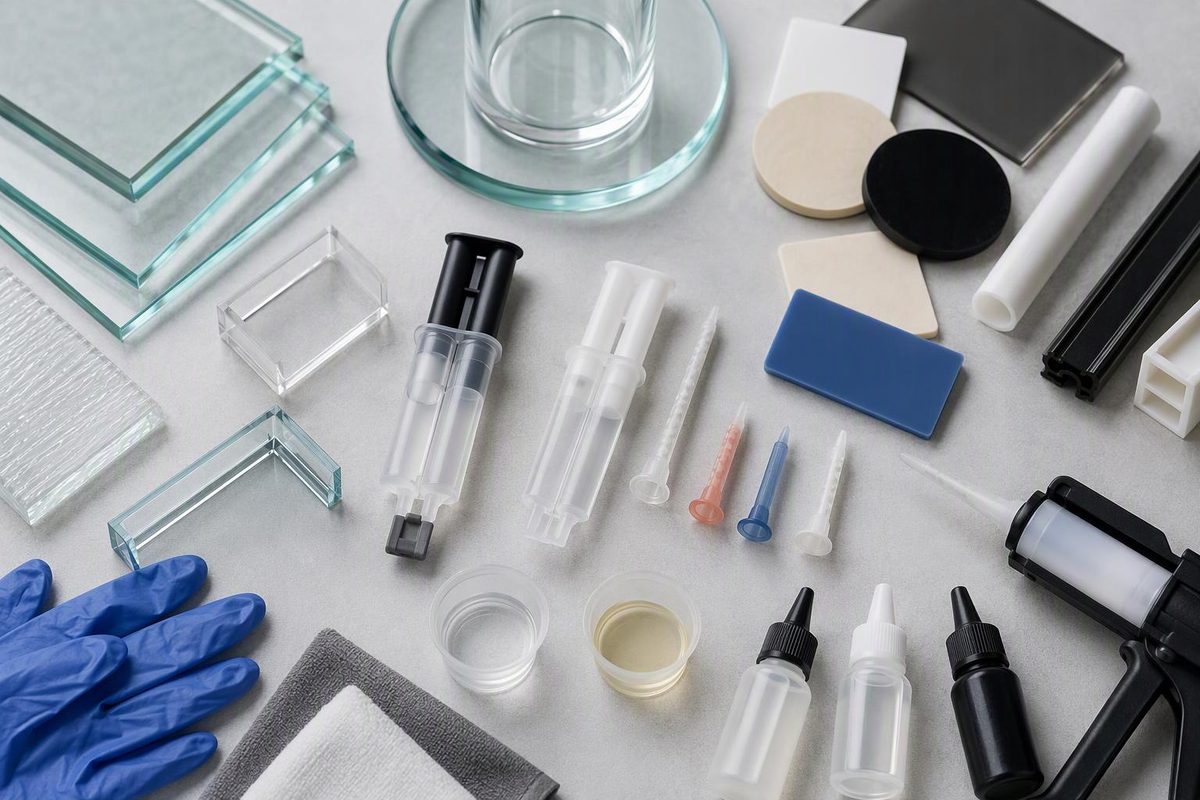
For a small, rigid indoor repair, a clear two-part epoxy rated for glass and your specific plastic is a practical starting point. Choose a compatible silicone adhesive when the attachment needs flexibility, or a specialist UV-curing adhesive for a highly transparent joint with suitable curing-light access. Polyethylene (PE) and polypropylene (PP) need a different approach—not simply a stronger general-purpose glue.
The plastic matters as much as the glass. An adhesive advertised as “plastic glue” may still exclude glass, while a glass adhesive may not suit your plastic.
Identify the plastic and the job first
Look for a molded material marking, product specification or confirmation from the part manufacturer: acrylic/PMMA, polycarbonate/PC, ABS, PVC, PE or PP. If the plastic is unknown, identify it before choosing an adhesive for a consequential repair. A trial bond on a spare piece can screen for damage and poor adhesion, but does not establish long-term compatibility.
Then check:
- Fit: Do the surfaces meet closely, or must the adhesive bridge a gap?
- Load: Is this a decoration, or will it hold weight or be pulled away from the glass?
- Movement and temperature: Will the plastic bend? What temperatures and temperature changes will the joint experience?
- Exposure: Is the bond indoors and dry, outdoors, splashed or continuously submerged?
- Appearance: Is a visible glue line acceptable, and does it need to resist yellowing?
For heavy, overhead or safety-critical glass, use an engineered attachment with appropriate mechanical support rather than selecting a glue from a household repair guide.
Match the adhesive to the joint
| Joint or requirement | Adhesive to investigate | Main limitation |
|---|---|---|
| Rigid indoor repair on a compatible plastic; some gap filling needed | Clear two-part epoxy | A rigid bond is not the default for a flexing part; “most plastics” does not mean every plastic |
| Light-duty attachment needing flexibility | Silicone adhesive/sealant rated for both substrates | Check plastic adhesion and allow moisture access during cure |
| Visible glass-to-acrylic, polycarbonate or PETG joint | Plastic-compatible UV-curing adhesive | The specified curing light must reach the entire bond |
| Glass to PE or PP | Specialist system confirmed for both materials | Do not assume general-purpose epoxy or silicone will work |
Compare the substrate and curing limits in Loctite’s epoxy technical sheet, Dow’s silicone technical sheet and Permabond’s UV639 data. Confirm the current label and technical data for the exact product you buy, including its service-temperature and exposure limits.
Prepare the surfaces before applying glue
- Dry-fit and arrange support. Set up tape, a jig or gentle clamping so the parts cannot shift during cure. Do not force a distorted plastic part against the glass.
- Clean and dry both surfaces. Loctite’s epoxy sheet specifies washing glass with soap and water, rinsing and drying. Remove grease, release agents and cleaner residue from the plastic using a method compatible with that plastic. Epoxy preparation directions.
- Do not default to acetone. Acrylic, polycarbonate, ABS and polystyrene can stress-crack, and aggressive solvents can increase that risk. Even isopropyl alcohol should be compatibility-tested on thermoplastics. See Permabond’s stress-cracking guidance and UV639 preparation instructions.
- Abrade only where appropriate. Follow the chosen adhesive’s instructions; do not indiscriminately sand visible glass or clear plastic. Abrasion leaves permanent marks.
- Apply and immobilize. Use the specified mix ratio, bond thickness and assembly time. Wear the protection required by the label and safety data sheet, and work with ventilation. For UV curing, follow the lamp’s safety instructions as well.
Three useful product options
Clear epoxy: practical for a compatible rigid repair
Loctite Epoxy Clear Multi-Purpose lists glass and most plastics on its current product page. Its April 2016 technical sheet specifies many rigid plastics and excludes PE, PP, nylon and flexible materials; it also excludes prolonged water immersion. Treat it as a candidate for a rigid household attachment, not a universal glass-to-plastic solution. That older sheet lists the cured color as clear colorless to clear amber: “clear” does not guarantee an invisible, colorless seam. Product listing and technical limits.
The current product page specifies equal volumes of resin and hardener, a 5-minute set and a 24-hour full cure. Mix thoroughly and assemble promptly; the set time is not permission to load the repair. Product instructions.
For a plastic-specific check, see whether epoxy sticks to your plastic.
Silicone: useful when flexibility matters
DOWSIL 732 cures to flexible rubber. Its technical sheet says unprimed adhesion may be obtained on glass and most common engineering plastics, but good adhesion is normally not obtained on PE, PP or PTFE. Test the actual plastic rather than assuming compatibility.
It cures inward from exposed surfaces: approximately 3 mm in 24 hours at room temperature and 50% relative humidity. A broad, enclosed sandwich can take longer; a dry surface does not prove the center has cured. It is an acetoxy silicone that releases acetic acid during cure, which can corrode some nearby metal components. Dow technical data.
UV adhesive: a specialist choice for clear joints
Permabond UV639 explicitly lists acrylic, polycarbonate, PETG and glass, and cures to a colorless bond. Its specified curing range is 365–420 nm, but lamp compatibility and exposure must be verified. Cure depends on lamp output, distance and the substrates’ light transmission—not simply whether the parts look transparent. Hold the parts stationary and expose the whole bond for the time needed for full cure. UV639 technical data.
Why ordinary super glue is not the default
A quick grab on glass can be misleading. Permabond explains that rapid cyanoacrylate cure on glass, brittleness and thermal-expansion differences can undermine long-term durability. Its guidance does not recommend cyanoacrylate as a general glass glue. Glass-bonding guidance.
Also, Loctite Super Glue Plastics Bonder is not a shortcut for glass-to-PE or glass-to-PP: its April 2026 technical sheet expressly excludes glass, despite supporting those difficult plastics. Choose a system whose documentation covers both sides of the joint. Plastics Bonder limitations.