
4 min read ·
Glue for Polycarbonate Plastic: Choose by Joint and Exposure
Choose polycarbonate glue by joint fit, movement and exposure. Compare epoxy, super glue, UV adhesives and sealants while avoiding stress cracking.
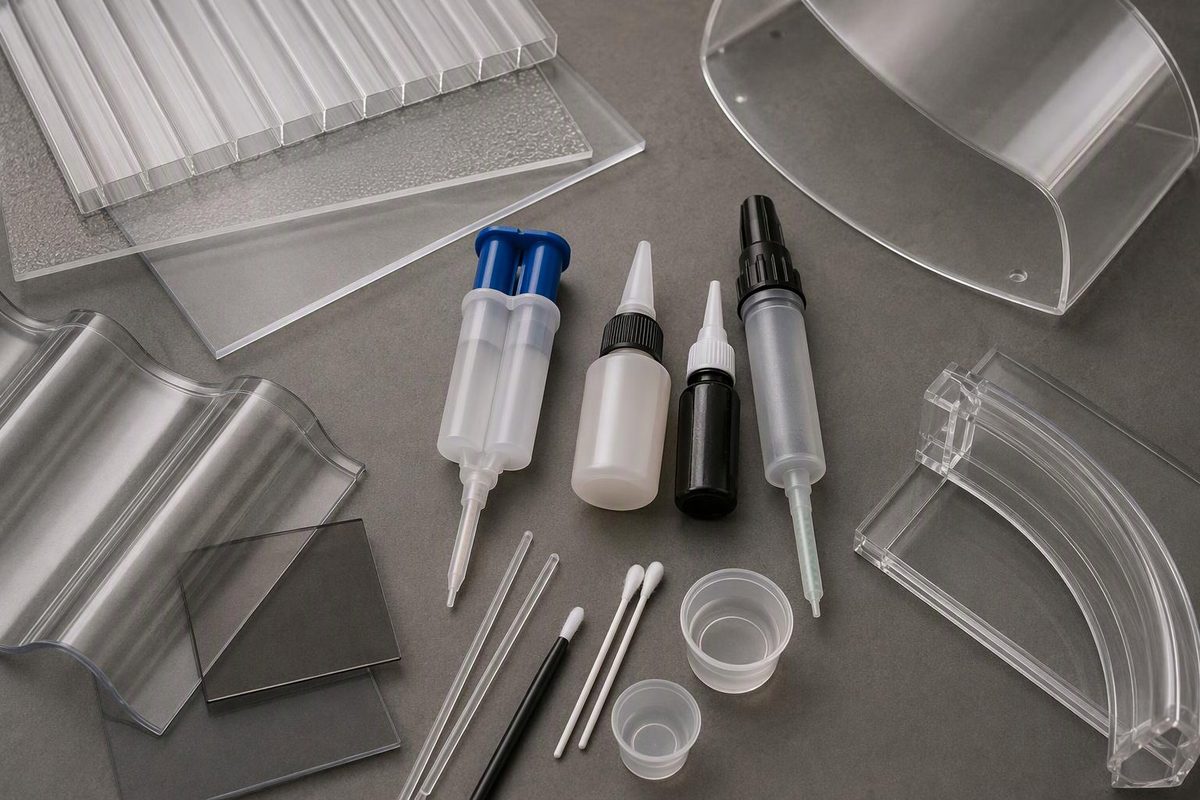
For a rigid polycarbonate repair, a two-part epoxy explicitly approved for polycarbonate and the second material is one option—not a universal best glue. For a small, close-fitting indoor joint, a compatible cyanoacrylate (super glue) can be faster. For a transparent assembly, consider a specialist UV/visible-light-curing adhesive; for a joint that must move or seal, consider a sheet-approved flexible adhesive or sealant.
The important limitation is stress cracking: an adhesive may stick while its uncured ingredients damage the plastic. Permabond identifies epoxy, cyanoacrylate, structural acrylic and light-curing adhesives as options, but warns that compatibility, correct mixing and complete cure matter for polycarbonate. Permabond bonding guidance
Match the adhesive to the joint
Confirm the material from its marking or supplier documentation rather than its transparency. If it is acrylic instead, use the acrylic adhesive selection guide. Identify any hard coating, too: bonding to a coated face is not the same as bonding to bare polycarbonate.
Measure the gap and decide whether the joint will carry load, flex, get wet or experience temperature changes before choosing a grade.
| Job | Adhesive category to investigate | Main selection check |
|---|---|---|
| Rigid repair or attachment to metal, wood or another plastic | Polycarbonate-compatible two-part epoxy | Approval for both surfaces, permitted gap and cured stiffness |
| Small, close-fitting indoor repair | Polycarbonate-compatible cyanoacrylate | Stress-cracking risk, excess adhesive and visible white residue |
| Clear, appearance-sensitive assembly | UV/visible-light-curing plastic adhesive | Whether the actual sheet transmits the light needed to cure the whole joint |
| Outdoor bonded assembly | Polycarbonate-compatible two-part structural acrylic or another exposure-rated system | Water, weathering and service-temperature limits for the specific grade |
| Flexible attachment or weather seal | Sheet-approved silicone, polyurethane or other flexible system | Exact-product compatibility, movement capacity and whether it provides the required bonding strength or only sealing |
These categories are supported by Permabond’s polycarbonate guidance and the bonding section of Plaskolite’s TUFFAK fabrication guide. They are not blanket approvals for every product in each family.
For polycarbonate-to-metal assemblies, account for different thermal expansion rates, especially on large parts outdoors. Plaskolite also advises overlapping sheets or adding a reinforcing strip rather than relying on a weak edge-to-edge butt joint. TUFFAK fabrication guide, bonding and mechanical-fastening sections
Prepare, apply and cure
- Dry-fit without forcing the parts. Remove protective masking from the bond area. Do not use clamps to bend mismatched pieces into contact. Press-fit assemblies need particular care: adhesive can lubricate insertion and allow over-engagement, adding stress to the polycarbonate. Permabond stress-cracking guidance
- Clean gently and dry fully. For dirty sheet, use mild diluted soap, a soft cloth and a thorough water rinse. Polycarbonate that is already clean, dry and uncontaminated can often be bonded as received. Do not automatically sand a clear or hard-coated face; abrasion can damage coatings. TUFFAK cleaning guidance Permabond preparation guidance
- Avoid acetone cleaning or cleanup. Permabond states that acetone can attack polycarbonate and identifies isopropanol as a solvent-wipe option. That general advice does not override the sheet maker’s cleaning restrictions. Follow the instructions for the actual grade and coating, and test any proposed cleaner first. Do not let solvent pool at exposed edges. Permabond Plaskolite
- Apply the specified amount and mix ratio. Use a small, controlled application of CA rather than flooding the repair. Mix two-part adhesives thoroughly; use the specified static mixer for cartridge systems. Incorrectly mixed or incompletely cured adhesive increases the risk of chemical attack. Permabond application guidance
- Separate fixture time from full cure. Support the joint for the specified fixture period and keep it unloaded until the required cure is complete. Follow the product’s working time and cure schedule at the stated temperature—not just “five-minute epoxy” or “instant glue” wording. Light-curing adhesive needs a matched lamp and adequate exposure throughout the joint; cure depends on lamp output, distance and the sheet’s transmission. Permabond UV640 technical datasheet
Follow the adhesive’s safety data sheet for ventilation, protective equipment and, where applicable, curing-lamp precautions. Make a trial joint using the same sheet grade, coating and preparation. Inspect after cure for haze, fine cracks and poor adhesion. A clean-looking short-term test does not establish long-term compatibility; Plaskolite recommends laboratory testing to assess long-term effects. TUFFAK fabrication guide
Product checks that change the choice
For a small cosmetic joint, Permabond 940 is one manufacturer-named low-odor, low-bloom CA option for polycarbonate. Low bloom addresses the white residue near a bond; it does not remove the need to check stress cracking. CA is also a poor default when the joint interface will remain in contact with water for long periods. Check the selected grade’s maximum gap and cure instructions before buying. Permabond product selection CA exposure limits
For flexible seals, use the sheet maker’s exact-product list rather than choosing by “silicone” or “polyurethane” alone. Plaskolite’s TUFFAK list includes both compatible and incompatible products within these categories and notes that formulations can change. Primer requirements also vary with the sheet and sealant; primers themselves may contain harmful solvents. Confirm current compatibility and follow the sealant manufacturer’s primer instructions. TUFFAK approved sealants and adhesives
Do not default to acrylic solvent cement. Solvent bonding requires compatibility with the actual plastic, and Plaskolite warns that solvent-bonded TUFFAK joints have reduced impact strength and increased brittleness. For protective glazing, machine guards or other safety-critical parts, use the specified repair or replacement method rather than an unvalidated glue repair. TUFFAK bonding guidance