
5 min read ·
Strong glue for metal to plastic starts with identifying the plastic
Choose metal-to-plastic glue by plastic type, joint gap and load. Compare epoxy, specialist acrylic and super glue, with preparation and cure guidance.
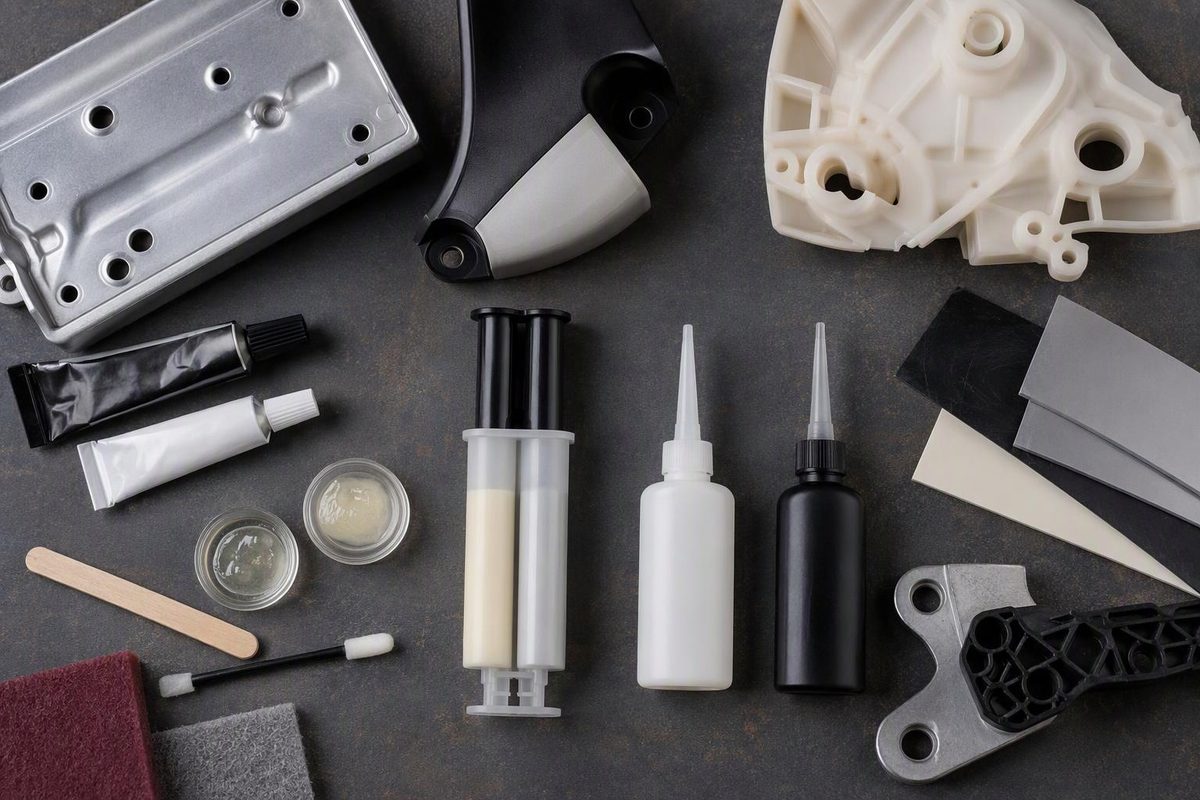
For rigid ABS, PVC or polycarbonate bonded to metal, start with a toughened two-part epoxy explicitly compatible with that plastic. For polyethylene (PE) or polypropylene (PP), choose a specialist plastic-bonding system—not ordinary epoxy by default. A small, close-fitting indoor repair may suit cyanoacrylate (super glue); a larger or impact-loaded joint needs a different assessment.
The plastic is often the deciding substrate. Permabond identifies PE, PP and PTFE as difficult to bond, while ABS, acrylic and polycarbonate bond more readily but can suffer chemical-induced stress cracking. Permabond’s compatibility guidance explains that distinction.
Match the adhesive to the joint
Look for a moulded material marking such as ABS, PVC, PC, PP or PE, or ask the part manufacturer. Also identify the metal and whether you are actually bonding to bare metal, paint or powder coating.
| Plastic and job | Adhesive route to investigate | Main limitation |
|---|---|---|
| Rigid ABS, PVC or PC; broad contact area, modest gaps or occasional impact | Toughened two-part epoxy rated for both substrates | Follow the plastic-specific preparation; do not assume every epoxy is compatible |
| PE or PP; durable metal-to-plastic assembly | Structural acrylic formulated for low-surface-energy plastics | Ordinary acrylic adhesive is not equivalent; grade, dispensing and surface cleanliness matter |
| Small, rigid, close-fitting indoor repair | Plastic-compatible cyanoacrylate; use its specified activator where required | Poor choice for substantial gaps or repeated flexing |
| PTFE, silicone, nylon or unidentified plastic | Obtain a substrate-specific recommendation and test it | Do not extend an ABS or PP recommendation to these materials |
The epoxy route is supported by WEST SYSTEM’s instructions for bonding prepared ABS, PVC and polycarbonate with G/flex. Specialist acrylics such as 3M DP8005 document bonding of many PE and PP grades to other materials, including metals, but explicitly exclude several difficult substrates. G/flex preparation instructions · DP8005 technical data
Before buying, check:
- Joint fit: measure the gap and compare it with the adhesive’s permitted bond-line thickness. “Gel” does not automatically mean suitable for filling a structural gap.
- Load: favour an overlapping attachment with useful contact area over a tiny edge bond. A projecting bracket can lever against the bond even when its attached weight is small.
- Movement: distinguish occasional shock from a plastic part that bends every time it is used.
- Exposure: verify temperature, water, chemicals and outdoor suitability for the exact product—not merely the adhesive family.
For overhead attachments, guards or other repairs whose failure could injure someone, use an approved fastening or repair method rather than an unvalidated glue-only repair.
Prepare both surfaces before mixing
Dry-fit the parts and arrange supports first. You need to hold alignment without distorting the plastic or squeezing out the required adhesive layer.
- Remove contamination before sanding. Oil, wax and mould-release residue must not be spread into the bonding surface. Use a cleaner approved for the particular plastic and adhesive. Follow its wiping instructions to remove contamination, then let the surface dry completely.
- Prepare the metal to the product instructions. Remove loose corrosion and unsound coatings. For DP8005, 3M specifies cleaning steel or aluminium, abrading with 150-grit or finer abrasive, then cleaning again. If retaining a sound coating, confirm compatibility and test the complete coated assembly. 3M surface-preparation instructions
- Prepare the plastic differently where required. G/flex instructions specify 80-grit sanding for ABS, PVC and polycarbonate. DP8005 can bond many PE and PP grades without special surface treatment, but still requires clean surfaces. Sanding alone is not a universal solution for difficult plastics. G/flex instructions · DP8005 product guidance
- Avoid an indiscriminate acetone wipe. Acetone can leave susceptible plastics vulnerable to stress cracking. Test the approved cleaning and bonding process on a spare piece or inconspicuous area. Permabond’s stress-cracking guidance
Use ventilation, eye protection and gloves specified by the label or safety data sheet. For the Loctite cyanoacrylate kit below, Henkel recommends nitrile gloves and warns against PVC, nylon or cotton gloves because skin contact may cause burns. Keep flammable cleaners and activators away from ignition sources. Loctite safety directions
Documented product examples and cure planning
These are examples for different jobs, not a strongest-to-weakest ranking. Follow the current instructions supplied with your exact product.
Toughened epoxy: G/flex 650 or 655
G/flex is a candidate for prepared rigid plastics bonded to metal where some shock or differential movement is expected. 650 is a honey-like liquid; 655 is pre-thickened. Both mix 1:1 by volume—not 1:1 by weight. At approximately 22°C (72°F), the technical sheet lists a 45-minute pot life, 75-minute working time and 7–10-hour workable cure; wait 24 hours before high loads. Cooler conditions slow curing. G/flex technical data · G/flex curing instructions
For more on substrate limitations, see does epoxy stick to plastic?.
Specialist structural acrylic: 3M DP8005
DP8005 is an example for many PE/PP-to-metal assemblies. 3M labels it for industrial/occupational use, not consumer sale or use. It requires 10:1 dispensing equipment and the appropriate mixing nozzle; 3M does not recommend hand mixing. 3M product page and use restriction
Although its nominal work life is roughly 3 minutes, the technical sheet directs mating the parts within 2–2.5 minutes, or sooner for one-sided applications. It specifies a bond line of 0.005–0.008 inches (about 0.13–0.20 mm) and warns that thinner layers give unpredictable results. Plan for 2–3 hours to handling strength and 24 hours to full cure near 22–23°C (72–73°F). DP8005 technical data · 3M cure guidance
Small indoor repair: Loctite Super Glue Plastics Bonder
This adhesive-and-activator kit is a candidate for close-fitting household plastic-to-metal repairs, including difficult plastics such as PE and PP. Its April 15, 2026 technical sheet excludes exterior use, high-flexibility repairs and gap filling. Fixture time is 5–30 seconds, but cure takes 12–24 hours, depending on conditions. Leave the assembly undisturbed for at least 10 minutes, preferably overnight. Follow the activator directions for the identified substrate; metal does not require activator. Loctite technical data
See super glue on metal for close-fitting joint guidance.
Do not turn a strength number into a load rating
A published shear-strength value describes a particular test—not the safe weight your repair can carry. For example, 3M’s DP8005 data specifies overlap dimensions, preparation, cure and test temperature, and reports different failure modes across substrates. A narrow bracket, coated metal surface or flexible plastic housing is not the same assembly. DP8005 test conditions
Make a representative trial bond, allow the stated cure, and evaluate it under the intended exposure and loading. If the adhesive releases cleanly from the plastic, revisit material identification, contamination and compatibility before simply applying more glue.