
4 min read ·
Best Glue for Metal to Concrete: Epoxy or Construction Adhesive?
Choose metal-to-concrete glue by load, gap and moisture. Compare epoxy and polyurethane options, surface preparation, support and cure times.
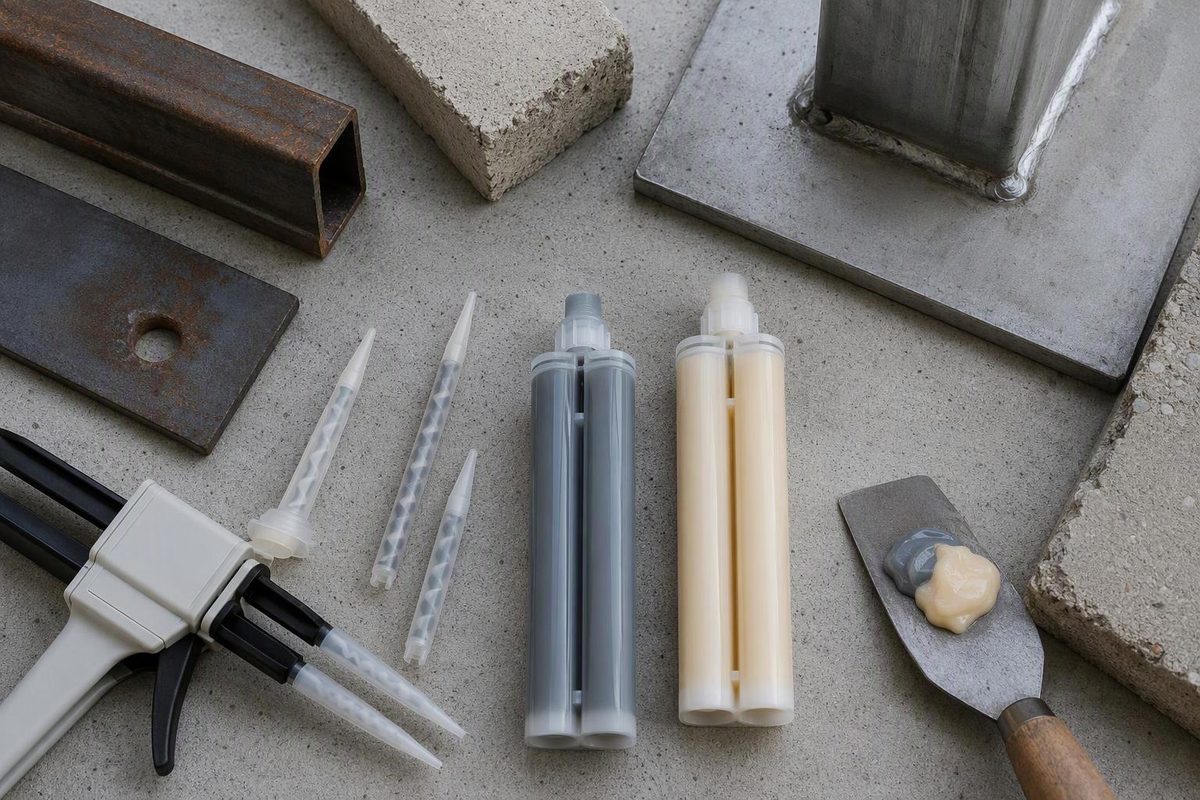
For a small, rigid metal-to-concrete attachment, start with a two-part epoxy explicitly rated for both materials. For nonstructural metal trim over a larger area, a polyurethane construction adhesive rated for both is a practical alternative. Neither choice makes a glued-on railing, load-bearing bracket or overhead fitting safe by itself.
The deciding factors are the metal’s finish, the concrete’s condition, the joint gap, and whether the load pulls the metal away from the surface.
Check the joint before buying glue
Identify whether you are bonding bare steel, aluminum, stainless steel, galvanized metal or a painted finish. An adhesive listing “metal” is not necessarily approval for every coating. If paint remains, its adhesion becomes part of the attachment’s strength.
Dry-fit the part and measure the gap. Gap-filling capability does not mean unlimited thickness: Sikadur-31 Hi-Mod Gel limits its adhesive layer to 1/8 in. (3 mm). Also distinguish occasional rain from standing water or continuous immersion; water-resistant products can still exclude continuously wet service. Sikadur-31 Hi-Mod Gel data sheet
For railings, safety-critical brackets, heavy overhead parts or sustained pull-out loads, use a designed fastening system—not an improvised surface-glue repair. Sika’s structural epoxy data sheet specifically excludes sustained tensile-load adhesive anchoring where failure could threaten public safety and calls for consultation with a design professional. Sika anchoring limitation
Prepare the surfaces and plan the cure
- Expose sound concrete. Remove dust, grease, curing compounds, sealers and weak surface material. For structural epoxy work, Sika specifies an open-textured, contaminant-free concrete surface produced by mechanical preparation. Glue cannot compensate for a loose surface layer. Sika preparation requirements
- Clean and roughen the metal as specified. Loctite’s repair epoxy requires surfaces free of oil, wax, paint and rust, with smooth surfaces roughened by sanding or sandblasting. Industrial steel-bonding specifications may demand more preparation than a quick hand-sanding. Control preparation dust and remove it before bonding. Loctite epoxy directions
- Match the moisture condition to the formula. The Loctite repair epoxy requires dry surfaces; Sikadur-31 Hi-Mod Gel permits dry or damp substrates without standing water. PL Premium’s technical sheet requires surfaces free of frost and standing water. Do not transfer one product’s damp-surface allowance to another. PL Premium preparation requirements
- Arrange clamps, tape or bracing before mixing. The part must stay in its final position while the adhesive develops strength. Apply the specified amount and maintain the permitted adhesive-layer thickness rather than squeezing out everything.
- Separate setting from loading. A five-minute set is not a five-minute full cure. Keep the attachment unloaded through the specified cure period; cold conditions can extend it. Use gloves and ventilation, and follow the product’s safety data sheet. Loctite epoxy application and safety directions
Documented options by job
These are application-based choices, not a strength ranking. Specifications below come from the manufacturers’ US technical data sheets dated April 2018 (Loctite epoxy), December 2019 (PL Premium) and February 2021 (Sikadur). Match the exact product and current label sold locally.
| Job | Adhesive to consider | Application and cure limits |
|---|---|---|
| Small, rigid, non-safety-critical attachment or repair | Loctite Epoxy Metal/Concrete | Equal parts by volume; mix about 1 minute. Sets in 5–12 minutes; secure for 1 hour for best results. Listed usable strength is 12 hours and full cure 24 hours, depending on conditions. Requires dry surfaces; application range 39–95°F (4–35°C). |
| Nonstructural metal trim on concrete | Loctite PL Premium polyurethane construction adhesive | Lists concrete, metal, stainless steel and galvanized metal. Normally join within 15–20 minutes and provide mechanical support for 24 hours. Listed cure is 24–48 hours at 78°F (25°C), 50% relative humidity; cold or low humidity slows it. |
| Professionally specified rigid bonding work | Sikadur-31 Hi-Mod Gel | Professional-use structural epoxy paste; maximum glue line 1/8 in. (3 mm). Mix 1:1 by volume. Approximately 60-minute pot life at 73°F (23°C) for a 500 g mass. Minimum substrate and ambient temperature 40°F (4°C). Secure until cured; tack-free time is not a loading approval. |
Sources: Loctite Metal/Concrete technical data, PL Premium technical data, and Sikadur-31 Hi-Mod Gel technical data.
PL Premium needs an additional application step for large sheet goods or very dry conditions. Its sheet directs a very light, atomized water spray onto the extruded adhesive when bonding large sheets, two nonporous surfaces, or at less than 30% relative humidity. This reduces repositioning time to less than 15 minutes. This is a product-specific instruction—not permission to bond over standing water. PL Premium application directions
Outdoor, wet and hot locations
Loctite Metal/Concrete is suitable for exterior projects but excludes continuous immersion and continuously wet areas. Its listed long-term service range is −10°F to 120°F (−23°C to 49°C). Do not mistake its higher short-term heat limit for a continuous-use rating, or its service range for an application-temperature range. Epoxy exposure limits
PL Premium is rated for interior and exterior use, with a listed service range of −40°F to 160°F (−40°C to 71°C), but excludes water-submersion applications and high-heat locations such as fireplace openings or fire-pit construction. PL Premium limits
For a long outdoor metal plate, a moving joint or an uncertain coating, ask the adhesive manufacturer to confirm the complete assembly—not just the two material names. For more on selecting a rigid metal bond, see the epoxy adhesive metal guide.