
5 min read ·
High Temp Epoxy Resin: Read the Rating Before Choosing
Choose high-temperature epoxy by bond-line temperature, load, substrates and cure schedule. Compare laminating resin, repair putty and oven-cured systems.
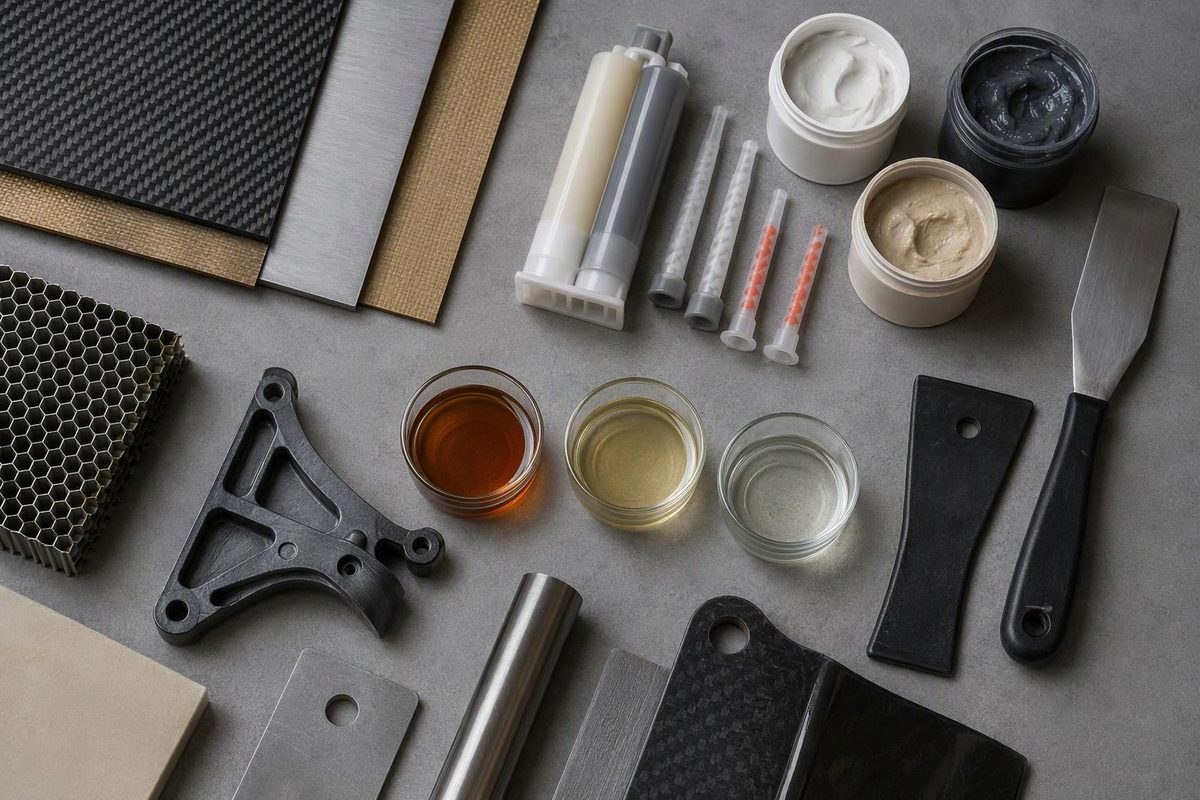
Choose high temp epoxy resin by the temperature at the bond line, how long it stays hot, and the load it must carry—not the largest temperature printed on the package. A laminating resin, metal-repair putty and oven-cured adhesive can all resist heat, but they serve different jobs.
For a sustained, loaded bond, look for strength data at the intended operating temperature and the cure schedule used to obtain it. The substrates, thermal cycling, chemicals and application constraints also matter; a short heat excursion is not equivalent to continuous operation. Master Bond’s selection guidance explains these selection factors.
What the temperature numbers mean
| Datasheet term | What it tells you | What it does not establish |
|---|---|---|
| Continuous service temperature | The manufacturer’s stated limit for sustained exposure, subject to its conditions | The load capacity of your particular joint at that temperature |
| Intermittent or peak temperature | A limit for temporary exposure | Permission to operate there continuously; check duration and frequency |
| Glass transition temperature, Tg | The transition from a stiff, glassy material toward a more pliable solid | A melting point or an automatic failure temperature |
| Heat deflection temperature, HDT | Deformation under a specified test load and heating procedure | A universal service limit for every bond or composite |
| Cure/post-cure temperature | The processing heat needed to develop specified properties | The allowable temperature in service |
Tg values also depend on the measurement method and reporting point. Compare like-for-like data, including cure history. WEST SYSTEM’s technical explanation distinguishes HDT from Tg and warns that constant loads can produce creep as epoxy becomes more flexible when heated. Neither number alone proves that a joint will fail—or remain adequate—above it. See its explanation of heat deflection and loaded joints.
Define the job before selecting a grade
Write down:
- Both substrates: identify the metal, plastic, ceramic or composite, including any coating already present.
- Joint geometry: overlap area, gap, adhesive thickness and whether the material must stay on a vertical surface.
- Temperature profile: normal and maximum bond-line temperatures, exposure duration, and heating/cooling cycles. Do not substitute nearby air temperature for the joint temperature.
- Load and exposure: sustained weight, peel, vibration, water, oil, fuel or other chemicals.
- Processing limits: whether the entire assembly and its fixtures can tolerate the required oven cure.
For a metal-to-composite joint, check the existing composite resin’s temperature limit as well as the new adhesive’s. A heat-resistant adhesive cannot make an unsuitable underlying resin suitable. Easy Composites specifically flags this issue when applying EL160 over other resin systems. Its product guidance covers both substrate compatibility and post-curing.
For substrate-specific joint selection, see the metal epoxy guide or carbon-fiber adhesive guide.
Preparation and cure are part of the heat rating
Prepare a sound, clean surface. Remove oil, grease and release agents before abrading, so sanding does not drive contamination into the surface. Remove loose coatings and dust, and follow the selected adhesive’s substrate-specific drying, abrasion and primer instructions. Use only cleaners compatible with the material. These are core practices in the WEST SYSTEM preparation manual, not a substitute for the chosen grade’s instructions.
Plan the cure before mixing. For two-part systems, use the specified resin/hardener pair and ratio, distinguishing weight from volume. Extra hardener does not accelerate epoxy correctly: EL160’s datasheet warns that an incorrect ratio can cause partial cure and greatly reduced mechanical properties. Mix thoroughly and stay within the documented batch and application limits. Its instructions also warn that leaving mixed resin in the pot can cause an uncontrollably rapid cure. EL160 technical datasheet.
A room-temperature initial cure may make a part demouldable without giving it its high-temperature properties. Where post-curing is required, follow the prescribed temperature steps, hold times, support and cooling procedure. Do not replace a controlled post-cure with “let it get hot during use.” Master Bond notes that Tg is strongly dependent on the cure schedule. Cure and temperature-resistance guidance.
Read the exact product’s SDS. Use its specified protective equipment and ventilation—even for hand-kneaded putty. J-B Weld’s HighHeat SDS identifies skin-sensitization, serious-eye-damage and reproductive-toxicity hazards; it calls for protective gloves, clothing, eye and face protection, and use in a well-ventilated area.
Three documented options—not interchangeable substitutes
Manufacturer information checked 18 October 2026:
| Product and intended role | Published temperature information | Cure requirement and selection limit |
|---|---|---|
| Easy Composites EL160: wet-lay composite laminating resin | Advertised service temperature up to 170°C (338°F) | Requires elevated-temperature post-cure for high-temperature properties. The datasheet recommends an initial 12 hours at 40°C (104°F), or at least 24 hours at 25°C (77°F); the latter leaves it brittle before post-cure. Follow the application-specific cycle. TDS |
| J-B Weld HighHeat putty, SKU 8297: shaped metal repairs | 450°F (232°C) continuous; 500°F (260°C) intermittent | Manufacturer lists 1-hour set and 8-hour cure at room temperature. It is a hand-mixable repair putty, not a pouring or fiber-wetting resin. Product specifications |
| Master Bond EP17HT: one-component bonding, sealing, coating and encapsulation system | Published service range −80°F to 600°F (−62°C to 316°C); Tg 200–210°C (392–410°F) | Minimum cure temperature 300°F (149°C); recommended post-cure 2–12 hours at 350°F (177°C) for optimum properties. Obtain the full cure schedule and application approval before use. Product information |
These numbers are not a strength ranking. EP17HT’s service ceiling exceeds its Tg, illustrating why serviceability and stiffness are different questions. For a loaded joint near a thermal limit, ask the supplier for hot-strength, creep and thermal-cycle data relevant to your substrates and cure. Use engineered mechanical support where failure would be hazardous.
EL160 also has application-specific limits: its datasheet describes the combined EL160/EG160/EMP160 tooling system for service up to 125°C (257°F), with a different post-cure procedure. Do not transfer the headline resin rating to every assembled mould.
For countertops, heat resistance is not enough
Do not select a laminating resin solely to tolerate hot pans. Easy Composites does not recommend EL160 for worktops: it is slightly amber, is not formulated for the desired self-leveling finish or UV protection, and needs an oven post-cure that can distort the substrate. Manufacturer’s worktop guidance.
Choose a documented countertop coating and protect it from direct hot cookware. Plan handling and full cure separately using the countertop epoxy cure-time guide.