
7 min read ·
Why BMW’s Recall Adhesive Is Not a Shortcut
BMW's recall uses inspection-led adhesive reinforcement for suitable joints and full replacement for advanced wear. Check models, symptoms, and next steps.
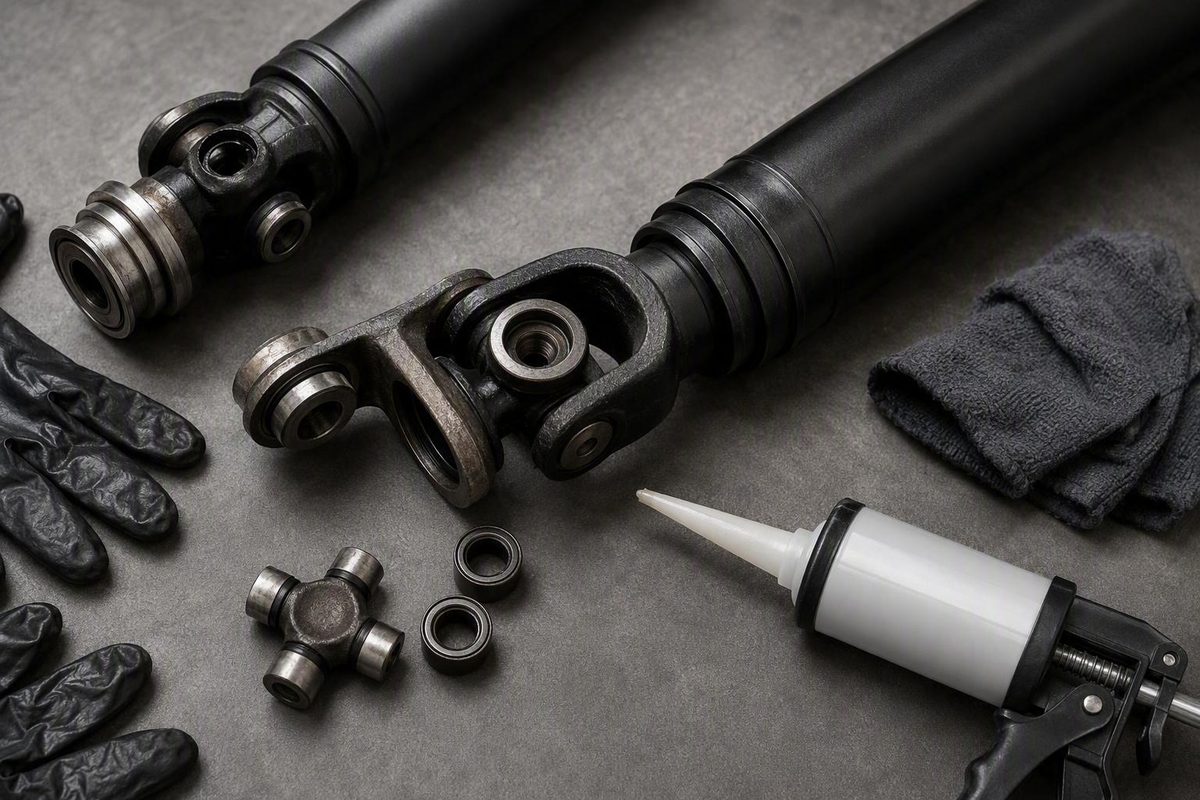
The BMW driveshaft recall glue fix is a proportionate, inspection-led remedy, not a universal substitute for new parts. BMW estimates that only 0.2% of the 27,720 recalled U.S. cars—roughly 55 vehicles—contain the defect. Dealers reinforce suitable connections with adhesive but replace the driveshaft and rear differential when deterioration is too advanced (Carscoops).
That distinction matters. Federal campaign 26V525000 does not prescribe glue for every affected car. It prescribes inspection followed by one of two authorized paths: conditional adhesive reinforcement or free replacement of both major driveline components.
The public reporting does not identify the adhesive chemistry, part number, application geometry, surface preparation, cure conditions, inspection limits, or durability-validation data. The remedy can be understood as condition-based engineering, but it cannot be reproduced or independently evaluated from the information released publicly. It is dealer recall work, never a do-it-yourself adhesive repair.
Choose your model, symptoms, and parking-brake habit; the checker shows which recall path should guide your planning.
This planning tool applies BMW’s reported 0.2% population estimate without pretending symptoms provide a personal probability. The dealer’s inspection still controls the repair.
With no reported shudder or rear clunking, the low population base rate supports planning around inspection and possible adhesive reinforcement. It does not predict what your VIN’s inspection will find.
Your parking-brake habit matches BMW’s reported interim guidance. Continue using it every time until any open campaign is completed.
| Checker Family | Covered U.S. Models | Model Years | Reported Vehicles |
|---|---|---|---|
| 540i | 540i, 540i xDrive, M550i xDrive | 2021–2023 | 18,150 |
| 840i | 840i, 840i xDrive | 2022–2026 | 7,372 |
| 750e | 750e xDrive | 2024–2026 | 2,198 |
| Total recalled U.S. population | 27,720 | ||
BMW reportedly estimates ~0.2% of the U.S. recall population—about 55 vehicles—contains the defect. Model and year do not replace a VIN check.
| Shudder | Rear Clunk | Parking Brake | Planning Result |
|---|---|---|---|
| No | No | Every time | Base-rate tier; adhesive-reinforcement outcome for planning, subject to inspection |
| No | No | Not every time | Base-rate tier; use parking brake now and arrange VIN check |
| Yes | No | Every time | Symptom-priority tier; dealer decides reinforcement or replacement |
| Yes | No | Not every time | Symptom-priority tier; use parking brake and contact dealer promptly |
| No | Yes | Every time | Symptom-priority tier; dealer decides reinforcement or replacement |
| No | Yes | Not every time | Symptom-priority tier; use parking brake and contact dealer promptly |
| Yes | Yes | Every time | Higher symptom priority, not a quantified probability; replacement remains possible |
| Yes | Yes | Not every time | Higher symptom priority; use parking brake and seek BMW instructions promptly |
Symptoms raise service priority but do not reveal BMW’s unpublished wear measurement or select the repair. Adhesive applies only when inspection permits; advanced deterioration requires driveshaft and rear-differential replacement.
Sources: BMW recall-filing summaries reported by Carscoops, Driving.ca and Fox Business. Figures shown: 27,720 U.S. vehicles, ~0.2% estimated defect rate, and model populations listed above.
Why the “Real Repair Means New Parts” View Sounds Reasonable
The skeptical view deserves a fair statement. A driveshaft connection transfers power, and the reported defect can interrupt propulsion or allow a parked vehicle to move. Against that risk, an unspecified adhesive can sound less credible than replacing metal components. The fact that BMW has not publicly disclosed the product or its validation details reinforces that concern.
The consensus is right about the seriousness of the hazard and the limits of the available technical evidence. Owners should not infer that every adhesive can carry structural loads, assume the repair is suitable for every damaged connection, or treat a quiet car as unaffected.
It is wrong, however, to describe the campaign as BMW applying glue instead of making a real repair. The reported procedure first separates connections that remain suitable for reinforcement from those with advanced deterioration. The latter receive a new driveshaft and rear axle differential at no charge. Inspection, rather than a preference for adhesive, determines the remedy.
That is the relevant engineering distinction. Reinforcing a serviceable condition and replacing an irreversibly deteriorated assembly are different interventions for different states of wear. The campaign does not claim that adhesive can restore every connection.
Nor does the evidence establish that cost is BMW’s reason for the adhesive path. Published summaries provide no labor allowances, parts costs, repair costs, or commercial analysis. They support a condition-based distinction, not the claim that BMW selected adhesive merely because it was cheaper.
The Recall Covers More Cars Than BMW Expects to Be Defective
The U.S. campaign covers 27,720 vehicles, although BMW’s reported defect estimate is approximately 0.2%. The estimated 55 defective vehicles cannot be identified from the percentage alone, which is why the recall population is much larger than the predicted number of defects.
The reported U.S. breakdown is as follows (Fox Business):
| U.S. Models | Model Years | Vehicles |
|---|---|---|
| 540i, 540i xDrive, M550i xDrive | 2021–2023 | 18,150 |
| 840i, 840i xDrive | 2022–2026 | 7,372 |
| 750e xDrive | 2024–2026 | 2,198 |
| Total | — | 27,720 |
The 0.2% figure is a population estimate, not a personal risk clearance. It does not identify which VINs contain the defect, and it does not justify ignoring an open campaign. Every included vehicle should complete BMW’s prescribed inspection even if it drives normally.
A matching model and year are only preliminary indicators. A U.S. 2022 540i, for example, warrants a VIN check but is not necessarily included. The VIN record controls.
Canadian Coverage Is Similar but Not Identical
Canadian reporting identifies 826 vehicles under Transport Canada recall 2026-391 and BMW campaign code 26 80 26RC. Its descriptions are broader than the U.S. model list (Driving.ca):
| Canadian Description | Model Years |
|---|---|
| Gasoline BMW 5 Series | 2021–2023 |
| 8 Series coupes and Gran Coupes | 2022–2024 |
| Plug-in-hybrid BMW 7 Series | 2024–2026 |
The Canadian 8 Series range ends earlier in the published description than the U.S. range. Owners should not use one country’s table to decide eligibility in the other.
Used-car shoppers should obtain the VIN before purchase. If a seller says the recall does not apply or has already been completed, ask for the repair record and confirm the current status with BMW.
Inspection Determines Reinforcement or Replacement
The dealer process begins with campaign verification by VIN. An authorized BMW center then inspects the connection between the driveshaft and rear axle differential.
If the condition remains within BMW’s criteria for reinforcement, the dealer may apply the specified adhesive procedure. If deterioration is too advanced, the dealer replaces both the driveshaft and rear differential. Published reporting describes both paths as free recall remedies (Carscoops).
The inspection thresholds have not been published in the supplied evidence. Neither mileage nor an owner’s visual judgment can substitute for them. A symptom-free car is not guaranteed to receive reinforcement, and a clunk or shudder does not prove that replacement is required.
The available summaries also provide no confirmed inspection duration, adhesive cure time, component-replacement time, parts-availability schedule, or later inspection requirement. Owners need vehicle-specific scheduling information from the servicing center.
The low base rate is useful for interpreting the recall, not bypassing it. It explains why automatic replacement of all 27,720 driveline assemblies would not match BMW’s estimated prevalence. It cannot establish the condition of one car.
The Hazard Involves Propulsion and Parked-Vehicle Movement
The reported issue is excessive or premature wear where the driveshaft connects to the rear differential. If deterioration progresses, power transfer may be interrupted and the vehicle may lose propulsion while being driven.
The same condition may allow a parked vehicle to move when the parking brake has not been applied, even if the transmission was placed in Park. BMW reportedly advised owners to use the parking brake while awaiting recall service (Driving.ca).
That guidance is an interim risk-reduction step, not a repair. Use the parking brake every time the vehicle is parked, including on level ground, until the VIN has been checked and any open campaign completed.
BMW was reportedly unaware of related crashes or injuries when the recall reporting was published (Kelley Blue Book). That was a time-bound statement about information then available, not a guarantee about later events or an argument for delaying service.
The public evidence does not identify the root cause as a particular design, material, lubrication, alignment, manufacturing, or operating problem. It also does not explain the adhesive’s precise mechanical role.
Shudder and Rear Clunking Raise Priority, Not Certainty
Canadian coverage identifies drivetrain shudder under load, clunking from the rear, and intermittent loss of drive power as possible warning signs. These symptoms are owner-observable, but they are neither guaranteed stages of the defect nor diagnostic tests.
A recalled car may have no warning signs. Conversely, similar noise or vibration may have an unrelated cause. Symptoms should change how promptly the owner contacts BMW, not be used to select the repair at home.
Contact an authorized BMW center promptly if the vehicle shudders under load, clunks from the rear, intermittently loses drive power, or displays other unusual driveline behavior. Give the center the VIN and identify the applicable driveshaft-to-differential campaign.
A general risk checker cannot decide whether a particular car should be driven or transported. Follow BMW’s or the authorized center’s instructions for that VIN and its current symptoms. The evidence establishes free recall inspection and repair, but it does not establish universal coverage for towing, rentals, loaners, or other transportation costs.
“Glue” Does Not Identify the Material or Its Function
Calling the remedy a glue fix reveals almost nothing about the actual product. The reporting does not identify it as epoxy, cyanoacrylate, threadlocker, retaining compound, sealant, or any other named chemistry.
It also does not disclose:
- The manufacturer or BMW part number
- The exact application point and quantity
- Surface-cleaning or preparation requirements
- Cure time, temperature, or other cure conditions
- Resistance to heat, water, road contamination, vibration, or fatigue
- Inspection measurements and acceptance limits
- Validation or durability-testing results
- The dividing line between reinforcement and replacement
Those unknowns prevent independent technical assessment. They do not establish that an authorized adhesive procedure is inherently inferior.
Industrial adhesive joints are engineered around the two surfaces, joint geometry, loading, environmental exposure, preparation, application control, and cure. A retail product chosen from the word “glue” alone provides none of that process control. No household, general automotive, or industrial adhesive has been publicly identified as equivalent to BMW’s material.
Owners should not buy an adhesive, crawl beneath the vehicle, or attempt to reinforce or inspect the connection themselves. The failure consequences make this an authorized recall procedure rather than a troubleshooting application.
VIN Status, Not Symptoms, Establishes the Next Step
U.S. owners can enter the VIN in BMW’s recall lookup or check Recalls & Campaigns under Service and Maintenance in the current My BMW App. BMW says the VIN appears on the driver-side dashboard near the windshield or on the driver-side door jamb, and that authorized centers perform recall repairs free of charge (BMW USA).
After an open campaign appears, contact an authorized BMW center and provide the VIN when scheduling. Owners do not need to wait for a mailed notice before checking.
Canadian owners should use the relevant BMW or regulator VIN resource and reference Transport Canada recall 2026-391 and BMW campaign 26 80 26RC when contacting a retailer.
The practical reading of the BMW driveshaft recall glue fix is narrow. Adhesive reinforcement is an authorized outcome for a connection that passes BMW’s inspection criteria; full driveshaft and differential replacement remains the outcome for advanced deterioration. The 0.2% estimate makes automatic hard-parts replacement an unlikely planning assumption, but only the dealer inspection can determine the remedy for an individual car.