
5 min read ·
Cyanoacrylate Works Best When the Joint Fits Closely
Choose cyanoacrylate by material, joint gap, load and exposure. Compare grades, prepare the surfaces, and separate fast fixture from full cure.
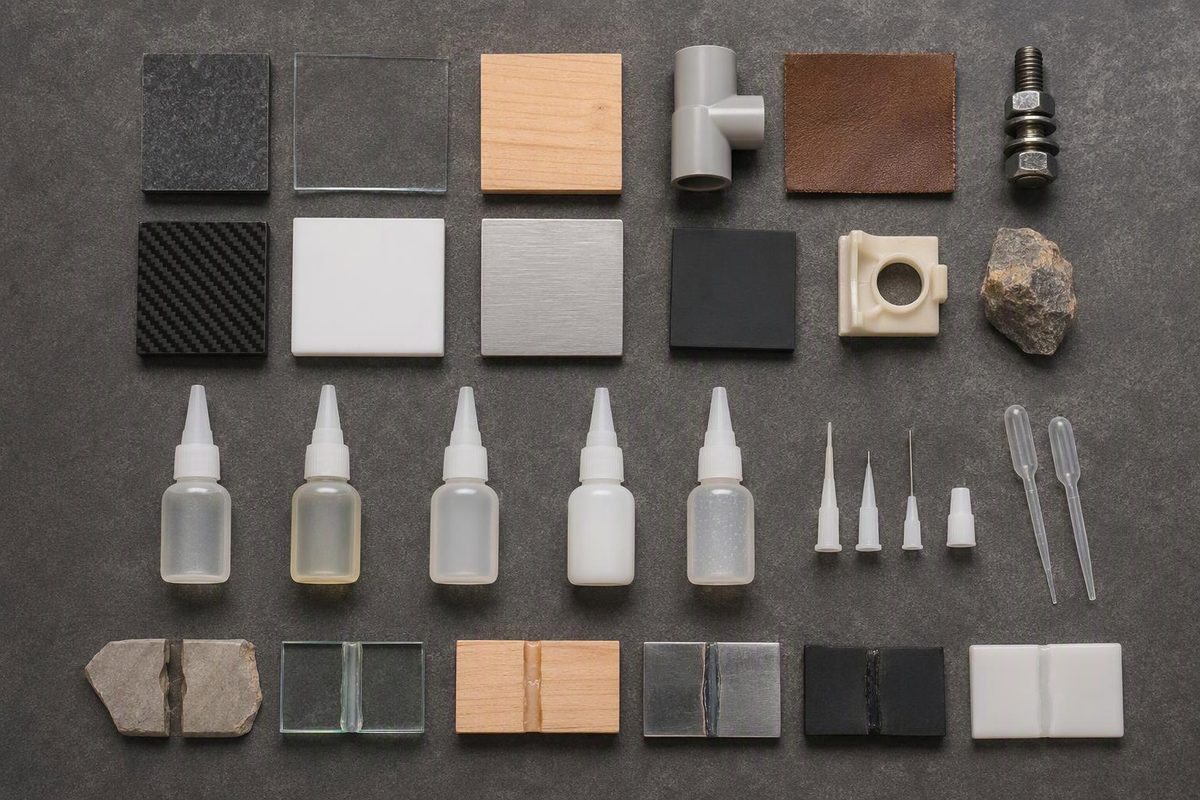
Cyanoacrylate (CA) is the adhesive family commonly called super glue or instant adhesive. It is usually a one-part adhesive that hardens through a reaction with trace moisture on the surfaces being joined—not simply by drying. A good starting point is a small, close-fitting joint that can be aligned quickly and held still. Permabond’s chemistry overview explains the moisture-triggered cure.
Choose it only after checking both materials, the gap between them, the direction of the load, and the expected water and temperature exposure. “Super glue” does not identify a single formulation or a universal performance limit.
Where cyanoacrylate fits
Many CA grades bond metals, rubber, ceramics, wood and plastics. Compatibility still depends on the particular grade and substrate: Henkel lists these material groups for LOCTITE 401 but specifies SF 770 primer for PP, PE and PTFE. LOCTITE 401 product guidance
| Material or job | Selection rule |
|---|---|
| Small metal parts with close contact | A plausible CA application. Check the gap and avoid a joint that loads the adhesive mainly by peeling. |
| Rigid plastic parts | Identify the plastic and verify compatibility with the adhesive, cleaner and any primer. |
| Polypropylene, polyethylene or PTFE | Do not assume ordinary CA will work alone. Use a documented adhesive-and-primer system or another adhesive explicitly approved for that plastic. |
| Wood or other absorbent surfaces | Look for a grade intended for porous or acidic surfaces; do not assume a thin liquid will remain in the joint. |
| Impact, repeated flexing or peel loads | Consider a toughened grade, then verify its performance. Standard CA is not a default choice for these loads. |
| Persistent water exposure or high heat | Require grade-specific resistance data for the actual conditions, rather than relying on the adhesive-family name. |
Permabond notes that ordinary cyanoacrylates have limited impact resistance, while toughened grades improve impact and peel performance. It also offers specialized water-resistant and high-temperature grades—exceptions that should not be generalized to every bottle of super glue. Grade differences
For a metal repair, see when super glue can work on metal. For a part marked PP, start with adhesive selection for polypropylene.
Thin liquid, gel or toughened grade?
Viscosity controls placement; it does not, by itself, establish a safe gap or load. Wicking grades flow into close joints. Gels stay where placed, including on vertical surfaces. Toughened grades address impact and peel resistance, while low-bloom grades address the white residue that can appear around a bond. Permabond’s CA range
Check the maximum gap in the technical data sheet (TDS). For scale:
- LOCTITE 401: listed gap fill of 0.15 mm, approximately 0.006 in. Henkel specification
- Permabond 2011 gel: listed gap-fill capability of 0.50 mm / 0.020 in. Permabond specification
These are product examples, not limits for the whole family. If the parts rock, have missing material or leave a gap beyond the chosen grade’s rating, correct the fit or select an adhesive with a documented larger-gap capability. Adding more CA is not a substitute for that check.
For a visible ceramic or stone chip repair, test appearance on an inconspicuous area or offcut first. Treat chip repair, countertop seams and slab installation as different jobs; a fast-set adhesive is not automatically an installation system.
Preparation and application
- Dry-fit first. Confirm contact, alignment and how you will hold the parts. CA may leave only seconds for adjustment.
- Clean and let the surfaces dry. Remove grease and contamination using a cleaner compatible with each substrate. Trace surface moisture needed for cure does not mean the parts should be visibly wet.
- Apply the specified primer or accelerator only if needed. Follow the matched system’s application sequence and drying instructions.
- Dispense a small amount onto one mating surface. Use enough to cover the bond area without flooding it. Do not spread liquid CA with tissue or a brush.
- Assemble promptly and immobilize through fixture. Do not keep moving the parts to test whether the adhesive has grabbed.
- Wait for the specified cure before loading. Fixture indicates initial holding strength, not full strength or readiness for service loads.
These steps follow Henkel’s LOCTITE 401 TDS. Plastic preparation deserves particular care: Permabond warns that aggressive cleaners such as acetone, excess uncured CA and assembly stresses can contribute to stress cracking in susceptible plastics, including acrylic and polycarbonate. Stress-cracking guidance
How long does it take to cure?
There is no single CA cure time. Substrate, gap and humidity all matter. Henkel’s February 2012 LOCTITE 401 TDS reports fixture times at 22°C and 50% relative humidity of under 5 seconds on steel and 15–30 seconds on oak. Here, fixture means reaching a shear strength of 0.1 N/mm² (0.1 MPa). The sheet recommends allowing full strength to develop before service loads, typically 24–72 hours, depending on materials, gap and ambient conditions. Use the current TDS applicable to your product; these figures are not a cure schedule for every CA adhesive. LOCTITE 401 cure data
A larger gap or lower humidity can slow cure. Accelerator can help in specified applications, but Henkel warns it may reduce ultimate bond strength. Use a compatible product and test the complete joint; see how to choose and use a CA accelerator.
Handling precautions that matter
Use adequate ventilation, eye protection and gloves specified by the product’s current safety data sheet. Avoid skin and eye contact: liquid CA can bond tissue rapidly and irritate the respiratory tract. Henkel’s July 2026 LOCTITE 401 SDS for Indonesia
Keep liquid CA away from cotton rags, cotton gloves and cotton swabs. Contact with cotton can produce a rapid heat-releasing reaction capable of causing serious burns. Do not use them to wipe up a spill; follow the product’s spill instructions. Published burn case and mechanism
If skin becomes bonded, do not pull it apart; warm soapy water may help loosen the bond. For eye exposure, do not force the eyelids open. Rinse with water for 15 minutes and obtain prompt poison-center or medical guidance; do not apply adhesive-removal solvents to the eye. Household CA is not a substitute for medical tissue adhesive. Poison Control guidance