
4 min read ·
Carbon Steel or Stainless Steel: Choose by Exposure and Upkeep
Compare carbon steel and stainless steel by corrosion resistance, strength, cost and maintenance before choosing metal for brackets, frames or bonded assemblies.
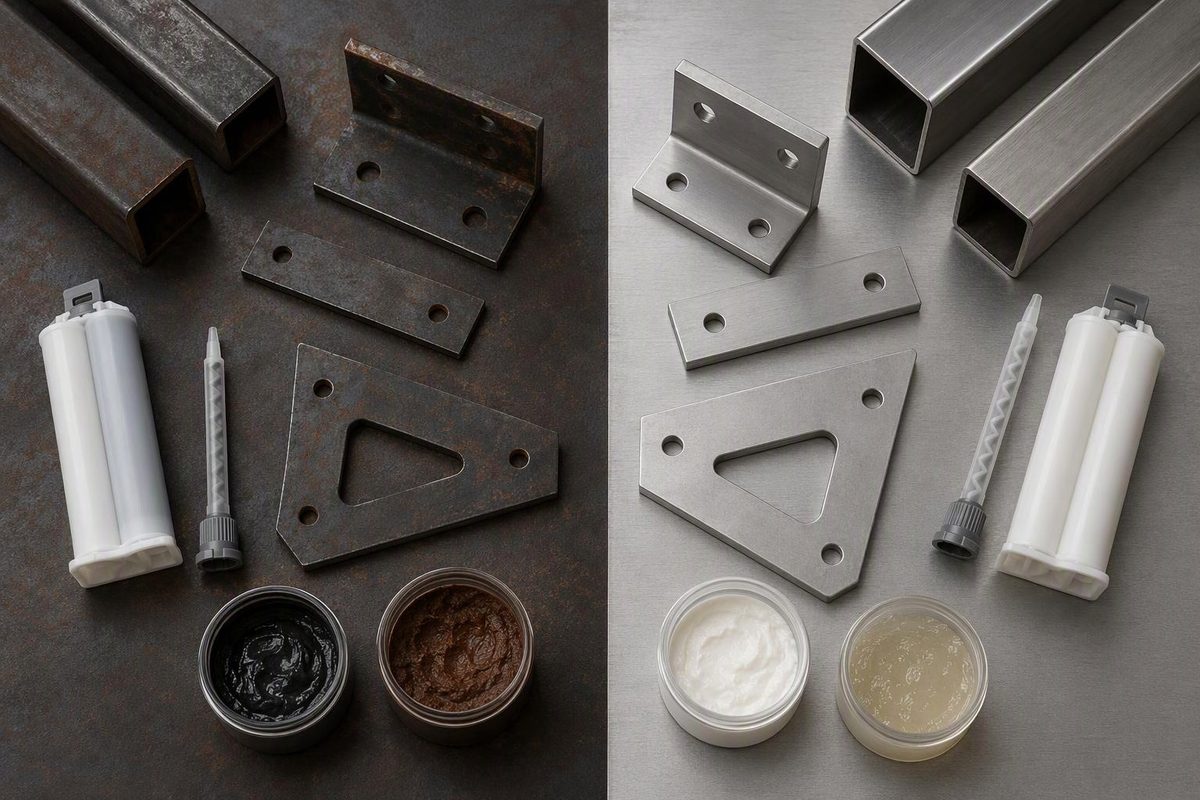
Choose carbon steel when initial cost matters and you can keep the metal dry or maintain a protective finish. Choose an appropriate stainless steel grade when repeated wetting, corrosion or difficult maintenance makes bare carbon steel a poor fit. Neither family is automatically stronger: grade, heat treatment and product condition matter.
For brackets, frames, trim and bonded assemblies, choose the metal for its service conditions first. Adhesive compatibility is a separate decision—not a reason to overlook corrosion or load requirements.
The practical differences
| Decision factor | Carbon steel | Stainless steel |
|---|---|---|
| Corrosion protection | Bare steel rusts in the presence of oxygen and moisture; paint, plating or coatings can protect it. | A chromium-rich passive film provides inherent corrosion resistance, but the wrong grade can still corrode. |
| Initial cost | Generally lower, though protective finishes and secondary processing add cost. | Generally higher; compare finished parts rather than raw-metal prices alone. |
| Strength and hardness | Available in many grades and heat-treated conditions. | Also available in many grades and conditions; the stainless label does not establish strength. |
| Maintenance | Plan inspection and upkeep of the protective finish where corrosion matters. | Still needs cleaning; resistance to rust does not mean maintenance-free. |
| Visible appearance | A polished bare surface needs protection against tarnishing and rust. | Often preferable for an exposed metallic finish without paint. |
The corrosion and cost distinctions are explained in SPIROL’s comparison of stainless and protected carbon-steel fasteners. The grade-dependent mechanical properties and appearance differences are covered by Metal Supermarkets; Euro Inox’s cleaning guidance confirms that stainless still requires care.
Corrosion is usually the deciding factor
Stainless steel contains at least 10.5% chromium by weight. Its protective surface film normally repairs itself after damage when sufficient oxygen is available. Carbon-steel rust does not provide the same stable protection: corrosion can continue as the oxide layer loses integrity and exposes more metal. See the BSSA corrosion guidance and SPIROL’s explanation of rust formation.
That makes these useful starting points:
- Dry indoor frame or bracket: carbon steel is a reasonable cost-led option, with any required protective finish specified.
- Outdoor assembly that is accessible for inspection and repainting: protected carbon steel remains an option. Include coating application and upkeep in the comparison.
- Wet or exposed assembly that will be difficult to maintain: consider stainless, selecting the grade for the actual environment rather than buying unspecified “stainless steel.”
Salt exposure changes the stainless choice
Stainless is corrosion-resistant, not corrosion-proof. Chlorides, acidic conditions and higher temperatures can promote localised attack; crevices are a particular concern. Grade 316 contains molybdenum, which improves resistance to chloride-induced breakdown of the passive film compared with 304. That is a reason to consider 316—not a guarantee of suitability for seawater, immersion or every cleaning chemical. The BSSA guidance explains both the grade progression and these failure mechanisms.
For chemical exposure, specify the chemical, concentration and service temperature before selecting a grade.
Do not choose strength from the family name
“Carbon steel is stronger” and “stainless steel is stronger” are both too broad. Low-carbon steel may have lower tensile strength than some stainless grades; other carbon steels can be heat treated to obtain different properties. Metal Supermarkets’ comparison explicitly warns against sweeping mechanical-property claims.
For a loaded bracket or frame, compare the specified grade and condition, section dimensions, yield strength, tensile strength and any required toughness. Do not replace a specified structural part with an equally sized stainless part solely to prevent rust.
Compare installed cost and realistic maintenance
Ask for quotations covering the same dimensions, grade requirements and finished condition. Include cutting, finishing, protective coating, installation and expected maintenance. Stainless’s higher purchase price may be worthwhile where recoating is difficult; protected carbon steel may be better value where upkeep is straightforward. SPIROL notes that secondary processing and component design can change the apparent cost advantage.
Stainless upkeep is usually about cleaning rather than repainting. Use suitable cleaning methods, avoid ordinary carbon-steel wool, and follow disinfectant instructions: bleach-containing products can damage stainless if concentration, contact time or rinsing is unsuitable. These precautions are detailed in Euro Inox’s maintenance guide.
If the part will be glued
Record the metal grade and the surface actually presented to the adhesive—bare steel, stainless, paint, plating or another coating. Decide the corrosion-protection arrangement before ordering the parts, rather than treating it as an afterthought.
Once the material is selected, use Steel and Stainless Steel: Adhesive Selection and Preparation for the separate bonding decision. If the chosen carbon steel is galvanized, see whether galvanized steel needs an adhesive primer.