
20 min read ·
Should You Patch That Leaking PVC Pipe—or Cut It Out?
A small defect on an accessible, stable, low-pressure or non-pressurized line is the most plausible candidate when the line can be shut down and monitored.
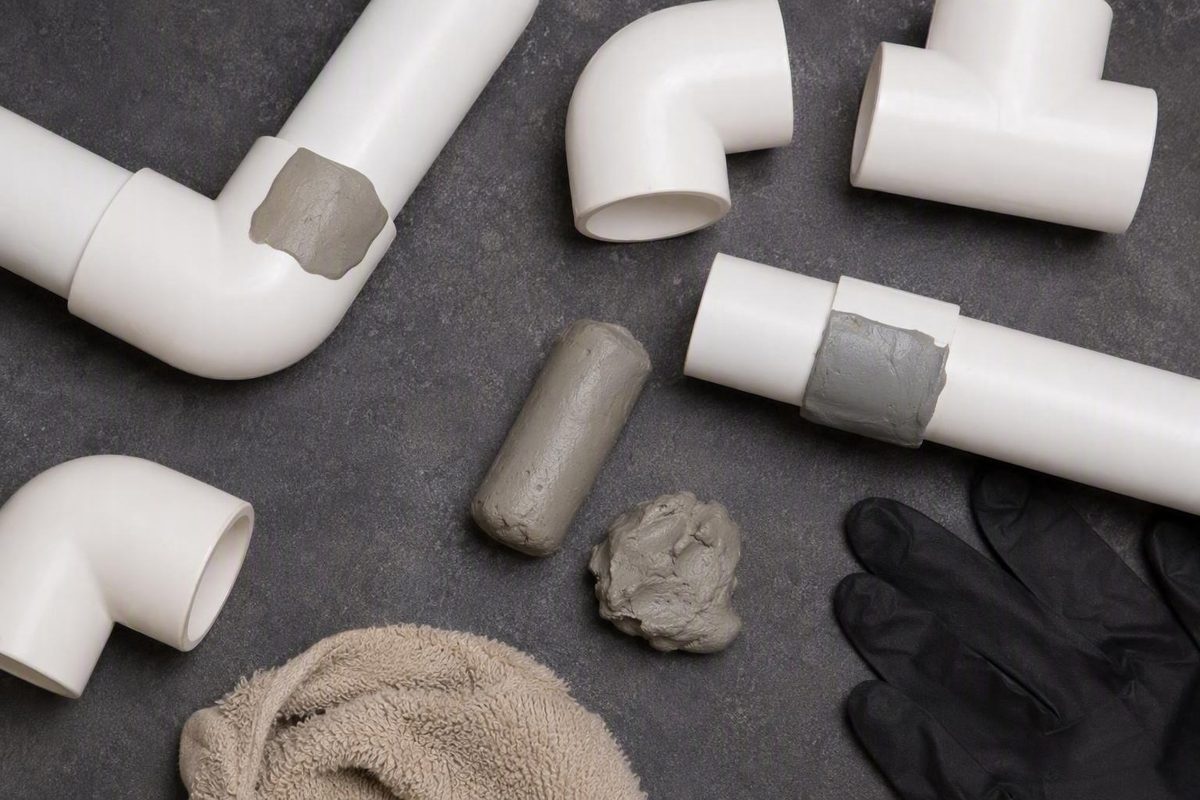
Epoxy putty for PVC pipe can stop some small leaks, but the right question is not simply, “Will it stick?” You also need to identify what is leaking, whether the line is pressurized, whether the surrounding PVC is sound, and what happens if the patch fails.
A pinhole on an exposed sink drain is a very different repair from a longitudinal crack in a concealed household supply line. Waterproof labels and impressive cured-strength figures do not erase that distinction. Treat epoxy putty as a localized external patch—not an automatic substitute for a properly assembled joint, suitable repair coupling, or replacement pipe section.
The short answer: classify the leak before reaching for putty
A PVC-compatible epoxy putty may patch a pinhole, short crack, or minor seepage. The most plausible candidate is a small defect on an accessible, stable, low-pressure or non-pressurized line that can be shut down, prepared properly, and monitored afterward.
It is not a universal permanent repair. Long splits, large gashes, several inches of damage, multiple cracks, brittle or discolored PVC, recurring failures, moving fittings, and concealed or critical lines generally justify a coupling, replacement section, or professional assessment.
Use this initial routing table before buying a product:
| Repair route | When it may fit | When it does not fit |
|---|---|---|
| Consider a temporary epoxy-putty patch | Small, localized defect; exposed and stable pipe; low-pressure or non-pressurized service; line can be isolated and monitored | Long split, extensive degradation, significant movement, inaccessible location, or serious consequences if the patch fails |
| Use a suitable repair coupling | Accessible pipe with localized damage and a coupling specifically rated or accepted for the pipe dimensions, material, and service | Pipe is too degraded to provide sound material on both sides, or the damaged fitting cannot be incorporated correctly |
| Replace the damaged section | Large or deep damage, a several-inch split, multiple cracks, brittle pipe, damaged fitting, or recurring leak | Mainly where access makes replacement impractical—in which case qualified assessment may still be needed |
| Call a qualified professional | Concealed, buried, main-water, sewer, difficult-to-isolate, repeatedly failing, regulated, or high-consequence work | A straightforward, accessible, noncritical repair may be within an experienced DIY user’s scope, subject to local requirements |
An “approved” or suitable repair coupling is not simply any product sold under that name. It must also be installed according to its current instructions and applicable local requirements.
Pressurized supply lines deserve a conservative decision. Available product claims do not establish one universal safe pressure limit for an externally patched PVC assembly. The putty, bond line, crack shape, remaining pipe wall, temperature, movement, pressure cycling, and patch geometry all influence the result.
Accessibility also changes the risk. If an exposed sink-drain patch begins to seep, you may notice it quickly and isolate the fixture. A failed patch inside a wall, beneath a floor, underground, or on a main line may remain hidden while causing much greater damage. Commercial repair guidance similarly directs concealed, underground, main-water, sewer, and recurring leaks toward qualified help rather than repeated surface patches (Tech-Bond’s PVC repair guidance).
Finally, distinguish emergency leak control from a durable plumbing repair. A patch that stops dripping today has demonstrated short-term leak control under the observed conditions. It has not automatically demonstrated long-term durability, potable-water suitability, regulatory acceptance, or safe performance at the line’s full operating pressure.
Find the real source of the PVC leak
Dry the surrounding area and inspect above, around, and behind the apparent leak before covering anything with putty.
Work through this checklist:
- Slip nuts: Check whether a serviceable compression or trap connection is loose. Tighten only as appropriate; excessive force can damage plastic components.
- Rubber gaskets and washers: Look for displacement, hardening, cracking, or wear.
- Clean-outs: Inspect the plug, threads, sealing surface, and surrounding fitting.
- Attachments: Check fixture outlets, valves, equipment connections, and anything mounted to or supported by the pipe.
- Fitting seams: Determine whether water is emerging from the pipe-to-fitting socket or merely traveling across it.
- Threaded fittings: Look for cracking, distortion, cross-threading, or signs of over-tightening.
- Straight pipe: Trace the entire visible crack or pinhole rather than marking only the wettest point.
- Original assembly: Look for a joint that is incompletely seated, misaligned, contaminated, or possibly never solvent-cemented.
- Upstream sources: Inspect higher fittings, condensation points, and nearby fixtures that could send water toward the apparent leak.
If a slip nut is loose, correct the nut. If a gasket is worn, replace the gasket. Burying either serviceable component under rigid epoxy can make later maintenance harder without restoring the intended sealing mechanism. Loctite’s PVC guidance likewise recommends checking slip nuts and rubber gaskets first and replacing pipe with long cracks or large gashes (Loctite’s PVC leak guide).
A Sawmill Creek discussion illustrates the value of diagnosis, although it is an anecdote rather than general evidence. A user initially suspected a leaking PVC fitting and considered epoxy. On closer inspection, the joint turned out to have been left dry-fitted and unglued. The correct repair was to assemble the joint, not patch its exterior (Sawmill Creek discussion of the dry-fitted joint).
Also distinguish minor seepage from structural failure. If the pipe moves when a pump starts, a fixture drains, or someone touches the assembly, a rigid patch remains exposed to that movement.
Possible contributors include impact, freezing, temperature extremes, prolonged outdoor exposure, installation defects, and over-tightened fittings. Appearance alone may not reveal which factor caused a particular failure. What matters for the repair decision is whether the defect is isolated or part of broader deterioration.
Look beyond the immediate wet spot. Multiple cracks, recurring leaks, brittleness, discoloration, flattening, bulging, or other deformation suggest that the surrounding PVC may no longer be a dependable substrate.
Epoxy putty is a surface patch, not a PVC solvent weld
Epoxy putty is normally a two-part material containing resin and hardener. Kneading combines the components and starts the cure reaction. During its working time, the putty can be pressed into irregular holes, cracks, and seams; it then hardens into a rigid mass adhered to the pipe’s exterior.
PVC solvent cement works differently. It softens compatible mating surfaces so that a properly fitted pipe and fitting fuse during assembly. The process depends on both the cement chemistry and the close interference fit inside the fitting socket. Epoxy remains a surface-bonding material and does not recreate that joint structure.
Weld-On says epoxy and general-purpose glues are not designed for assembling PVC piping and recommends compatible solvent cement for PVC pipe-to-fitting joints (Weld-On’s explanation of solvent cement and glue). Oatey likewise advises using solvent cement labeled for the specific plastic, system, and application rather than treating epoxy as an interchangeable pipe-assembly product.
That does not mean epoxy putty has no role. Its role is narrower: a moldable external patch may be considered for a qualified localized defect when rebuilding the pipe is not the immediate action. It should not be represented as reproducing the tapered fit or solvent-welded structure of a properly assembled fitting.
Do not confuse moldable putty with liquid two-part epoxy. Liquid-epoxy guidance may illustrate the broader distinction between adhesion and solvent welding, but it does not prove how a particular putty will perform.
Material-strength numbers also require context. A cured-strength figure describes the product under a specified or manufacturer-selected test condition. It is not the operating-pressure rating of a repaired pipe.
The repair depends on the interaction among:
- the particular putty;
- the PVC formulation and condition;
- the cleanliness and texture of the bonding surface;
- the size, direction, and depth of the defect;
- the remaining pipe-wall strength;
- patch thickness and overlap;
- temperature and chemical exposure;
- vibration, flexing, and thermal movement; and
- internal pressure and pressure cycling.
That is why the largest number on a package is not automatically the safest buying criterion.
How to choose an epoxy putty for PVC service
Start with the current package, technical data, and application instructions for the exact product—not a generic product-category page or an old retailer description.
Verify the following before buying:
- Explicit material compatibility: Does the product-specific information name PVC or the relevant plastic?
- Intended repair: Does it mention pipe cracks, holes, leaking joints, plumbing, or the exact repair you intend to make?
- Wet-surface conditions: Does “wet” mean damp, submerged, or capable of resisting water actively escaping?
- Working time: How long do you have to mix, position, press, and shape the material?
- Initial set: When will it begin resisting movement?
- Functional or handling cure: When can the repair tolerate limited handling, if applicable?
- Full cure: When has it reached the manufacturer’s completed cure milestone?
- Service temperature: Is the range suitable for the water, equipment area, and ambient environment?
- Pressure restrictions: Does the manufacturer expressly permit the intended pressure service and repair geometry?
- Substrate preparation: Which cleaning and abrasion methods are allowed?
Add service-specific checks where relevant:
- Is current certification required for contact with potable water?
- Is continuous immersion permitted, rather than occasional wetting?
- Is the material compatible with chlorinated pool or spa water?
- Can it tolerate the system’s other chemicals?
- Is it suitable for outdoor UV exposure?
- Does it tolerate the expected temperature cycling?
- Do local plumbing requirements and the pipe or system manufacturer permit this repair method?
These are questions to verify, not assumptions that follow from the word “waterproof.” A website selector labeled “plastic,” “composite,” or “PVC” is weaker evidence than product-specific instructions naming the material and intended service.
Likewise, “sets underwater” can mean the putty cures on a submerged or damp, depressurized surface. It does not necessarily mean it can be applied successfully over water escaping under line pressure.
Consider two manufacturer examples without treating either as a universal recommendation.
J-B Weld lists WaterWeld with a 25-minute set, one-hour cure, 4,370 PSI cured strength, resistance to water pressure “up to 500 PSI,” and temperature resistance “up to 250°F” (J-B Weld’s WaterWeld specifications). These are manufacturer claims for the product. The supplied product-specific use list does not explicitly name PVC, and the figures do not demonstrate approval of every externally patched PVC pressure-pipe assembly. In particular, 4,370 PSI is not the operating-pressure rating of a repaired pipe.
Loctite presents Repair Putty-All Purpose as a way to patch PVC cracks, holes, or leaking joints. Its guidance specifies a 60-minute functional cure and 24-hour full cure. That clearer PVC-specific use statement may be more relevant than a larger headline strength number, but pressure, potable-water, temperature, and regulatory suitability still require separate verification for the actual job.
Do not rank putties by strength alone. The better candidate is the one whose current instructions most clearly match the PVC, defect, water exposure, pressure conditions, temperature, chemicals, and required certifications.
Step by step: applying epoxy putty to a minor PVC defect
Use this procedure only after the defect has passed the earlier screening: localized damage, sound surrounding PVC, stable geometry, acceptable consequences of failure, and a product explicitly suitable for the intended material and exposure.
1. Shut down and depressurize the line. Turn off the water or equipment, isolate the affected section, relieve trapped pressure, and drain the pipe where possible. Do not plan to knead and position ordinary consumer putty against an actively pressurized leak.
Confirm that valves have isolated the section and that static head or backflow is not continuing to feed the leak.
2. Confirm and mark the full defect. Dry the area and observe where water reappears if diagnosis requires a brief, controlled flow check. Then isolate the line again. Mark both ends of a crack and inspect around the circumference. Covering only the point where a drop forms can leave part of the defect untreated.
3. Clean the bonding area. Remove dirt, grease, oils, scale, adhesive residue, and loose material using methods allowed by both the pipe and putty instructions. Do not improvise with an aggressive solvent merely because it evaporates quickly; a cleaner suitable for one PVC or adhesive system may not be appropriate for another.
The objective is a sound, contaminant-free surface—not a cosmetically bright pipe.
4. Dry the PVC as thoroughly as possible. Some putties claim they can be used on wet or underwater surfaces. Even so, a clean, dry, depressurized surface is the more conservative preparation because water, active seepage, and contamination can interfere with intimate contact.
If complete drying is impossible, verify that the exact product permits the actual condition. Do not stretch “wet surface” to include active line pressure unless the manufacturer expressly says so.
5. Abrade only if instructed or permitted. Light abrasion may increase the available bonding texture, but follow the current product directions. Do not aggressively thin the pipe wall, deepen a crack, or prescribe one sanding grit for every PVC and putty combination. Remove abrasion dust before continuing.
6. Put on gloves and mix thoroughly. Cut or break off the required amount. Knead the components until the color is completely uniform, with no streaks or unmixed core remaining. Incomplete mixing can leave soft or uncured areas. Work within the stated application time.
7. Press the putty firmly into and beyond the defect. Force the mixed material into the pinhole, crack, or seam rather than merely laying a cap over it. Extend the patch onto sound PVC around the full defect. If the product instructions call for wrapping a leaking joint around its circumference, follow the stated overlap and shaping method.
The goal is broad contact and complete coverage—not using the putty to force a moving or misaligned fitting into place.
8. Shape the patch and leave it alone. Feather or smooth the edges as directed so they do not form obvious lifting points. Once the material begins to set, stop repeatedly pressing, twisting, or reshaping it. Keep the pipe supported and motionless during cure.
For its named wet-surface application, Loctite instructs users to maintain force on the putty for three to five minutes. That timing is product-specific and should not be generalized to other epoxy putties (Loctite’s PVC putty application instructions).
Before walking away, check the main causes of preventable failure:
- no trapped or residual line pressure;
- no dirt, grease, loose material, or inappropriate cleaner residue;
- complete, uniform mixing;
- coverage extending past the full defect;
- no unsupported pipe movement;
- no disturbance after setting begins; and
- no return to service before the required cure milestone.
Set time is not the same as safe return to service
Epoxy labels may use several different timing terms:
- Working time is the window after mixing during which the putty can be applied and shaped.
- Initial set is when it begins holding its shape and resisting light disturbance.
- Handling or functional cure indicates limited usability under the manufacturer’s stated conditions.
- Full cure is the completed cure milestone identified by the manufacturer.
These terms are not interchangeable, and their timing varies by product. Initial hardness is not proof of full cure, reliable adhesion, or system-level pressure capacity.
The manufacturer examples above illustrate the difference: one lists a relatively short set and cure, while the other distinguishes functional cure from a substantially longer full cure. Do not combine timings from different products into a generic rule.
Unless the manufacturer supplies explicit, application-specific return-to-service directions, follow the stated full-cure requirement before restoring full pressure. If temperature or other site conditions affect cure, follow the label’s stated conditions rather than assuming the nominal time still applies.
After the required cure:
- Confirm that the patch is intact and its edges remain bonded.
- Restore water gradually rather than subjecting the repair to an abrupt pressure change.
- Inspect it under normal flow.
- Observe it at the highest operating condition reasonably expected in service.
- Recheck after cycling the system and over the following days.
Commercial PVC repair guidance likewise recommends allowing the product-specific cure, restoring water gradually, and monitoring the patch under normal and peak expected flow (AquaBond’s PVC putty repair guidance).
Any testing must follow the procedures applicable to the pipe, system, and repair product. Never test PVC piping with compressed air or gas; the available commercial repair guidance identifies hydrostatic testing as the appropriate route where pressure testing is required (Tech-Bond’s PVC testing warning).
Isolate the line and move to a suitable coupling, replacement, or professional repair if the patch weeps, cracks, lifts at an edge, shifts with the pipe, or if the original crack extends beyond it. Adding more putty over a failing patch does not correct deteriorated PVC or continuing movement.
Drain, supply, pool, and joint leaks require different decisions
The same putty can face very different conditions depending on where the PVC is installed.
| System or defect | Principal concern | Evidence strength | Possible short-term action | Preferred durable action |
|---|---|---|---|---|
| Accessible sink drain with tiny pinhole | Correct diagnosis, intermittent drainage, and movement at trap connections | Moderate for localized putty use, but highly condition-dependent | Isolate, prepare, and patch if the pipe wall is sound and the product is PVC-compatible | Replace the damaged pipe or fitting when practical |
| Slip nut or gasket seepage | Serviceable seal rather than damaged pipe wall | Strong diagnostic rationale | Tighten correctly or replace the gasket | Restore the intended mechanical seal |
| Household pressurized supply | Continuous pressure, cycling, and costly failure | Insufficient for a universal external-putty pressure limit | Isolate the line; use putty only as expressly permitted emergency control | Suitable coupling, section replacement, or qualified assessment |
| Pool or spa circulation line | Pressure, continuous immersion, chlorine, temperature, and UV | Product-specific evidence required | Use only a product verified for all applicable exposures | System-appropriate coupling, joint rebuild, or replacement |
| Non-pressurized submerged component | Immersion compatibility and static water head | Anecdotal support only | A compatible underwater putty may be considered | Proper component repair or replacement |
| Leaking fitting seam | Failed solvent weld, cracked fitting, misalignment, or dry-fitted joint | Diagnosis is stronger than patch evidence | Consider an external patch only after identifying a stable, localized defect | Rebuild or replace the joint |
| Gap around a wall, floor, or fixture penetration | Sealing the opening, not repairing the pipe wall | Clear distinction of task | Apply an appropriate PVC-compatible sealant | Maintain a flexible, service-appropriate penetration seal |
| Concealed, buried, sewer, or main line | Inaccessibility, inspection, regulation, and consequences of failure | Strong case for escalation | Isolate and limit damage | Professional assessment and compliant repair |
An accessible sink drain is among the more plausible patch scenarios because it is generally low-pressure and observable. Even there, check trap nuts, washers, gaskets, clean-outs, and joint assembly first. If the fitting is cracked or the pipe is under stress, replacement remains the better repair.
A household supply line calls for more caution. Do not infer that a consumer putty is a permanent pressure-pipe repair because it is waterproof or has a high laboratory strength. Isolate the line and favor a suitable coupling, replacement section, or qualified assessment.
Pool and spa circulation plumbing adds several variables at once. Verify resistance to the actual pressure, continuous immersion, chlorinated water, operating temperature, and outdoor exposure. A general recommendation for “plastic” or “pools” does not necessarily cover every point in the circulation system. Participants in a specialized pool forum similarly cautioned that epoxy products differ and should be checked for continuous chlorinated-water and UV exposure (Trouble Free Pool discussion of PVC repair epoxy).
The Sawmill Creek discussion also includes an individual report of putty success on non-pressurized submerged PVC under approximately one foot of water and less than 0.5 PSI. That is an anecdote, not controlled evidence, and it cannot be transferred to household supply pressure, pump discharge, or another product and repair geometry (Sawmill Creek PVC repair discussion).
At a fitting seam, diagnose the fitting and original solvent weld before considering any exterior patch. A cracked socket, incompletely seated pipe, failed fitting, or misalignment should not be hidden under putty.
A gap around a pipe passing through a wall, floor, cabinet, or fixture is a separate sealing job. The pipe itself may be intact. PVC-compatible silicone may suit this type of penetration gap because a flexible sealant can accommodate perimeter movement; rigid putty is selected for a different purpose.
For concealed, underground, sewer, main-water, recurring, or otherwise consequential leaks, seek qualified assessment and follow applicable local requirements. Convenience is not a good reason to leave an uncertain patch where it cannot be inspected.
When a coupling or new pipe section is the better repair
Replace or structurally repair the pipe when you find any of the following:
- a long crack or longitudinal split;
- a large, deep, or irregular hole;
- damage extending several inches;
- multiple cracks or pinholes;
- brittle, chalky, or discolored PVC;
- flattening, bulging, warping, or other deformation;
- a cracked or distorted fitting;
- a leak that returned after an earlier patch;
- a crack that continues growing;
- unsupported movement, vibration, or misalignment; or
- insufficient sound pipe around the defect for dependable adhesion.
A suitable repair coupling or replacement section addresses damaged pipe as part of the piping system. Putty remains dependent on adhesion to the exterior of the original pipe. If that pipe is degraded, a carefully mixed patch is still bonded to an unreliable substrate.
Choose materials by purpose:
| Material or method | Proper role | Important limitation |
|---|---|---|
| Moldable epoxy putty | Qualified external patch for a small, stable, localized defect when the exact product fits the material and service | Does not recreate a solvent-welded fitting or restore extensively damaged pipe |
| Liquid two-part epoxy | Separate adhesive form that can flow into a localized crack or seam where its instructions permit | Evidence for liquid epoxy does not prove putty performance, and vice versa |
| Compatible PVC solvent cement | Assembly of close-fitting, compatible PVC pipe and fittings | Not a generic crack filler; requires the correct joint geometry, product, preparation, assembly, and cure |
| PVC-compatible silicone | Flexible sealing around a pipe penetration or similar perimeter gap | Not a structural repair for a cracked pressure pipe |
| Suitable repair coupling | Durable repair of accessible localized damage when rated or accepted for the pipe and service | Suitability depends on dimensions, pressure or DWV service, material, installation conditions, and current instructions |
| Replacement pipe section | Removal of extensive, degraded, recurring, or consequential damage | Requires sufficient access and correct reassembly of the system |
A full solvent weld depends on compatible chemistry and the fitting’s tapered interference fit. Primer requirements vary with the plastic, cement formulation, product label, and local code; there is no sound universal rule that primer is always required or never required (Oatey’s solvent-cement guidance).
Call a qualified professional when the line is concealed, buried, difficult to isolate, connected to a main supply or sewer, repeatedly failing, or subject to licensing or inspection requirements. Professional assessment is also appropriate when replacement would require substantial demolition or when you cannot determine whether the line remains pressurized.
The governing rule is consequence-based: as pressure, inaccessibility, damage extent, pipe movement, or the cost of failure increases, the case for a coupling or replacement becomes stronger.
Frequently asked questions
Will epoxy putty stick to wet PVC pipe?
Some epoxy putties are advertised for wet or underwater application, and certain product-specific instructions permit use on wet PVC. That does not mean every putty adheres to every PVC formulation, or that “wet” includes water actively escaping under pressure.
For the best chance of adhesion, isolate and depressurize the line, clean the surface, and dry it as thoroughly as possible. If drying is impossible, confirm that the exact product instructions cover PVC under the actual damp or submerged condition.
Can epoxy putty repair a pressurized PVC water line?
It may provide emergency leak control if the manufacturer expressly permits the material, repair type, pressure, and service conditions. The available evidence does not establish a universal safe pressure for an externally patched PVC line.
Treat household supply piping conservatively. Isolate it and favor a suitable repair coupling, replacement section, or professional repair—especially if the line is concealed or failure could damage the building. A product’s cured-strength or water-pressure claim is not automatically the pressure rating of the repaired assembly.
How long should epoxy putty cure before turning the water back on?
Follow the exact product’s full-cure and return-to-service instructions. Do not use set time or surface hardness as a substitute for full cure.
Different products publish different milestones, including initial set, functional cure, and full cure. Unless the manufacturer provides application-specific directions allowing earlier service, wait for the stated full cure before restoring full pressure. Then restore water gradually and inspect the patch closely.
Is epoxy putty a permanent repair for a cracked PVC pipe?
Not reliably in every system. It may remain serviceable on a small, stable defect, but the available evidence does not establish a universal service life for an epoxy-putty patch. Pressure, movement, temperature cycling, chemicals, crack growth, preparation, and pipe deterioration can all change the outcome.
Use a suitable coupling or replacement section for long splits, large holes, multiple cracks, brittle PVC, damaged fittings, recurring leaks, and concealed or critical lines. Even where a patch holds, replacement may remain the more durable repair.
Can epoxy putty replace PVC solvent cement at a leaking joint?
No. Epoxy putty adheres to the exterior surface. Compatible PVC solvent cement softens and fuses properly fitted pipe-and-fitting surfaces during assembly. Putty does not recreate the fitting’s interference fit or solvent-welded structure.
A minor, stable seam leak may sometimes be externally patched as temporary control, but first determine whether the joint is uncemented, cracked, misaligned, moving, or improperly assembled. Those conditions call for rebuilding or replacing the joint rather than covering it.
The bottom line
Epoxy putty can be reasonable emergency leak control for a small, accessible, stable PVC defect when the selected product explicitly fits the material and exposure. It should not conceal widespread deterioration or automatically substitute for a properly assembled joint, suitable repair coupling, or replacement pipe section.
Diagnose the source first, isolate and prepare the line, follow the exact product instructions through the required cure, and restore water cautiously. When pressure, deterioration, inaccessibility, movement, or the consequences of failure rise, cutting out the damage is usually the safer decision.