
4 min read ·
Choose Fast-Set Epoxy by Work Life, Handling Time and Full Cure
“5 minute” epoxy is not fully cured in five minutes. Compare work life, handling time, full cure, joint fit and service limits before choosing one.
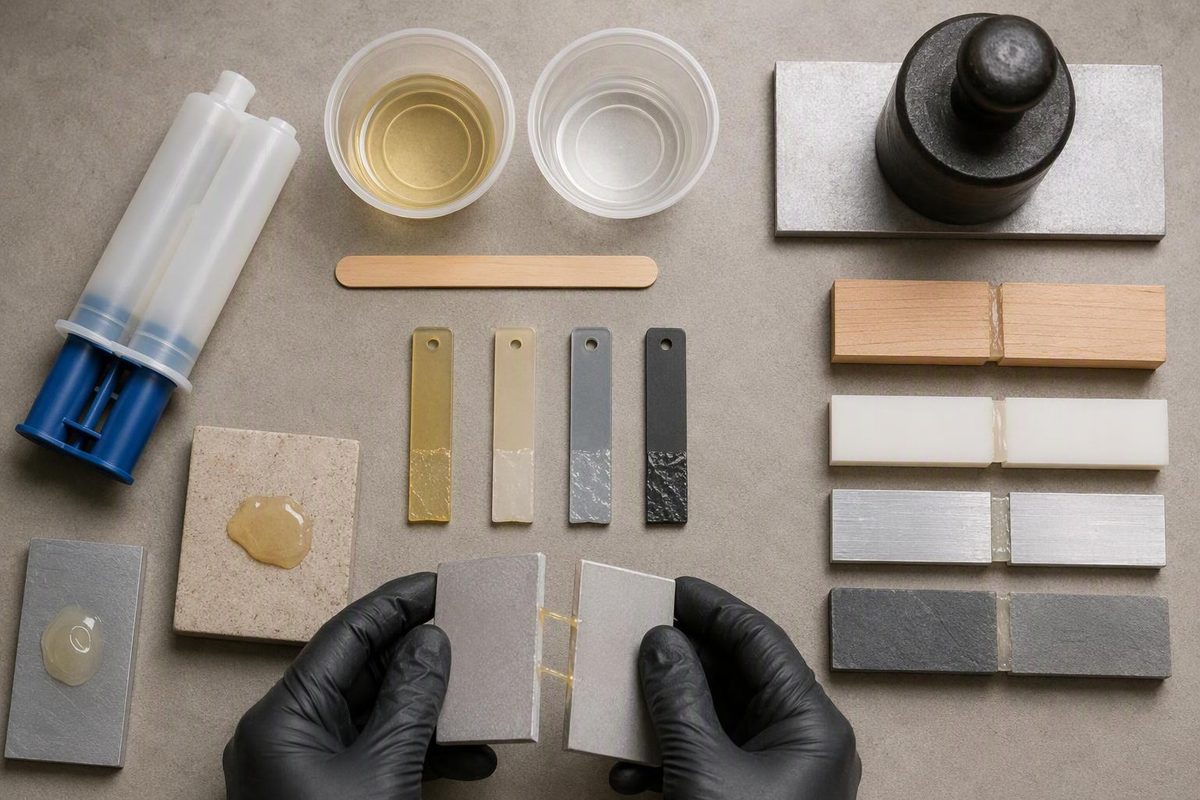
A “5 minute” epoxy is not necessarily ready for service in five minutes. The label may refer to work life or set time, while handling strength can take longer and full cure can still require 4–48 hours, depending on the product and temperature.
Before choosing one, check the current technical data sheet for five things: compatible substrates, maximum gap, work life, handling time and full cure. Then confirm that its water, temperature, chemical and load ratings fit the joint.
The four times that matter
| Datasheet term | Practical meaning |
|---|---|
| Work life / pot life | Usable time after resin and hardener are mixed. Mixing and dispensing consume part of it. |
| Open time | Maximum time after application before the surfaces must be joined. Not every manufacturer states it. |
| Handling or fixture time | When the assembly can usually be unclamped or moved carefully—not when it can necessarily carry its full load. |
| Working strength, structural strength or full cure | Later strength milestones. These terms are not interchangeable; use the manufacturer’s definition. |
Product figures show how far apart these milestones can be:
- Permabond ET500 has a 3–4 minute pot life, 5–8 minute handling time, 30–60 minute working-strength time and 24-hour full cure at 23°C (73°F). Its maximum stated gap is 2 mm (0.08 in), according to the ET500 technical data sheet.
- The industrial 3M DP100 Plus Clear data sheet gives a 2–5 minute work life, 15-minute handling-strength time and 5-hour structural-strength time at 23°C (73°F). Its directions state a 48-hour cure at 24°C (75°F). Maximum shear strength is obtained with a 0.08–0.13 mm (0.003–0.005 in) bond line under the stated conditions (3M technical data sheet, revised December 2025).
- J-B Weld KwikWeld lists a 6-minute set and 4–6 hour full cure, while the slower Original formula lists a 4–6 hour set and 15–24 hour cure (KwikWeld specifications; Original specifications).
These are product-specific figures, not timing rules for every fast epoxy.
When fast-set epoxy fits
Choose it when:
- Both substrates appear in the manufacturer’s compatibility guidance.
- The parts are small enough to coat and assemble within the work life.
- The joint has been dry-fitted and needs little adjustment.
- The adhesive’s viscosity and gap capacity suit the joint.
- Its cured environmental and load ratings suit the service conditions.
Fast cure is useful for small, prepared repairs and for spot-tacking parts while a slower structural epoxy cures. It is less forgiving on large bonding areas, multi-part assemblies and joints requiring careful alignment.
Do not assume every quick epoxy suits permanent wet or highly loaded service. WEST SYSTEM gives G/5 a 3–5 minute working time and 4-hour full cure at 22°C (72°F), but does not recommend it for long-term bonds under high load or moisture (G/5 product guidance). Qualify the individual formulation rather than approving or rejecting the whole category.
For metal joints, see the epoxy adhesive for metal guide. For plastics, identify the polymer first: ordinary epoxy is generally a poor choice for polyethylene, polypropylene and PTFE, as explained in does epoxy stick to plastic?.
Apply it before the clock runs out
- Dry-fit the assembly. Decide the clamp position and rehearse the sequence.
- Prepare the surfaces. Follow the product instructions for removing dust, grease, oxidation, release agents or unsound coatings. Abrade only where appropriate, then remove the debris. Surfaces should normally be clean and dry.
- Stage the tools. Put the applicator, mixing tools, timer, shims and clamps within reach.
- Use the specified ratio. A 1:1 package does not mean every epoxy mixes 1:1. With a dual cartridge, purge until both components flow before fitting the correct static mixer.
- Mix completely. Follow the label’s procedure and scrape across the mixing surface until no separate streaks remain.
- Apply, close and align immediately. Work life starts when the components mix, not when the parts touch.
- Fixture without starving the joint. Stop movement while preserving the required bond-line thickness.
- Wait for the relevant milestone. Set or handling strength may permit careful movement; loading, machining, immersion or heat exposure may require a later cure stage.
Temperature changes the schedule. The ET500 data sheet says lower temperature slows cure, while larger quantities or higher temperatures shorten usable life. Keep the adhesive, substrates and curing area within the manufacturer’s stated range, and preserve the specified mix ratio.
Keep batches small
Epoxy cure generates heat. A contained mass can become much hotter than the same quantity spread through a thin bond line. WEST SYSTEM reports that a contained 100 g mixed mass can reach 204°C (400°F) and warns that larger or thicker masses present more risk. It advises transferring mixed epoxy to a wide, shallow container and using an appropriate slower system for larger pours (uncontrolled-cure guidance). A fast-set bonding epoxy is not a substitute for a casting or deep-pour resin.
Read both component labels and safety data sheets. Prevent skin and eye contact, and follow the specified ventilation and personal-protective-equipment requirements. Do not clean epoxy from skin with solvent. Epoxy exposure can cause irritant dermatitis or sensitization; after sensitization, even small skin exposures can trigger an allergic reaction (NIOSH-hosted epoxy hazard alert).