
22 min read ·
Choose a Bond That Fits the Joint, Not Just the Materials
For long aluminum profiles bonded to glass, consider flexible silicone or MS polymer where thermal-expansion differences are substantial.
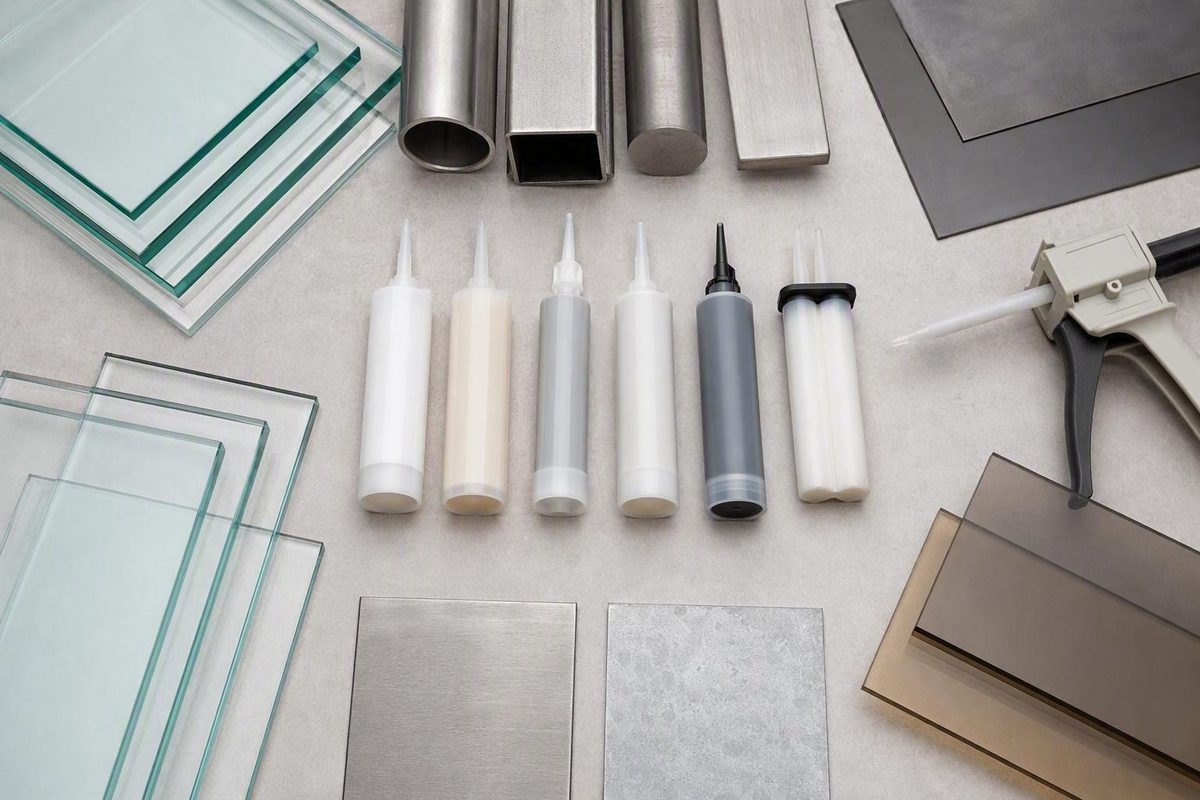
Glass can be bonded to metal, but “glass to metal adhesive” is not one universal product category. The correct choice must be compatible with the exact glass, the bare metal or finish, and the conditions the joint will face. Confirm all three on the product label and technical data sheet (TDS) before buying.
A small indoor ornament, a clear display joint, a rigid gap-filled repair, and a long outdoor aluminum profile are different bonding jobs. Joint size, gap, appearance, load, moisture, temperature change, vibration, and curing access can each change which adhesive family is appropriate.
Quick selector: which adhesive family fits your glass-to-metal project?
Start with the joint rather than the strongest claim on the package.
| Adhesive family | Typical use | Clarity | Rigid or flexible? | Gap filling | Curing requirement | Typical project scale | Principal limitation |
|---|---|---|---|---|---|---|---|
| Specialty glass glue | Small indoor repairs and decorative fittings | Clear products available | Product-dependent | Usually low | Product-specific | Small | Usually requires a close fit; exposure limits vary |
| Cyanoacrylate | Tiny, close-fitting, quick repairs | Usually clear, although appearance varies | Usually rigid | Very low | Thin layer and close contact | Small | Not the default for large, outdoor, moving, or loaded joints |
| Two-part epoxy | Permanent repairs, modest gaps, hard finished joints | Clear and colored versions exist | Usually rigid | Product-dependent | Accurate mixing and time-based cure | Small to moderately large | Rigidity may be undesirable where glass and metal move differently |
| UV-curable adhesive | Precise, appearance-sensitive joints | Clear options common | Product-dependent | Usually intended for thin layers; some gels differ | Specified light must reach the adhesive | Small to industrial precision joints | Metal can shadow the bond line and prevent complete cure |
| Structural acrylic | Durable product assembly | Clear and colored options exist | Often described as toughened | Product-dependent | May require an initiator, primer, or two-part process | Product making and industrial assembly | Cure method, color, and preparation vary significantly |
| Silicone or MS polymer | Long profiles and movement-prone assemblies | Clear and colored versions exist | Flexible | Product-dependent | Moisture or product-specific cure | Medium to large | May not provide the rigidity needed for precise, fixed alignment |
| Polyurethane, contact, multipurpose, or construction adhesive | General repairs or larger installations where expressly approved | Varies | Varies | Varies | Product-specific | Small repair to construction scale | The category name alone does not establish suitability |
For a small, closely fitted indoor repair, investigate a compatible specialty glass glue or cyanoacrylate. Loctite’s guidance places these products in small-repair roles and identifies epoxy when a gap or hard, rigid result is required. These are use-case distinctions, not proof that one chemistry is universally better. Loctite also advises checking the selected product’s material compatibility.
For a rigid joint with a modest gap, a compatible two-part epoxy is a common candidate. Its hard cured surface can be useful when a repair must later be sanded, drilled, or machined. That rigidity is not automatically beneficial in a long joint exposed to temperature changes.
For a thin, precise, visually discreet joint, consider a UV-curable adhesive only when the specified light can reach the entire adhesive layer. Cured material around an exposed edge does not demonstrate that adhesive hidden beneath an opaque fitting has cured.
For a durable product assembly, structural acrylics deserve consideration. Some are colorless; others are visibly colored. The selected product’s process controls.
For a long or movement-prone bond, flexibility may matter more than maximum rigidity. Permabond recommends considering flexible silicone or MS-polymer products for long aluminum profiles bonded to glass where thermal-expansion differences are substantial.
Multipurpose and construction adhesives are conditional options. Use one only if its documentation covers the exact glass, metal or coating, joint dimensions, exposure, and intended load.
The available evidence does not include sufficient independent, head-to-head testing to name one adhesive family or branded product as the strongest glass-to-metal adhesive overall.
Compare the main glass-to-metal adhesive technologies
Two-part epoxy
Epoxy combines resin and hardener. Compatible formulations may suit permanent repairs, larger bonding areas, modest gaps, or joints that need a hard finished surface. Some products can be sanded, drilled, or machined after cure.
Clear epoxies exist, but “clear” does not settle every appearance question. Check the selected product’s documentation for:
- Cured color at the intended thickness
- Bubble visibility
- Any yellowing-resistance claim
- Minimum and maximum gap
- Working, fixture, handling, and full-cure times
- Moisture and outdoor limits
- Service-temperature range
- Compatibility with the exact metal finish
- Primer requirements
Epoxy’s key design question is whether rigidity serves the joint. It may be appropriate between small, stable parts, but a long rigid bond can be a poor match where temperature changes cause the materials to move by different amounts.
UV-curable adhesive
UV-curable adhesive can provide useful positioning control because the parts may be aligned before deliberate light exposure. Suitable products are also offered for clear, precise bond lines.
The cure mechanism imposes a firm limitation: the specified wavelength and intensity must reach the adhesive in accordance with the product instructions. If a metal plate covers the adhesive, the hidden area may remain uncured even when the exposed perimeter appears hard.
Do not select a UV system without product documentation confirming that the intended geometry is workable. Particular concerns include:
- An opaque fitting that covers the bond
- A deep recess
- A layer exceeding the permitted cure depth
- A lamp that does not meet the specified wavelength or intensity
- An assembly too large or heavily loaded for the available product data
UV systems also differ in viscosity, flexibility, moisture resistance, color stability, cure depth, and primer requirements. “UV adhesive” describes a curing method, not a standardized performance level.
Structural acrylic
Structural acrylics are candidates for durable glass-to-metal assembly, particularly in manufacturing. Products differ in color, handling time, preparation, and cure process.
Permabond describes clear UV products, a colorless toughened structural acrylic, and a separate structural acrylic that is not suitable where a clear finish is required. Its instructions for one no-mix product place initiator on the metal and adhesive on the glass, demonstrating why one acrylic’s procedure cannot be transferred to another. Permabond’s technical guide distinguishes these UV, acrylic, and epoxy systems.
Before selecting an acrylic, determine:
- Whether it is transparent at the intended thickness
- Whether a primer or initiator is mandatory
- Which component belongs on each surface
- Whether a coating changes the preparation method
- How quickly the parts must be assembled
- Whether the stated gap and exposure limits suit the joint
Cyanoacrylate and specialty glass glue
Cyanoacrylate, commonly called super glue, is convenient for very small, close-fitting parts. Specialty glass glue may offer similarly simple application while being marketed for smooth, nonporous surfaces.
These products commonly specify a small amount. Some cyanoacrylate repairs can also develop a pale visible bloom, so make an appearance sample when clarity matters.
Permabond states that cyanoacrylate can initially bond glass to metal but may weaken over time and is generally better reserved for small parts. That does not contradict guidance describing super glue as fast and convenient: convenience in a tiny repair does not establish suitability for a large, outdoor, thermally cycled, or loaded assembly.
Flexible and multipurpose products
Their properties and curing requirements depend on the specific formulation.
A flexible product may be useful where movement or vibration is expected, but suitability still depends on:
- Adhesion to the exact glass and metal finish
- Permitted bond thickness
- Cure mechanism and depth
- Moisture, UV, temperature, and chemical limits
- Required stiffness
- Available strength data
- Whether mechanical support is necessary
Construction adhesives may be practical for some larger installations, but a general material list or retailer category does not prove suitability for every glass composition, coating, joint geometry, or load.
Examples, not a ranking
- Beacon markets Glass, Metal & More for glass and metal and states a 24-hour cure. Its descriptions—including waterproof, weatherproof, flexible, clear, and strong—are manufacturer claims rather than independent comparative results. See Beacon’s directions and product claims.
- Art Glass Supplies describes E6000 as a multipurpose adhesive that bonds glass and metal and cures clear and flexible. The listing does not provide glass-to-metal strength, service-temperature, or gap data. Review the retailer’s E6000 listing.
- Loctite and Gorilla publish brand-specific recommendations, while Permabond identifies UV, structural-acrylic, and epoxy systems. These are useful starting points, not independent rankings.
Treat terms such as permanent, high strength, crystal clear, non-yellowing, waterproof, and weatherproof as manufacturer or retailer claims unless relevant testing supports them for your substrates and service conditions.
Account for thermal movement and design the joint before choosing the glue
An adhesive can stick well during an indoor trial and still fail in service. Glass and metal may expand and contract by different amounts as temperature changes. When they are bonded together, the mismatch loads the joint.
Permabond supplies the following typical illustrative coefficients of thermal expansion, expressed as ×10⁻⁶/°C. These manufacturer-supplied values are not universal constants. The source notes that material selection and thermal cycling must be considered in glass-to-metal joints.
| Material | Typical value |
|---|---|
| Standard glass | About 8–9 |
| Mild steel | About 11–13 |
| Stainless steel | About 15–17 |
| Copper | About 16–17 |
| Aluminum | About 23–24 |
Actual values vary with glass composition, alloy, material condition, and temperature range. The figures nevertheless illustrate why aluminum-to-glass joints deserve particular attention: the cited aluminum range is farther from standard glass than the cited mild-steel range.
Thermal-movement concerns increase with:
- Longer bonded components
- Outdoor exposure
- Direct sunlight
- Heated parts
- Repeated temperature cycling
- Rigid fittings that restrain movement
A rigid epoxy may be suitable for a small, stable, gap-filled repair. The same type of joint may be unsuitable for a long aluminum strip on outdoor glass if the adhesive system and bond design cannot accommodate the expected movement. For long aluminum profiles, Permabond recommends evaluating flexible silicone or MS polymer.
Design for distributed loading
Permabond advises distributing stress evenly and avoiding point loading or tension during clamping.
Watch for:
- A small metal stud creating substantial leverage
- Force concentrated near a glass edge
- A fitting pulled away from the glass at one side
- Point pressure from clamps or weights
- Misaligned components held under continuing tension
- Uneven support across a broad joint
Bond-line thickness also needs control. A flexible adhesive may be specified with a thicker layer when movement is important, but there is no universal ideal measurement. Stay within the selected product’s minimum, maximum, and curing limits.
Too much adhesive can make alignment and appearance harder to control or exceed the permitted cure depth. Follow the product’s application method rather than assuming the thinnest possible layer is always best.
Large transparent joints require particularly consistent dispensing and even support because bubbles and incomplete coverage remain visible. Permabond recommends even pressure and attention to adhesive viscosity when reducing trapped air across larger areas.
Finally, assess the consequence of failure. A decorative object resting on a shelf is not equivalent to overhead glass, a railing, a door, or a loaded furniture fitting. Consequential applications require documented, application-specific design rather than a generic adhesive recommendation.
Prepare glass, bare metal, and coated metal correctly
Preparation begins with identifying the surfaces.
Determine the glass type where possible and look for tint, films, mirror backing, coatings, prior treatment, cracks, chips, or edge damage. Then determine whether the metal is:
- Bare
- Painted
- Powder-coated
- Anodized
- Plated
- Polished
- Lacquered or otherwise sealed
A practical preparation sequence
- Inspect both components. Stop if loaded glass is cracked, its edge is damaged, or a coating is loose.
- Remove old adhesive using a method permitted for the surfaces.
- Remove dust, grease, oil, fingerprints, and cleaning residue.
- Allow the surfaces to dry completely.
- Dry-fit the parts. Check overlap, gap, alignment, fixture placement, and cleanup access.
- For UV adhesive, trace the light path. Verify that the specified light can reach the entire bond line after assembly.
- Apply any required primer, initiator, or adhesion promoter exactly as directed.
Permabond advises cleaning glass with isopropanol or acetone without reintroducing fingerprints, then degreasing and, where appropriate, lightly abrading metal. Treat this as manufacturer guidance rather than a universal recipe.
A solvent suitable for bare glass may damage paint, polymers, mirror backing, seals, or nearby finishes. Scrapers and blades can scratch surfaces. Check the adhesive instructions and the substrate or finish documentation before using any of these methods.
Do not roughen glass by default. Only do so if the documentation for the particular glass and adhesive permits it.
Primers and initiators are not optional when specified. Structural-acrylic procedures illustrate how much systems can differ: one may place initiator on metal and adhesive on glass, another may use a mixed cartridge, and another may require a separate primer.
Run a representative compatibility test
For a noncritical project, use offcuts or a hidden area of the exact glass and metal finish. Duplicate:
- The intended cleaner and drying process
- Any permitted abrasion
- Primer or initiator
- Adhesive quantity and bond thickness
- Assembly pressure
- Full cure conditions
- Expected moisture exposure
- A representative temperature cycle, if relevant
- The intended loading direction
After cure, inspect the sample for poor adhesion, coating lift, clouding, staining, soft adhesive, cracking, corrosion, or other surface damage.
A successful sample reduces uncertainty. It does not establish an engineering load rating or certify a structural or safety-critical assembly.
Apply, secure, and cure the adhesive without confusing the time milestones
Before application, read the label, TDS, and Safety Data Sheet (SDS). Prepare the support fixture before opening or mixing the adhesive. Follow the stated ventilation and protective-equipment instructions; Loctite’s published process, for example, specifies ventilation, workspace protection, and gloves for its products. Its guide also separates product-specific holding, use, and full-cure times.
A technology-neutral workflow is:
- Protect the work surface and nearby finishes.
- Dry-fit the components and rehearse the assembly.
- Clean and prepare both substrates.
- Apply required primer or initiator and observe its timing rules.
- Dispense or mix the specified adhesive amount.
- Assemble within the stated working time.
- Support the joint evenly.
- Remove squeeze-out only by a permitted method and at the stated time.
- Leave the assembly undisturbed through the required milestones.
- Wait for service readiness or full cure as specified before applying the intended load.
Cure-time terms are not synonyms
- Working or open time: Time available to dispense, position, and assemble.
- Initial grab: Early resistance to movement.
- Fixture time: The stated point at which temporary support may be removable.
- Handling strength: Sufficient strength for limited handling, not necessarily service.
- Service readiness: The manufacturer’s stated point for a defined use.
- Full cure: Completion of the specified cure schedule under the stated conditions.
A fast grab, a hard exposed edge, or survival of gentle handling does not prove that the entire joint is cured or ready for its final load.
Two-part epoxy
Measure resin and hardener in the specified ratio and mix them using the product’s stated method.
Loctite gives a one-minute mixing time and 24-hour full-cure schedule for one described epoxy procedure. Those figures are product-specific and do not apply to every epoxy. Use the times on the current label and TDS.
Cyanoacrylate and specialty glass glue
Use the quantity specified and make sure the components fit closely. These products are commonly intended for thin interfaces. Excess adhesive is not automatically stronger and may create more visible squeeze-out.
Align carefully where repositioning time is short. Support the complete fitting instead of applying concentrated pressure at one point on the glass.
UV-curable adhesive
Reject the method if the selected product’s curing requirements cannot be met. Check:
- Whether metal shadows any adhesive
- Required wavelength and intensity
- Lamp distance
- Permitted cure depth
- Exposure time
- Whether the complete bond line can be verified as exposed
Craft Resin specifies a 395 nm, 5 W light held 1–2 cm away for 5–10 seconds for its named product and recommends exposure from both sides where possible. These settings are not general UV-adhesive instructions. The same guide limits that product to small, thin, light-accessible, nonstructural bonds.
Cure schedules differ substantially among products. Beacon states 24 hours for its adhesive. Gorilla’s described glass-to-metal process also specifies securing the parts and allowing 24 hours for full cure. Gorilla’s instructions remain specific to the named products and process.
Support the assembly without point pressure on the glass and leave it undisturbed for the complete specified period. Cure time alone does not establish allowable load, fatigue life, impact resistance, or thermal-cycling durability.
Match the adhesive to real glass-to-metal applications
Jewelry, ornaments, and small decorative fittings
Compare compatible specialty glass glue, cyanoacrylate, and UV adhesive.
Prioritize:
- Close fit
- Minimal squeeze-out
- Required clarity
- Positioning time
- Resistance to visible clouding or blooming
- Complete light access for UV curing
- Compatibility with plating and decorative coatings
A UV product may suit a transparent, precisely fitted piece when the entire adhesive layer can be illuminated. Specialty glass glue or cyanoacrylate may be simpler when the repair is small, closely fitted, and kept indoors.
Visible display joints
Compare clear UV adhesive, clear epoxy, and clear structural acrylic without assuming one is optically superior.
Check actual cured color, allowable thickness, bubble visibility, yellowing claims, primer visibility, and cure access. “Dries clear” does not establish long-term optical clarity. For a broad visible joint, make a full-size appearance sample under the intended lighting.
Modest gaps and hard repairs
A compatible two-part epoxy is a common candidate where the joint has a modest gap or needs a hard surface that can later be shaped. Verify the product’s maximum gap and decide whether its rigidity suits the expected movement.
Do not use epoxy merely to compensate for unstable or poorly fitting components. The joint geometry and adhesive dimensions must remain within the product’s limits.
Glass tabletops and loaded furniture fittings
For loaded furniture, the fitting and load path matter more than the words “high strength.”
Assess:
- How the load reaches the fitting
- Whether a small attachment creates leverage
- Point pressure on the glass
- Proximity to glass edges
- Impact and accidental side loading
- Thermal movement
- Consequences if the fitting detaches
Do not infer a safe load from a general glass-to-metal claim. Where detachment could cause injury, use a documented system and obtain competent design review.
Long outdoor aluminum-to-glass joints
Evaluate a flexible system documented for the exact substrates, exposure, and bond thickness. The cited typical thermal-expansion values show a comparatively large difference between aluminum and standard glass, making long joints and repeated temperature cycling particularly demanding.
Check water exposure, temperature limits, UV exposure, drainage, joint length, and the need for mechanical support. “Weatherproof” marketing alone is not an outdoor service specification.
Larger construction work
Some manufacturer guidance includes construction adhesives for larger glass-to-metal projects. That is only a starting category. Verify:
- Compatibility with the exact finish
- Environmental resistance
- Gap and bead limits
- Cure depth
- Joint orientation
- Applicable loads
- Need for spacers or mechanical retention
- Relevant building or glazing requirements
Do not assume adhesive replaces mechanical support merely because a product lists both material names.
Rear-view mirror buttons
Follow its exact preparation, orientation, application-temperature, and cure instructions.
Windshields and automotive glazing
Wurth lists separate rear-view-mirror products and automotive-glass urethane systems, including systems supplied with primer. Its category page does not provide enough technical information to approve a product for a particular vehicle or installation. Wurth’s listings illustrate the distinction between mirror-button kits and automotive-glazing products.
Follow the vehicle maker’s and adhesive manufacturer’s approved process or use a qualified auto-glass installer.
Stop points
Do not extrapolate from a general compatibility claim for:
- Structural glazing
- Overhead or suspended glass
- Railings and guards
- Doors with consequential failure risks
- Oven or appliance doors
- Aquariums
- Food-contact items
- Windshields
- Other regulated or safety-critical assemblies
Troubleshoot weak, cloudy, bubbly, or incompletely cured joints
| Symptom | Probable causes | Safe next check | Remake? |
|---|---|---|---|
| Adhesive peels cleanly from glass | Contamination, cleaner residue, incompatible coating, omitted primer | Inspect the failed interface and repeat preparation on a sample | Usually |
| Adhesive peels cleanly from metal | Oil, oxidation, incompatible finish, omitted preparation | Identify the finish and check the TDS | Usually |
| Paint or plating lifts with adhesive attached | Coating-to-metal failure | Test coating integrity and confirm whether bonding to it is permitted | Yes |
| UV adhesive remains tacky or liquid | Shadowing, wrong lamp, excessive distance, short exposure, thick layer, contamination | Verify the full optical path and all specified cure conditions | Yes if material inside the joint is uncured |
| Bubbles appear in a clear joint | Entrained air, unsuitable viscosity, excessive application, uneven pressure | Make a controlled sample using the documented dispensing method | Usually for appearance-critical work |
| Parts slip out of alignment | Insufficient support or fixture removed too early | Recheck fixture and handling-strength times | Yes if alignment is unacceptable |
| Bond fails after temperature changes | Movement mismatch, unsuitable rigidity, excessive joint length, exposure beyond limits | Reassess the joint design and service specifications | Yes, after redesign |
| Joint remains soft | Incorrect mixing, contamination, unsuitable cure conditions, expired material | Check ratio, procedure, conditions, and batch information | Yes |
| Clouding or a white halo appears | Excess adhesive, moisture, cleaner incompatibility, cyanoacrylate blooming | Test a smaller quantity or another compatible clear system | Usually for visible work |
When adhesive peels from one surface, do not immediately apply another bead around the perimeter. Determine which interface failed. Clean separation may indicate contamination, incompatible surface treatment, or an omitted primer.
If a coating lifts while the adhesive remains attached, adding more adhesive does not strengthen the coating beneath it. The substrate and finish must be reassessed.
Treat UV adhesive hidden beneath opaque metal as potentially uncured unless the selected system documents another applicable cure mechanism. If the complete bond line cannot be cured as specified, remove the joint from service and remake it using a suitable technology.
For bubbles in broad transparent joints, make a representative sample with controlled dispensing, suitable viscosity, and even support. Avoid applying more adhesive than the product requires.
Use only a removal method compatible with the adhesive and substrates. Acetone can affect some coatings and polymers; blades can scratch surfaces; abrasion can remove finishes. The relevant product and substrate instructions control.
Remake a contaminated, incorrectly mixed, incompletely cured, or badly aligned joint rather than covering the failure with a cosmetic bead. Repeated unexplained failure, cracked glass, damaged edges, or any safety-critical assembly warrants professional assessment.
Safety, specification checks, and claims you should not take at face value
Before purchase, find the current TDS and verify:
- Compatibility with the exact glass
- Compatibility with the bare metal, paint, plating, powder coat, or anodized finish
- Required primer, initiator, or adhesion promoter
- Minimum and maximum gap
- Permitted bond-line thickness
- Working, fixture, handling, service, and full-cure times
- Cure temperature, humidity, moisture, or light requirements
- Service-temperature range
- Moisture, UV, chemical, and cleaner resistance
- Relevant strength data on comparable substrates
- Joint-design limitations
- Storage life and application-temperature limits
Review the SDS for:
- Ventilation requirements
- Specified protective equipment
- Eye and skin exposure response
- Flammability
- Storage
- Spill and cleanup procedures
- Disposal
For UV systems, follow both the adhesive and curing-equipment instructions. The available evidence does not support one universal UV-exposure or protective-equipment protocol.
Marketing terms are not specifications. Permanent, industrial strength, waterproof, weatherproof, non-yellowing, and crystal clear do not establish performance on your exact surfaces and in your intended environment.
In particular:
- Water resistance does not prove suitability for continuous immersion.
- “Waterproof” does not approve an adhesive for aquariums.
- Clear curing does not establish long-term resistance to yellowing.
- Full cure does not establish a safe working load.
- High initial strength does not establish fatigue life.
- A room-temperature test does not establish thermal-cycling durability.
- General compatibility does not constitute approval for food contact, dishwashing, automotive glazing, or structural use.
Most available glass-to-metal recommendations come from manufacturers and retailers. They are useful for identifying candidates and following product-specific procedures, but they provide little independent comparative testing of strength, impact, fatigue, aging, or weathering. This guide should therefore be used as a selection framework, not as engineering approval or a project warranty.
Before proceeding, complete this go/no-go check:
- [ ] I have identified the exact glass.
- [ ] I know whether the metal is bare, painted, plated, anodized, powder-coated, or otherwise finished.
- [ ] The finish is sound and firmly attached.
- [ ] The product documentation confirms both surfaces.
- [ ] I understand the expected load and consequence of failure.
- [ ] The joint avoids concentrated pressure and distributes the load where practical.
- [ ] The selected rigidity or flexibility fits the expected movement.
- [ ] The gap and bond thickness are within the product limits.
- [ ] Moisture, temperature, UV, vibration, and chemical exposure are within the service limits.
- [ ] The cure method can reach the complete bond line.
- [ ] I can support the assembly without point pressure on the glass.
- [ ] I have checked the TDS, SDS, primer requirements, and cure milestones.
- [ ] I have tested the exact materials where appropriate.
- [ ] The application is not safety-critical—or it has documented, application-specific approval.
Frequently asked questions
What is the strongest glass to metal adhesive?
There is no evidence-supported universal winner. A structural acrylic or epoxy may be a candidate for a rigid, durable joint, while a flexible silicone or MS polymer may be better suited to a long assembly that must tolerate thermal movement.
Performance depends on the exact glass, metal finish, preparation, gap, joint geometry, cure conditions, and loading direction. Choose using relevant product data for comparable substrates and conditions rather than a generic “strongest” claim.
Can super glue bond glass to metal?
Yes. A compatible cyanoacrylate can bond glass to metal, particularly in a small, close-fitting indoor repair. Use the specified amount and confirm both-material compatibility on the label or TDS.
It is not the default choice for large gaps, outdoor exposure, substantial movement, thermal cycling, or loaded joints. Permabond also warns that cyanoacrylate adhesion in this pairing may weaken over time.
Will UV adhesive cure when the metal covers part of the bond?
Not reliably when the metal prevents the required light from reaching the adhesive. The exposed perimeter may cure while hidden material remains liquid or tacky.
Use a UV adhesive only when its specified light can reach the entire bond line at the required wavelength, intensity, distance, depth, and exposure time. If the fitting creates an unavoidable shadow, select another curing technology.
Which adhesive should I use for glass bonded to metal outdoors?
Begin with movement and exposure, not merely a waterproof claim. For a small, stable assembly, a compatible outdoor-rated epoxy or another documented system may be worth evaluating. For a long aluminum-to-glass joint, investigate a flexible silicone or MS polymer designed for the exact substrates, bond thickness, and environment.
Verify UV, moisture, temperature, and thermal-cycling limits in the TDS. “Weatherproof” or “waterproof” marketing alone is insufficient.
Can I use ordinary multipurpose glue for a rear-view mirror or windshield?
Do not use ordinary multipurpose glue solely because it lists glass and metal. A rear-view mirror button requires a purpose-specific mirror adhesive system.
Use a qualified installer where required. A general-purpose compatibility statement does not establish automotive safety or approval.
The practical selection sequence is straightforward: identify the exact glass and metal finish; define the load and consequence of failure; decide whether the joint needs rigidity or movement tolerance; measure the gap; choose the required appearance; account for moisture and temperature change; and confirm that the curing method can reach the complete bond line. Then check the current TDS and SDS and test the exact materials before committing.
For automotive, structural, overhead, aquarium, appliance, food-contact, or other safety-critical work, use a documented purpose-specific system or a qualified professional rather than extrapolating from a general glass-to-metal claim.