
4 min read ·
Choose Glue for Leatherette by Coating, Backing and Flex
Choose glue for leatherette by identifying PVC, PU or the fabric backing. Compare flexible cements, patching steps, cure and failure limits.
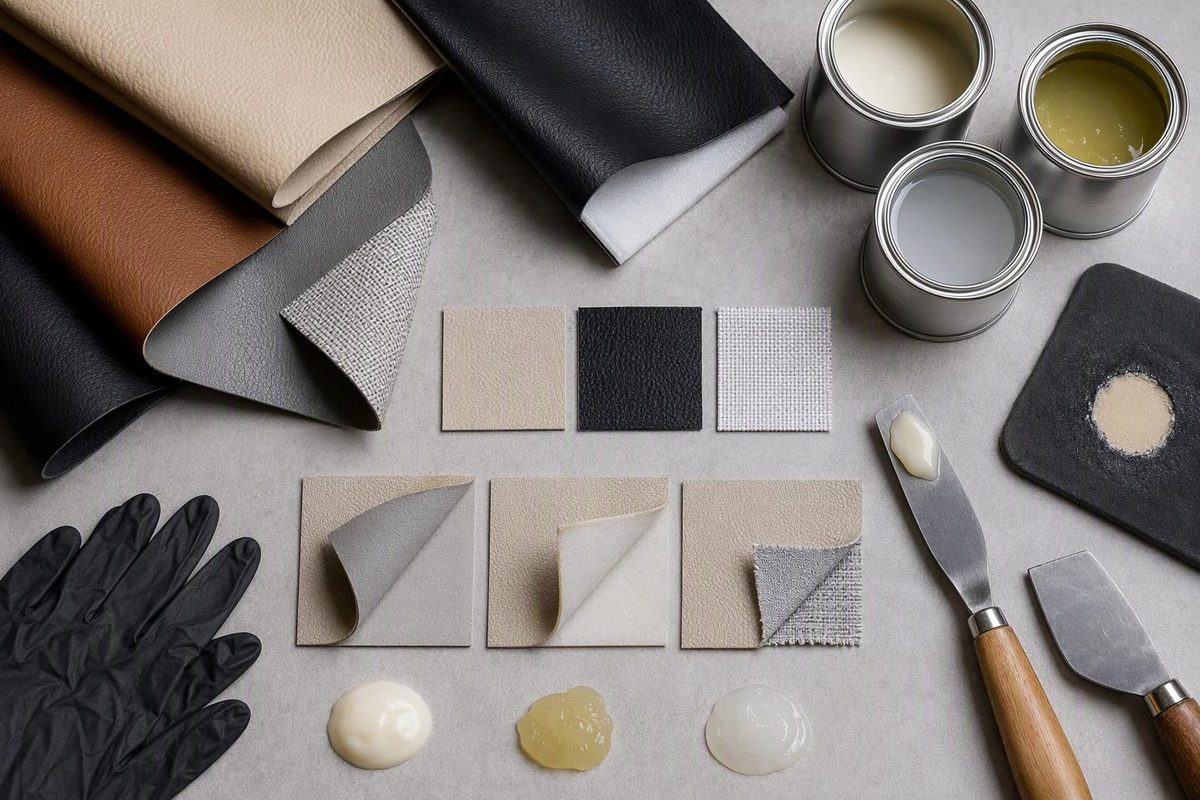
For PVC/vinyl leatherette, look for a flexible cement that explicitly lists PVC vinyl or vinyl-coated fabric. For PU leatherette, use only an adhesive whose current instructions name polyurethane (PU/PUR) and the other substrate. If a patch bonds to the fabric backing instead of the decorative face, choose for that backing and the material beneath it.
“Leatherette” describes an appearance, not one bondable material. It may be PVC-coated fabric, polyurethane-coated fabric or another synthetic construction. Do not choose glue from the leather-like finish alone.
Quick selection table
| Job | Adhesive to look for | Main limitation |
|---|---|---|
| PVC leatherette to a PVC patch | Flexible PVC/vinyl cement | Solvent may mark or distort a thin coating; test first |
| PU leatherette | Flexible adhesive explicitly approved for PU/PUR and the second material | Some systems require a primer or hardener; vinyl compatibility does not establish PU compatibility |
| Small split in vinyl upholstery | Flexible vinyl repair adhesive, normally used with a backing patch | A bead over the face does not restore torn reinforcement |
| Fabric backing to wood, board or firm foam | Upholstery or contact adhesive approved for both substrates | Excess adhesive can soak through or leave a visible ridge |
| Temporary positioning before sewing | Removable fabric or rubber cement approved for the materials | Not a substitute for the finished seam |
| Peeling, sticky or powdery coating over a wide area | Replace the panel or reupholster | Glue cannot restore a coating that is failing across the sheet |
For natural or bonded leather rather than synthetic leatherette, use the separate glue for leather guide.
Identify what will actually be bonded
Check the furniture label, fabric specification, repair manual or an offcut for PVC/vinyl or PU/polyurethane. Avoid burn tests and improvised solvent tests.
Also inspect the reverse. A backing patch can often provide more bond area than trying to bridge a tear with adhesive on the visible face. Its material—commonly a woven or knitted textile—then becomes one side of the joint.
If the coating cannot be identified, test the complete process on scrap or a hidden area. After the stated cure, check for discoloration, swelling, loss of grain, softening or persistent tack. A successful spot test reduces risk but does not prove that a badly degraded coating can carry a repair.
PVC/vinyl leatherette
A flexible vinyl cement is the direct category match, but verify the thickness and construction limits. HH-66, for example, lists PVC vinyl and vinyl-coated materials. Its manufacturer says to coat both surfaces, allow a 2–5 minute tack time, join while tacky, wait at least 1 hour before use and allow 1 day for the strongest hold. The same page says extremely thin vinyl is incompatible and recommends other adhesives for very soft, highly stretchy fabric-backed marine vinyl (RH Adhesives). Follow those times only for that product.
For a small indoor upholstery split, a repair-tube adhesive may be easier to control. 3M Vinyl & Leather Adhesive 18060 is described for splits and tears in vinyl upholstery and for bonding vinyl to surfaces including wood and metal. 3M says it remains flexible, dries clear and sets in 10 minutes (3M). Set time is not full cure; use the package directions before flexing or loading the repair.
PU leatherette
Do not assume that “vinyl glue” also bonds polyurethane. The product documentation should name PU or PUR, the other substrate and the intended service conditions.
Renia Colle de Cologne illustrates why the full process matters. Its footwear technical sheet addresses both plasticized PVC and PUR, gives material-dependent open-assembly times, and specifies a PUR primer for very soft polyurethane. It also calls for grinding and substantial pressing pressure (Renia technical data sheet). Those instructions may suit a shoe component but not a delicate upholstery face. Treat such a product as an option only when its preparation method is acceptable for the particular article.
How to patch a tear
- Assess the coating. If it crumbles under light handling or is peeling well beyond the tear, replace the panel rather than gluing it.
- Choose and dry-fit a flexible patch. Extend it onto sound material and round its corners to reduce peel points.
- Clean conservatively. Follow the leatherette maker’s care instructions. Use alcohol, thinner, acetone or abrasion only if both the material and adhesive instructions permit it.
- Apply a thin, even film. Follow the label on whether to coat one or both surfaces. Keep adhesive off the visible grain.
- Observe the tack or open time. Contact cement joined too wet may trap solvent; once ready, it may offer little opportunity to reposition.
- Align once and press evenly. Work from the center outward without stretching the leatherette out of shape.
- Immobilize for the stated cure. Do not treat “set,” “handle” or “initial bond” time as full cure.
Poor default choices
- Ordinary super glue: usually too rigid for repeatedly flexed coated fabric and may leave a hard, visible spot.
- Rigid epoxy: generally a poor match for a fold, seat or garment that must flex.
- Hot-melt glue: leaves a bulky bond line and applies heat to a potentially heat-sensitive coating.
- White PVA craft glue: may work on a porous textile backing in a light craft assembly, but it is not a default for a nonporous PVC or PU face.
Finally, check the exact safety data sheet. Many contact and vinyl cements are solvent-based and flammable. Barge, for example, directs users to provide ventilation and keep its products away from heat, flames, pilot lights and sparking equipment (Barge FAQ). “Toluene-free” does not mean nonflammable: HH-66 Toluene Free lists MEK, acetone and ethyl acetate and a flash point of 7°F (-14°C) (RH Adhesives).