
5 min read ·
Best Glue for Plexiglass to Metal: Choose by Joint and Movement
Choose plexiglass-to-metal glue by joint fit, load and movement. Compare epoxy, structural acrylic and silicone, with preparation and cure guidance.
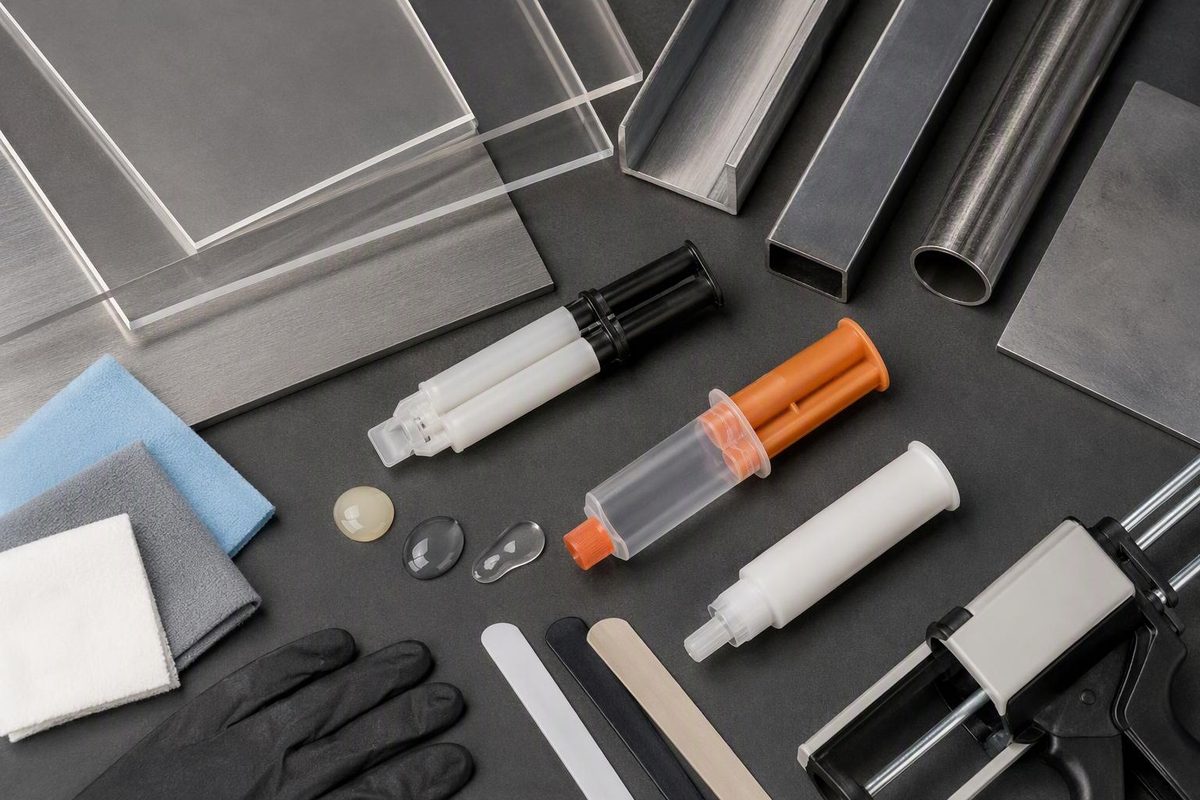
For a small, lightly loaded, close-fitting indoor joint, start with a two-part epoxy that has documented adhesion to acrylic (PMMA) and your metal. A slightly flexible grade is a useful candidate—not every “metal epoxy” is suitable for plexiglass. For a demanding structural assembly, investigate a toughened methacrylate adhesive explicitly rated for both substrates. For sealing a mechanically supported panel, use an acrylic-compatible flexible sealant rather than treating sealant as structural glue.
Confirm that the sheet is acrylic/PMMA, not polycarbonate. Also identify the metal’s actual bonding surface: bare aluminum, stainless steel, galvanized steel, paint and powder coating are different adhesive-selection problems. For other plastics, see our metal-to-plastic adhesive guide.
Choose by fit, load and movement
| Joint or task | Adhesive to investigate | Main limit |
|---|---|---|
| Small, lightly loaded indoor attachment with close-fitting faces | Two-part epoxy with PMMA and metal adhesion data | Do not assume metal-only strength figures apply to the mixed joint |
| Structural assembly, including acrylic attached to galvanized framing | Toughened structural acrylic/methacrylate rated for both surfaces | Requires application testing; appearance and cure heat matter |
| Supported panel needing a flexible weather seal | Acrylic-compatible neutral-cure silicone | A sealing product is not a substitute for load-bearing retention |
| Tiny, tightly fitting, lightly loaded part | Compatible cyanoacrylate | Acrylic can stress-crack; avoid excess adhesive and forced fits |
The documented examples below support the first three choices. Permabond’s stress-cracking guidance supports the caution for cyanoacrylate.
Large outdoor panels need movement allowances, not just stronger glue. ACRYLITE gives its Premium acrylic sheet a linear expansion coefficient of 0.000072/°C—approximately 1.2 mm per foot for a 56°C temperature change. A long joint to metal must accommodate the materials’ different movement. Use a mounting design that allows expansion; provide mechanical retention where a falling or detached panel could injure someone. ACRYLITE sign-design guidance
Prepare the surfaces before choosing the final product
- Dry-fit the parts without bending the acrylic into position. Favor overlapping faces over a narrow edge attachment. Measure the gap and check it against the adhesive’s permitted bond-line thickness.
- Clean the acrylic gently. Start with mild soap and lukewarm water, rinse thoroughly and allow it to dry. Do not use acetone or lacquer thinner: ACRYLITE warns that these can weaken the sheet and cause crazing—fine surface cracks. Do not assume concentrated alcohol is safe either. Use only a cleaner approved for the sheet and adhesive, and keep polish or antistatic treatments out of the bond area. If an adhesive’s general plastic-cleaning instructions conflict with the sheet guidance, obtain a compatible preparation procedure from the manufacturers before proceeding. ACRYLITE cleaning guidance
- Prepare the metal separately. Remove oil, dirt, rust and loose material. Where required, abrade the mating surface and remove the debris. Follow metal-specific preparation instructions; do not transfer a metal solvent-cleaning procedure to the acrylic. For coated metal, verify compatibility with the coating and that the coating itself is sound. 3M preparation instructions
- Abrade acrylic only where the selected procedure requires it. Scratches remain visible through clear sheet. Test the preparation and adhesive on matching scraps before committing to a visible joint.
- Arrange support before mixing. Use padded clamps or a jig that holds alignment without bowing the sheet. Keep the assembly stationary through the specified cure.
Documented products worth considering
Small close-fitting joint: 3M Scotch-Weld DP100 Plus Clear
DP100 Plus Clear is a 1:1 two-part epoxy, transparent and slightly flexible when cured. Its datasheet includes adhesion tests on PMMA, aluminum and cold-rolled steel, making it a documented candidate for a small acrylic-to-metal attachment. It is not proof of a particular mixed-material joint’s load capacity: the reported strengths are substrate-specific laboratory results, with a heat-assisted cure used for the main strength table. 3M technical datasheet, February 2019
The datasheet gives 3–4 minutes of working time, but its application instructions require applying the mixed adhesive within 3 minutes. Larger batches and higher temperatures shorten that window. It specifies 48 hours to cure at 24°C (75°F). Both the approximately 20-minute handling time and the listed “full cure” time are based on aluminum-joint strength—not your plexiglass assembly.
Follow the supplied mixing directions and maintain the recommended bond line; 3M specifies 3–5 mil (0.076–0.127 mm) for maximum shear strength. Do not squeeze the joint dry or copy the laboratory heat cure onto a finished acrylic part. Check the instructions supplied with the product before use.
Galvanized framing: SCIGRIP SG3000
SG3000 is a 1:1 toughened methacrylate whose manufacturer lists acrylic, aluminum, stainless steel and galvanized steel among recommended substrates. It is particularly relevant to galvanized-frame assemblies, not an automatic upgrade for every DIY repair. Its components are amber and black, so it is not a water-clear adhesive. Confirm the permitted gap and cure schedule for your assembly, and test the actual sheet and metal finish. The published bond-strength table does not establish an acrylic-to-metal load rating. SCIGRIP technical datasheet
Supported panel seal: Soudal Silirub PC
Silirub PC is a neutral-cure, permanently elastic silicone sealant. Soudal states that it does not cause stress cracking in non-prestressed acrylic glass and recommends preliminary adhesion and compatibility testing on every surface. It lists metals including anodized aluminum and stainless steel. Use it for a compatible flexible seal around a retained panel—not as an unverified structural attachment. Soudal technical datasheet, revised October 17, 2026
Its stated cure speed is approximately 2 mm per 24 hours, varying with conditions. Surface skinning does not mean a thick joint has cured. Follow its joint-dimension requirements; the same datasheet excludes aquarium bonding and continuous water immersion.
Avoid the acrylic-cement mix-up
An adhesive made from acrylic chemistry is not necessarily the same as an acrylic solvent cement. Ordinary solvent cement is intended to join acrylic surfaces; it is not the default for attaching plexiglass to metal. ACRYLITE describes solvent cementing as joining its sheet to itself or other acrylic surfaces. For that different task, see glue selection for acrylic plastic. ACRYLITE cementing guidance
For any selected adhesive, use the label and safety datasheet’s ventilation and protective-equipment requirements, mix only the needed amount, and wait for the specified cure before loading the joint.