
4 min read ·
How to Choose an Adhesive to Glue Wood to Concrete
Choose wood-to-concrete adhesive by load, moisture and joint fit. Compare construction and flooring products, preparation, support and cure times.
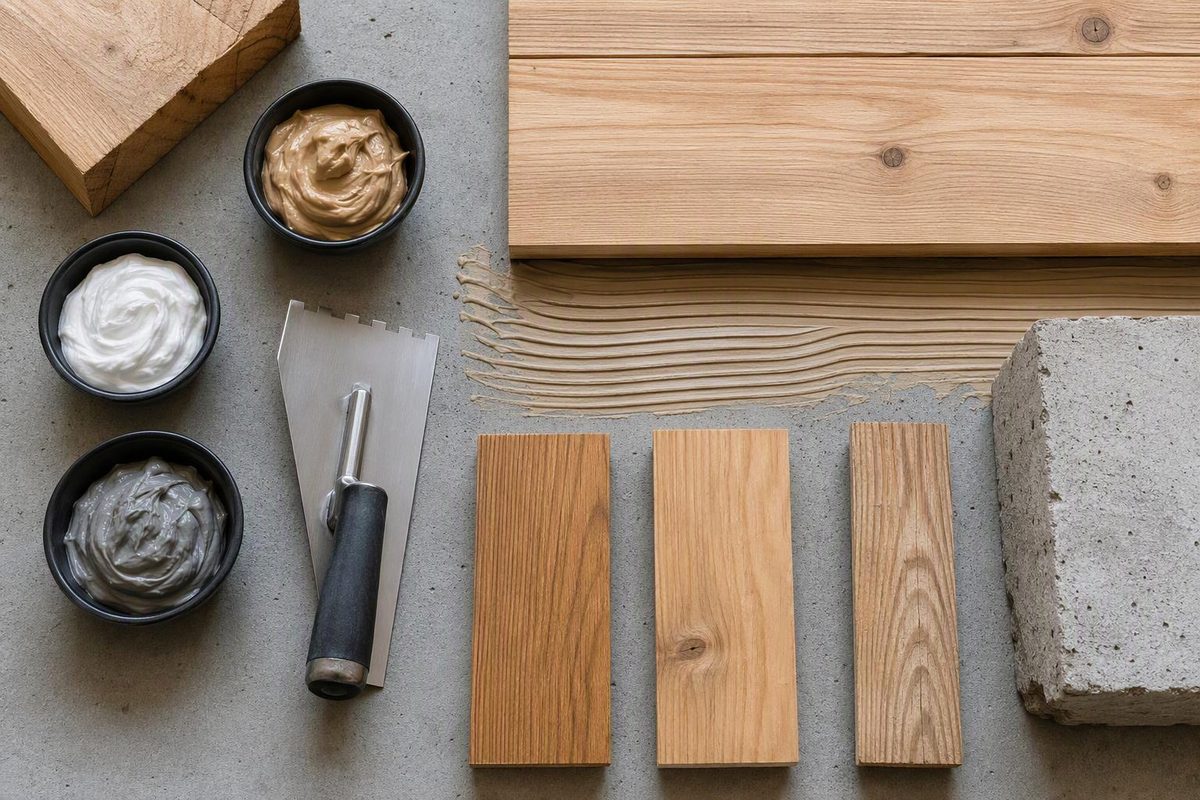
For nonstructural wood trim, moldings and similar attachments, start with a construction adhesive explicitly approved for both wood and concrete. A polyurethane construction adhesive is one documented option. For wood flooring, use a flooring-specific adhesive approved by the flooring manufacturer—not a general-purpose cartridge adhesive merely because its label lists hardwood.
The choice depends on the joint’s fit, load, moisture and temperature. Adhesive compatibility alone does not establish that an attachment is safe to carry a structural load. The product examples below use U.S. manufacturer documentation; check the instructions for the version sold in your market.
Match the adhesive to the job
| Job | Selection route | Main check |
|---|---|---|
| Lightweight trim or molding on concrete | Construction adhesive listing both substrates | Sound concrete, suitable bead application and support during cure |
| Exterior, nonstructural wood attachment | Exterior-rated wood-and-concrete construction adhesive | Application moisture limits, weather exposure and wood treatment |
| Engineered or solid wood flooring on a slab | Approved wood-flooring adhesive system | Flooring approval, slab moisture requirements, coverage and acclimation |
| Framing, load-bearing brackets, railings or overhead attachments | Designed fastening or anchoring system | Do not substitute general construction glue for specified anchors |
SikaBond Construction Adhesive, for example, lists wood and cement-based materials, with uses including floor moldings, door sills and lightweight construction materials. Its cured adhesive remains elastic. Those documented uses make it a candidate for nonstructural attachments, not a general structural design approval. Sika product data sheet
Before buying, dry-fit the wood. Check whether the mating face contacts the concrete without rocking or needing substantial force to hold it flat. If the gap is large or the board is badly bowed, correct the fit rather than assuming “gap filling” means unlimited adhesive thickness.
Prepare the surfaces first
- Check the concrete’s surface condition. It must be sound—not dusty, crumbling or covered by a weak surface layer. Remove oil, grease, loose material and curing-compound residue. Sika requires clean, dry, frost-free surfaces for its construction adhesive. A bead attached to loose material is not attached securely to the concrete beneath it. Preparation requirements
- Identify coatings and sealers. If concrete is painted or sealed, you are bonding to that coating rather than directly to concrete. Obtain approval for the exact surface or prepare the bond area as the adhesive manufacturer specifies. Do not add an arbitrary primer; flooring systems such as SikaBond-T21 warn that some primers can impair adhesion. SikaBond-T21 data sheet
- Check the wood’s bonding face. Remove dust and identify any paint, finish, preservative or oily surface. Treated lumber needs particular attention: PL Premium’s December 2019 technical sheet requires pressure-treated lumber to be well seasoned for at least six months in weather exposure. Verify the current product’s restrictions before choosing it for treated wood. PL Premium technical data sheet
- Resolve moisture conditions. Follow the exact product’s instructions. Exterior-rated or water-resistant after cure does not necessarily mean suitable for application to wet concrete, standing water or every damp slab.
- Arrange restraint before applying glue. Have weights, braces or suitable fasteners ready so the wood cannot slide, lift or spring away during cure. Protect visible finishes from squeeze-out. Read the current label and safety data sheet before handling the adhesive.
Two construction-adhesive options
Loctite PL Premium: general interior or exterior bonding
Loctite PL Premium is a one-component, moisture-curing polyurethane adhesive whose manufacturer lists both wood and concrete, along with interior and exterior uses. Loctite product information
Apply it to one surface and press the parts together within 15 minutes, following the current product page’s directions. The manufacturer-hosted technical sheet, revised December 2019, specifies 24 hours of mechanical support and 24–48 hours cure at approximately 25°C (78°F) and 50% relative humidity. Cold temperatures and low humidity extend cure. The product page gives a simpler 24-hour cure claim; follow the current package instructions for your product and conditions rather than treating 24 hours as universal. PL Premium technical data sheet
SikaBond Construction Adhesive: an elastic exterior option
SikaBond Construction Adhesive is a one-part polyurethane option for wood and cement-based materials. Its May 2026 data sheet specifies application at 4–38°C (40–100°F), clean and dry surfaces, and a 5–7 day cure. Heavier substrates may need additional support during that period. Sika product data sheet
These products illustrate why cure time must be checked by product, not inferred from the word “polyurethane.” Initial grab or a surface skin is not full cure.
Wood flooring needs a separate system
Do not substitute construction-adhesive beads for a flooring manufacturer’s specified full-spread installation. Use the approved adhesive, trowel, coverage and moisture-control procedure.
For example, SikaBond-T21 is a professional-use, interior wood-flooring adhesive that can also function as a moisture-vapor membrane. That protection requires 100% substrate coverage and adhesive transfer under its specified application conditions. Its July 2025 data sheet still excludes wet substrates, hydrostatic pressure and secondary moisture sources such as leaks; “unlimited moisture vapor protection” is not permission to install over a wet or defective slab. SikaBond-T21 requirements
For that job, follow the complete glue-down engineered hardwood sequence rather than the trim-bonding procedure above.