
4 min read ·
Best Glue for Foam to Plastic: Choose by Both Materials
Match foam-to-plastic glue to the foam, plastic and joint. Compare flexible adhesives, foam-safe CA and sprays, with preparation and cure guidance.
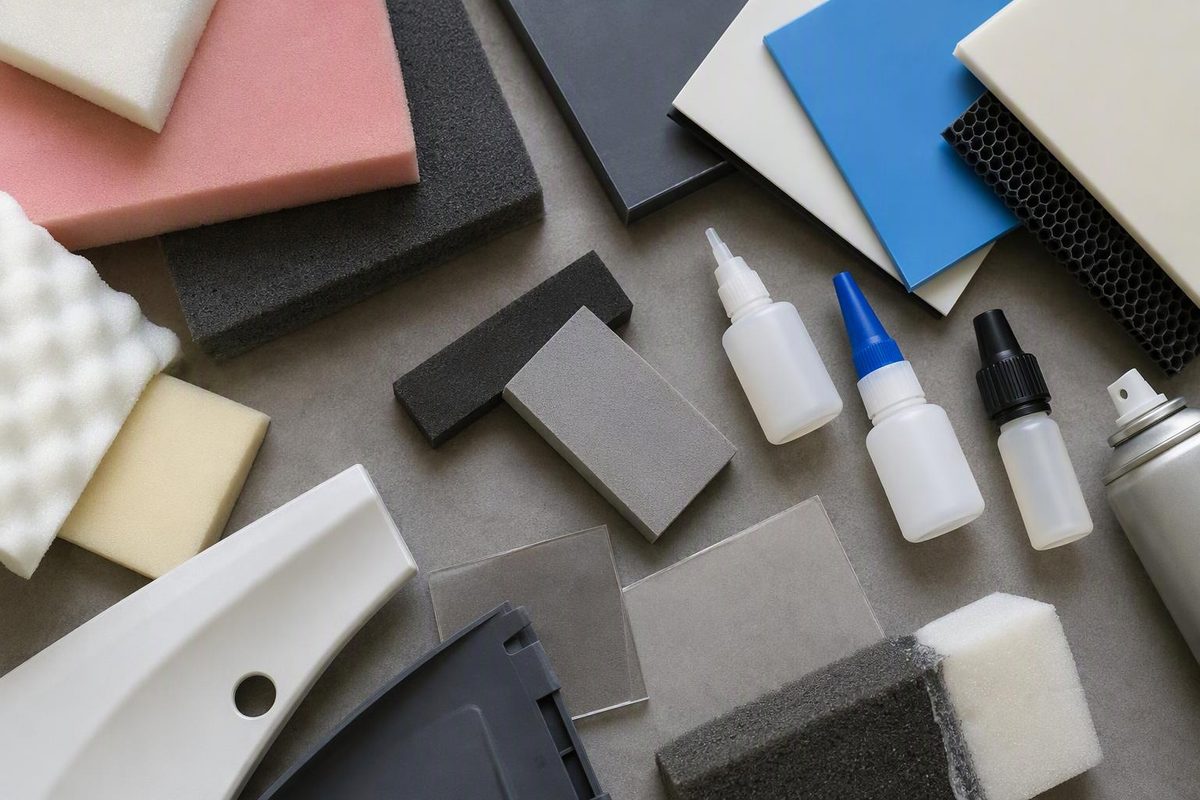
For a close-fitting foam-to-plastic joint that needs to flex, start with a flexible adhesive explicitly rated for both materials. Polystyrene foam needs a formulation that will not dissolve it; a polypropylene plastic part needs a bonding system capable of adhering to polypropylene. “Foam-safe” answers only half the compatibility question.
Identify and prepare the joint first
Find the foam specification on its packaging or supplier’s data: EPS or XPS polystyrene, flexible polyurethane, EVA, polyethylene, or another named foam. Check the plastic part’s marking or specification too—ABS, PVC, acrylic, PP and PE are not interchangeable adhesive substrates. If the foam has a film, foil or fabric facing, that facing is the actual bonding surface.
Before choosing a product, settle four things:
- Fit: Will the surfaces make continuous contact, or is there a gap? Do not assume a thin spray or contact adhesive will fill it.
- Movement and load: Will the foam repeatedly compress, or will an edge be pulled away from the plastic? Prefer a flexible bond for moving foam; use mechanical retention where failure could cause injury or damage.
- Exposure: Check the actual moisture, sunlight and operating-temperature requirements against the adhesive’s data. “Water-resistant” is not automatically approval for immersion.
- Appearance: For clear or visible plastic, test for haze, staining and surface damage as well as adhesion.
Dry-fit the pieces. Remove loose foam dust and clean the plastic using a method approved for that plastic; let both surfaces dry fully. UHU POR’s technical sheet and Beacon’s Foam-Tac directions both require clean, dry surfaces. Do not use acetone or another strong solvent as a universal plastic cleaner. For acrylic parts, see the separate acrylic adhesive selection guide.
Adhesives worth considering
These are compatibility-based candidates, not a tested ranking. None is a universal glue for every foam and plastic combination.
| Foam and job | Candidate | Important limit |
|---|---|---|
| Small expanded-polystyrene foam assembly on a compatible plastic | UHU POR, a flexible contact adhesive | UHU lists various plastics but explicitly excludes PP, PE, PET, PTFE, POM and silicone. Confirm your specific plastic before use. Technical sheet |
| Small foam assembly needing a clear, flexible bond | Beacon Foam-Tac | Beacon lists foams and plastics broadly, not a resin-by-resin compatibility table. Test the exact pair; do not treat that wording as verified PP or PE performance. Product and directions |
| Broad-area flexible urethane or latex foam bonding to compatible plastic in a workplace | 3M Foam Fast 74 aerosol | Its technical sheet names these flexible foams and plastics. It is an industrial/occupational product, not a consumer recommendation or a substitute for a polystyrene-specific adhesive. Technical sheet, 3M use restrictions |
| Small white-foam-to-hard-plastic model joint needing rapid assembly | BSI Super-Gold foam-safe cyanoacrylate | BSI lists white foam and hard plastics, but that does not establish compatibility with every plastic resin. If using accelerator, BSI warns that excess INSTA-SET can generate enough heat to melt foam. Manufacturer guidance |
If either material is PE or PP, pause before buying a general-purpose glue. For polypropylene, Permabond describes specialist polyolefin-bonding acrylic adhesives or surface treatment; its POP primer works only with cyanoacrylate. Any such adhesive or primer must also be approved for your foam. Do not assume sanding makes a general-purpose glue suitable for polypropylene. Permabond polypropylene guidance.
For EVA or polyethylene foam, ask for compatibility with the exact foam grade and plastic rather than assuming a product approved for polystyrene will work.
Apply it according to its own assembly schedule
Contact adhesives, sprays and instant glues do not share one procedure:
- UHU POR: Normally coat both surfaces and allow the adhesive to become touch-dry before joining. Its sheet says the joining point is reached about 5–20 minutes after application, depending on coating quantity and absorption; use the touch-dry criterion rather than the clock alone. Final bond strength is reached after 72 hours. Do not use below 5°C (41°F). The solvents are highly flammable; provide appropriate ventilation and keep ignition sources away. UHU instructions.
- Foam-Tac: Coat both surfaces evenly and air-dry for a few seconds. Press together and immediately pull apart; wait a few seconds, then repeat that press-apart step. Wait a few seconds more and firmly press together for the final bond. Allow 24 hours for cure before evaluating the joint. Beacon instructions.
- 3M Foam Fast 74 aerosol: Its May 2022 technical sheet gives a typical bonding range of 30 seconds–15 minutes; this is an assembly window, not a full-cure time. Follow the exact can’s directions and workplace safety requirements. 3M technical sheet.
Make a scrap bond before committing to the finished part. After the specified cure, flex and peel it in the direction the real joint will experience. Reject an adhesive that pits the foam, damages the plastic or releases cleanly under the expected load. If the foam tears instead, adhesion may be adequate—but the foam itself can still be too weak for the job.