
3 min read ·
How Can I Remove Super Glue From Plastic? Start With Warm Soapy Water
Soften cured super glue with warm soapy water and lift it gently. Use acetone or CA debonder only after confirming plastic compatibility.
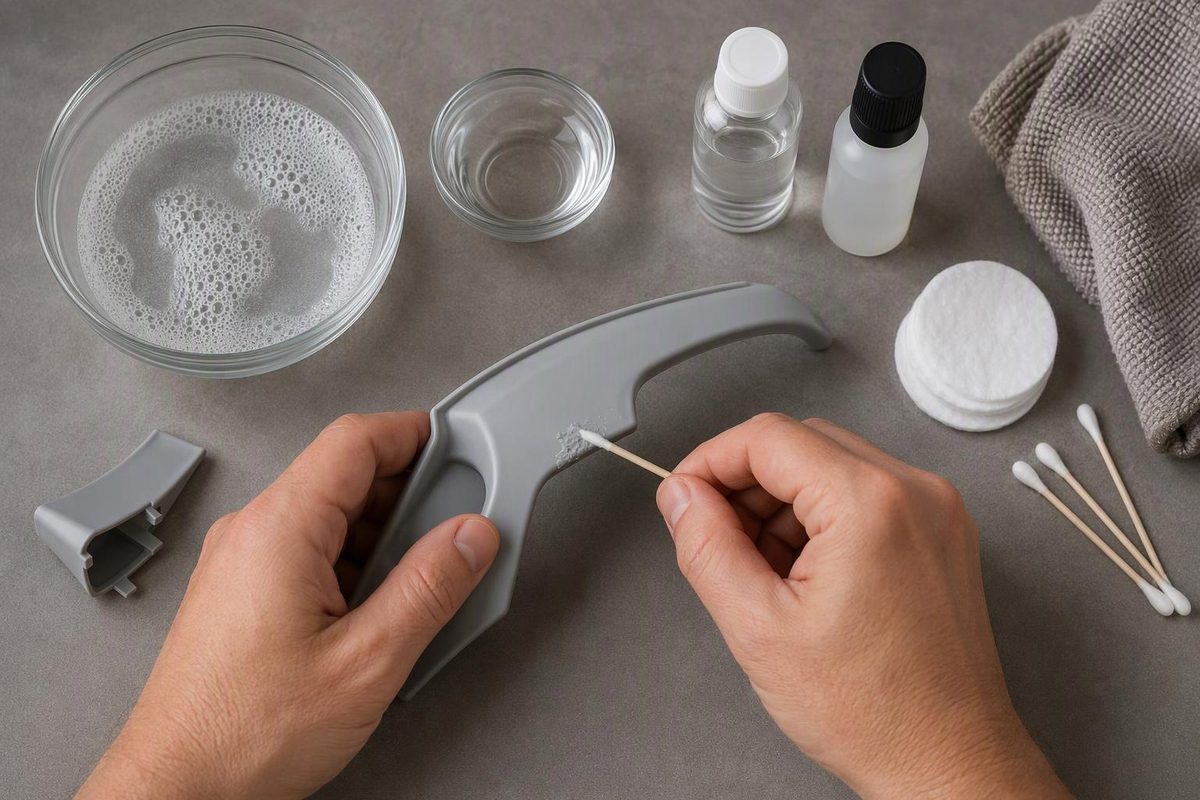
Start with warm water and dish soap—not acetone. Hold a wet, soapy cloth against the cured super glue, then gently work at a softened edge with a fingernail or plastic card. Repeat the soak rather than forcing the glue off.
Acetone removes cured cyanoacrylate, but it may discolor, soften, craze or dissolve plastic and damage paint or clear coatings. Gorilla warns that both acetone and isopropyl alcohol can damage some plastics, while Loctite notes that acetone or a sharp blade may damage plastic (Gorilla Glue; Loctite). Treat unidentified plastic as solvent-sensitive.
Use this removal sequence
- Check the adhesive. Confirm from the package or project history that the deposit is cyanoacrylate super glue. Epoxy, hot-melt glue and polyurethane adhesive require different removal methods.
- Check whether the object can get wet. Do not immerse electronics, laminated assemblies or anything with water-sensitive components. Apply a damp cloth only to the affected surface instead.
- Remove loose flakes. Pick off only material that releases without force. Avoid metal blades, which can gouge plastic.
- Soften the glue. Mix warm—not boiling—water with a small amount of dish soap. Immerse the area where safe, or press a saturated soft cloth against the deposit. Loctite’s guidance for plastic glasses recommends leaving the wet cloth in contact until the glue softens and repeating as necessary (Loctite).
- Work from an edge. Use a fingernail, plastic card or nonmetallic scraper at a low angle. Stop if the plastic starts to scratch, whiten or flex.
- Repeat, then wash. Several soak-and-lift cycles are safer than aggressive scraping. Rinse away the soap where the object permits and dry with a soft cloth.
If two plastic parts are bonded together, work soapy water into the seam and use only gentle wiggling pressure. Pulling or twisting may break the part before the adhesive releases.
When can you use acetone or CA debonder?
Use a solvent only when the plastic, finish and remover are known to be compatible. A recycling code may identify the base resin, but it does not identify paint, plating, a hard coat or all additives in the finished part.
| Surface | Safer decision |
|---|---|
| Plastic is unknown | Stay with warm soapy water and gentle mechanical removal |
| Clear, painted, plated or coated plastic | Avoid acetone unless the item manufacturer expressly permits it |
| Acrylic | Avoid a general-purpose CA debonder unless its data sheet lists acrylic; Permabond CA Solvent specifically says it is not recommended for acrylic (technical data sheet) |
| Polycarbonate | Avoid acetone; Plaskolite classifies it as incompatible with TUFFAK polycarbonate and explains that chemical exposure can cause swelling, dissolution or stress cracking (fabrication guide) |
| Exact material and finish confirmed compatible | Follow the remover label, use the smallest practical amount and test an inconspicuous area first |
A spot test may reveal immediate whitening, tackiness or color transfer, but it cannot establish long-term compatibility. Plaskolite notes that a hidden-area test shows only possible short-term effects and that chemical damage depends partly on stress, temperature and exposure time.
For a broader compatibility check, see where acetone is safe for super glue removal.
A purpose-made cyanoacrylate debonder is not automatically safe for plastic. Permabond says its CA Solvent can affect certain plastics and coatings. Its data sheet gives 15–30 minutes, with reapplication, for thick drops; bonded parts may require several hours. Those times apply to that specific nitroethane-based product, not every debonder. Check the current technical and safety data sheets for the remover you have.
Treat fresh spills cautiously
Do not mop up liquid super glue with cotton, paper towel or another cellulose material. Cyanoacrylate can polymerize rapidly on cellulose and generate heat, smoke and irritating vapor. A University of Reading safety data sheet says not to use a cloth for mopping and warns against contact with cotton or paper (safety data sheet). Keep people away, ventilate the area and follow the product label’s spill instructions. Do not reach for acetone unless the plastic is known to tolerate it.
If glue has reached skin, eyes or the mouth, deal with the exposure before the object. Do not pull bonded skin or eyelids apart. Poison Control advises rinsing an affected eye with water for 15 minutes and contacting a poison center for eye or mouth exposure (Poison Control).