
21 min read ·
When an Epoxy Repair Will Hold on Aluminum—and When It Won’t
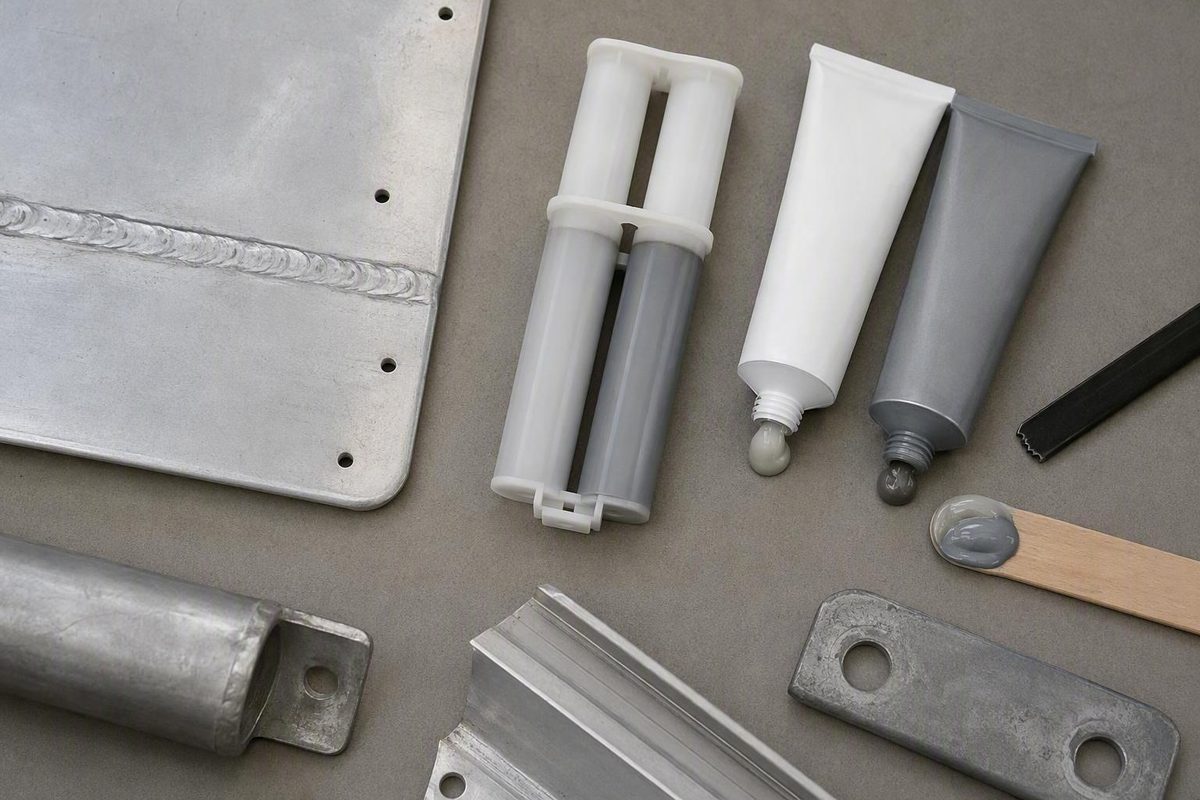
The short answer: yes, with important limits
Yes, J-B Weld can work on aluminum. The clearest manufacturer-documented example is MarineWeld Twin Tube, which explicitly lists aluminum among its compatible materials. It is a two-part epoxy for bonding similar or dissimilar surfaces—not a process that melts and fuses aluminum into a metallurgical joint. J-B Weld’s MarineWeld product page documents its aluminum compatibility and application requirements.
That distinction matters. Epoxy can bond parts, bridge gaps, rebuild contours, or seal some low-consequence leaks.
There are therefore two separate questions:
- Can the selected epoxy adhere to properly prepared aluminum?
- Is that rigid adhesive joint suitable for the component’s real service conditions?
The first depends on formulation, surface condition, cleaning, abrasion, mixing, and cure. The second depends on joint geometry, load direction, movement, temperature, fluids, wear, pressure cycling, and the consequences of failure. Material compatibility answers only the first question.
User experiences help illustrate the uncertainty, but they do not establish universal performance. In one aluminum dashboard-panel discussion, a quick-setting J-B Weld repair released after curing overnight in a shop reported to be about 55°F. The formulation, low temperature, cure duration, mixing, surface condition, and panel movement were all uncontrolled variables. The same discussion also included more favorable experiences, so it cannot prove that J-B Weld always succeeds or fails on aluminum. The Factory Five thread documents the reported cold-shop failure and the mixed user experiences.
Practical bottom line: rigid epoxy is most credible for static, non-critical bonding, filling, rebuilding, or sealing where there is ample prepared surface area and the surrounding metal still supports the part. Confidence falls when the aluminum flexes, vibrates, wears, carries a major structural load, contains repeated pressure, or belongs to a safety-critical assembly.
If failure could cause injury, loss of control, dangerous pressure or fluid release, or major equipment damage, adhesion alone is not sufficient validation.
Is your aluminum repair a good candidate?
Classify the repair by movement, loading, exposure, and failure consequences before selecting a product. That is more useful than asking whether J-B Weld is generically “strong enough.”
| Suitability | Typical examples | Why |
|---|---|---|
| Plausible | Rigid non-critical brackets, supported gap filling, cosmetic rebuilding, low-consequence static sealing | Movement and loads are limited, and failure is manageable |
| Questionable | Thin sheet, vibrating panels, repeated flexing, temperature changes, modest pressure, uncertain fluid exposure | Initial adhesion may not survive movement, wear, chemical exposure, or cycling |
| Stop and reassess | Structural cracks, loaded mounting areas, pressure vessels, safety-critical parts, high-wear surfaces | Neither informal testing nor material compatibility establishes adequate service durability |
Plausible candidates
A rigid, lightly loaded bracket can be a reasonable epoxy application if it has generous overlap, can remain immobile throughout cure, and will not be subjected to substantial prying, impact, or edge lifting. Cosmetic void filling and rebuilding a non-wearing edge can also be plausible.
Supported gap filling is another possible use. “Supported” is the key qualification: the surrounding aluminum should continue to position the component and carry its primary load. A large freestanding mass of cured epoxy should not automatically be treated as replacement aluminum.
Low-consequence sealing may also be acceptable when pressure is negligible, the exact formulation is compatible with the actual fluid, and renewed leakage would be an inconvenience rather than a hazard. Even then, the repair should be evaluated under realistic exposure rather than only on a dry workbench.
Questionable candidates
Thin aluminum sheet can move under handling, vibration, fastener tension, or temperature changes. A rigid epoxy may initially grip both surfaces but later release as the panel repeatedly bends.
Vibration is similarly difficult to assess through a one-time pull test. A bond that feels solid after cure may experience repeated edge-lifting loads in service. Bonding aluminum to a dissimilar material can add further movement as temperatures change.
Pressure requires caution as well. Passing one leak test does not demonstrate durability under repeated pressure cycles. Stress may be concentrated at a crack tip, thread, unsupported wall, or patch edge.
Unknown fluid exposure is another reason to pause. A general resistance label does not establish compatibility with every fuel, lubricant, hydraulic fluid, coolant, solvent, or cleaner. The exact substance, concentration, temperature, exposure time, and whether contact is a splash or continuous immersion all matter.
Stop-and-reassess cases
Structural cracks, steering or suspension parts, loaded engine or transmission mounting areas, brake-related parts, pressure vessels, bearing surfaces, and other high-wear or safety-critical components should not be validated through an informal epoxy trial.
A cracked aluminum transmission case illustrates why the component must be assessed before selecting a repair method. Crack location, missing material, mounting loads, heat, fluid exposure, internal pressure, and the original cause can all change the answer. In one application-specific discussion, participants first questioned whether the apparent defect was actually a crack and then favored inspection, replacement, or professional welding rather than relying on epoxy near a loaded mounting area. The transmission-case discussion emphasizes defect confirmation, crack location, loading, and cause.
Favor broad, supported loading
A rigid adhesive generally has a better chance when load is spread across a broad overlap and the surrounding structure limits movement.
Simply adding a thicker lump of epoxy does not eliminate that lever. The joint may still begin to separate at one edge.
Wear creates a different problem. In one reported aluminum repair, epoxy was used to restore roughly 1/16 inch of material over a machined surface. It could be shaped successfully and initially appeared sound, but it was quickly compromised in a moderate-wear location where the repair tapered to thin edges. The Eng-Tips account distinguishes successful machining from poor in-service wear durability.
That case does not prove every machined epoxy repair will fail. It does demonstrate that successful application and machining do not establish resistance to rubbing, chipping, or repeated contact.
Choose the exact J-B Weld formulation, not just the brand
J-B Weld is a brand covering multiple product families, including twin-tube epoxies, syringe adhesives, putty sticks, marine products, automotive products, sealants, and high-temperature repair materials. The manufacturer’s catalog includes aluminum as a surface or application category, but the catalog does not establish that every product is suitable for every aluminum repair. The J-B Weld product catalog shows its range of formulations and aluminum as a selection category.
MarineWeld Twin Tube is the best-documented option in the available evidence because its individual product page expressly names aluminum. The manufacturer lists:
- A two-component 1:1 mixing ratio
- A dark-gray cured color
- Water-resistant and oil-resistant attributes
- A 4–6 hour set time
- A 15–24 hour cure time
- A minimum of 15 hours before returning the object to use
- A stated tensile strength of 5,020 psi
These are manufacturer specifications for MarineWeld, not interchangeable specifications for every J-B Weld product. The page does not provide the test method, aluminum alloy, surface treatment, bond-line dimensions, joint geometry, temperature, or service conditions needed to convert that figure into a safe working load. J-B Weld provides the MarineWeld specifications and preparation directions on the product page.
The 15-hour minimum return-to-use statement should not be read as permission to ignore a longer cure requirement. Follow the current instructions for the actual temperature and application, and do not assume the repair is ready for full loading merely because the minimum return time has elapsed.
MarineWeld is therefore a documented option, not a universally superior answer. Before applying any formulation, verify its current label and technical information for:
- Compatible substrates
- Application and cure conditions
- Working, set, and full-cure times
- Service-temperature limits
- Water and chemical exposure
- Surface-preparation requirements
- Intended applications and restrictions
Do not transfer specifications between products merely because they share the same brand. A faster formulation may have a different ratio, working time, cure behavior, or environmental limits.
The cold-shop dashboard failure mentioned earlier is useful only as a warning about uncontrolled variables. It involved a quick-setting formulation, a cool workspace, an overnight cure, uncertain mixing and surface conditions, and panel components that may move. It does not establish that quick-setting products are inherently unsuitable for aluminum—or that a slower product would necessarily have succeeded.
Prepare aluminum so the epoxy bonds to the part
Surface preparation is part of the joint, not a cosmetic cleanup step. Unless the current directions for the selected product specify otherwise, use this sequence:
-
Inspect the damage and dry-fit the parts. Determine how the pieces meet, where adhesive can be placed, how much gap exists, and how the joint will be held. Investigate an unexplained crack, leak, or missing section before covering it.
-
Remove paint, corrosion products, old adhesive, and loose material. Bonding to a weak coating only attaches the epoxy to that coating.
-
Remove grease, oil, dirt, and process residue. Use a cleaner permitted by the current adhesive instructions and compatible with adjacent finishes, plastics, seals, and coatings. Follow the cleaner’s label and safety directions.
-
Roughen the bonding area. Use a file or coarse abrasive to remove polished smoothness and create a fresh, textured surface. The objective is useful bonding area, not deep damage to thin aluminum.
-
Prepare both mating surfaces. When bonding aluminum to aluminum, clean and roughen both faces rather than treating only the easiest one to reach.
-
Remove abrasion residue. Clear the residue without leaving lint, oil, or cleaner deposits.
-
Avoid touching the prepared area. Handle the parts outside the bond zone or use clean, suitable gloves.
-
Apply the mixed epoxy promptly. Arrange clamps, braces, tape, tools, and the mixing surface before final preparation so the cleaned parts are not left exposed on a dirty bench.
For MarineWeld, the manufacturer’s core procedure is to clean and degrease the surface, remove paint or loose debris, and roughen it with a file or coarse sandpaper. That is a sound baseline for this product.
Forum contributors frequently attribute aluminum-bond failures to contamination, oxidation, inadequate abrasion, or delays after preparation. Those explanations are useful troubleshooting possibilities, but they are user reports rather than controlled surface-science findings.
Do not prescribe one solvent for every repair
Acetone and brake cleaner commonly appear in user advice, but neither should be treated as a universal requirement. A cleaner may be inappropriate for the selected adhesive or may damage nearby paint, plastic, seals, or finishes.
Use a cleaner allowed by the current product instructions, and let the surface reach the required condition before mixing. Do not assume that rapid evaporation guarantees a residue-free or bond-ready surface.
Anodized aluminum requires product-specific judgment
The available user discussions disagree about whether anodizing should be retained or removed. A universal rule would ignore the type and condition of the anodized layer, the adhesive formulation, and the consequences of damaging the finish.
For a low-consequence job, consult the exact adhesive guidance or prepare a representative test using the same anodized material. For consequential work, obtain application-specific technical advice rather than improvising an unverified surface treatment.
Mix, assemble, and cure the repair correctly
Preparation cannot compensate for the wrong ratio, incomplete mixing, movement during set, or insufficient cure. Read the directions for the exact formulation before dispensing it.
For MarineWeld, the manufacturer calls for equal portions of the two components mixed thoroughly, followed by an even coat or bead. A practical sequence is:
- Arrange the prepared parts, mixing surface, tools, and fixture.
- Dispense the ratio specified for the product.
- Mix thoroughly until the material is uniform.
- Coat the intended bonding zone rather than applying an isolated dot where broad contact is needed.
- Assemble the parts without touching or contaminating the prepared faces.
- Bring the joint to its designed position.
- Clamp, tape, brace, or otherwise secure it so it cannot shift while setting.
- Remove only the excess that can be reached without disturbing the joint.
- Leave the assembly unloaded for the required cure period.
Working, set, cure, and return-to-service times differ
- Working time is the usable period for mixing, spreading, and positioning.
- Set time is when the material has developed enough body to resist minor disturbance.
- Cure time is the period required to reach the manufacturer’s stated cured condition.
- Return-to-service time is when the item may be used under conditions permitted by the product instructions.
Initial set does not mean the repair is ready for loading, machining, vibration, leak testing, or service. If the listed cure can take longer than the minimum return-to-use period, follow the requirement applicable to the actual repair rather than treating the shortest number as permission for immediate full loading.
Cure conditions matter. The reported dashboard separation after an overnight cure in a cool shop shows why room-temperature timing should not be extrapolated to a colder workspace without checking the selected product’s requirements. That single case does not isolate temperature as the cause.
An improvised heating method introduces another uncontrolled variable.
For consequential but non-safety-critical work, make a test coupon first. Use comparable aluminum, the same coating or anodizing, identical preparation, the same adhesive batch, and the same cure temperature. After full cure, expose the coupon progressively to the expected moisture, temperature, fluid, or movement. A coupon can reduce uncertainty, but it cannot certify a safety-critical component.
Design the joint for epoxy instead of asking glue to replace metal
A compatible epoxy can still fail because the joint was designed around the function of the original metal rather than the behavior of a rigid adhesive.
Increase useful overlap
Where practical, distribute the load across a broad, supported area. A backing plate or flange may reduce local bending, although any redesign still needs to suit the actual part.
Area alone is not enough. The surfaces must fit reasonably, remain clean, and stay fixed until cure is complete.
Reduce peel and prying
Rigid epoxy is a poor substitute for a hinge. If one component can lever away from the other, stress becomes concentrated at the adhesive edge.
Consider how the assembly moves under load, not merely where the force enters it.
Avoid feathered edges in wearing areas
Do not taper a functional epoxy rebuild to nearly zero thickness where it will be rubbed, struck, or scraped. A feathered transition may look smooth after sanding or machining, but it leaves a vulnerable edge.
If the geometry cannot provide a supported perimeter, replacement or an application-appropriate metal-repair process may offer a more suitable wear surface.
Distinguish gap filling from metal replacement
Epoxy can occupy a void where two parts do not fit perfectly. That does not mean a large unsupported block of cured adhesive can replace a missing lug, threaded boss, bearing surface, flange, or structural section.
Evaluate what the original metal carried. Filling the same volume does not necessarily restore resistance to bending, impact, thread loads, clamp forces, or repeated contact.
Match the adhesive to panel movement
Thin aluminum panels may flex under vibration, temperature changes, handling, or fastener movement. A rigid adhesive over a small area can release at the edge even when its initial adhesion is good.
Mechanical fasteners may be preferable where the connection must carry a defined load or remain inspectable. Neither is automatically superior; the choice depends on the joint, environment, and consequences of release.
Machinability is not wear resistance
J-B Weld says cured MarineWeld can be shaped, tapped, filed, sanded, and drilled. Those finishing options can be useful for cosmetic rebuilding, a non-wearing contour, or a carefully positioned hole.
They do not establish that the repaired material can serve as a bearing, heavily loaded thread, sliding surface, sealing face, or impact zone. Reinforcement or fasteners may form part of a better design, but they are redesign choices—not guaranteed upgrades. A screw placed through already weakened aluminum can introduce another concentrated load.
Why J-B Weld releases, cracks, or wears away
Diagnose failure by examining the failed surfaces. “It did not stick” can describe several different mechanisms.
Clean release from the aluminum
If the cured epoxy separates and leaves relatively clean metal, investigate:
- Grease, oil, fingerprints, or polishing compounds
- Cleaner residue
- Paint or a weak coating in the bond zone
- Loose corrosion products or abrasion debris
- Insufficient roughening
- Recontamination after preparation
- Too little bonding area
- Peel or edge-lifting loads
- Movement while setting
- Loading before full cure
Inspect both sides. If epoxy remains attached to one part but not the other, the preparation or surface condition may have differed.
Soft, rubbery, or tacky epoxy
If the material remains soft beyond the specified cure period, check:
- Whether the ratio matched the exact formulation
- Whether both components were dispensed
- Whether they were mixed uniformly
- Whether unmixed material from the edge of the mixing area was applied
- Whether the curing conditions met the product instructions
- Whether sufficient cure time elapsed
- Whether contamination may have interfered
Do not cover uncured material with another coat and assume the new layer will correct the foundation. Remove the failed material and identify the cause before starting again.
Cracking within the cured epoxy
A fracture through the epoxy rather than at the aluminum interface points toward possibilities such as:
- Excessive movement
- Impact
- Temperature cycling
- An unsupported gap
- A thick mass carrying bending loads
- A stress concentration
- A load pattern poorly suited to a rigid adhesive
Adding more epoxy may not solve the problem if the assembly continues to flex. The repair may require different geometry, a flexible adhesive, a mechanical connection, welding, or replacement.
Edge lifting, chipping, or flaking
When failure starts at a thin perimeter, inspect for:
- Feathered transitions
- Abrasion or direct contact
- Peel loading
- Inadequate edge support
- Sharp changes in section thickness
- Damage during finishing
- Repeated flexing
A larger cosmetic fillet may protect an otherwise suitable edge, but it cannot make a heavily loaded or high-wear surface appropriate for epoxy.
A leak that returns
Cracks, threads, and unsupported walls can move as pressure changes.
One cast-aluminum air-cap demonstration shows the limits of a short test. The first epoxy application still leaked near the threaded nipple. After a second application bonded and sealed the nipple to the cap, the assembly reportedly passed a brief bubble test at 150 psi. No long-term vibration, temperature, or repeated-pressure testing was provided. The air-cap video documents both the initial leak and the limited second test.
That demonstration should not be treated as approval for pressure vessels or consequential pressure-containing equipment. It shows only that the particular assembly did not visibly leak during that brief test.
Retesting a low-consequence repair
Where failure would be inconvenient but harmless:
- Remove all failed and poorly bonded material.
- Examine where separation occurred.
- Identify the most likely failure mode.
- Correct the preparation, geometry, mixing, cure, or fixture.
- Make a representative coupon if practical.
- Allow the full specified cure.
- Begin with a gentle test.
- Increase load, movement, moisture, or temperature progressively.
- Inspect the edges and interface between stages.
- Stop if lifting, cracking, softening, or leakage appears.
Do not use progressive DIY testing to validate a safety-critical repair.
Water, oil, heat, vibration, and pressure: read each claim narrowly
MarineWeld is labeled water resistant and oil resistant, and the manufacturer says the cured material retains strength above or below the water surface. These statements apply to MarineWeld and should be interpreted within its current instructions.
Water resistance after cure does not prove that the product can be applied successfully to wet aluminum. Its documented application process calls for cleaning, degreasing, removing loose material, and roughening the substrate.
Likewise, an oil-resistance label does not establish compatibility with every:
- Gasoline or diesel fuel
- Brake or hydraulic fluid
- Coolant
- Transmission fluid
- Solvent
- Cleaning chemical
- Lubricating oil
Confirm compatibility for the actual substance and formulation. Account for temperature, concentration, immersion versus occasional splash, and exposure duration.
Heat also requires product-specific limits. One epoxy formulation’s cure or service conditions should not be transferred to another. Cure temperature and service temperature answer different questions.
The available manufacturer information and anecdotal reports do not establish quantified long-term MarineWeld performance under vibration, abrasion, temperature cycling, or repeated pressure cycles. A tensile figure, machining statement, cured-water claim, or short leak test does not fill those gaps.
For a low-risk repair, reproduce the expected environment as closely as practical:
- Cure the sample under the same conditions as the actual part.
- Expose it to the actual fluid rather than a substitute.
- Reproduce likely temperature changes.
- Introduce representative panel movement or vibration.
- Inspect after repeated cycles rather than one load.
- Check the edges as well as the center of the bond.
If testing could release hazardous pressure, fluid, fragments, or stored energy, it is not an appropriate DIY validation method.
When to use fasteners, flexible adhesive, welding, or replacement instead
Choose the alternative according to the expected failure mode. No method is universally strongest.
| Main concern | Option to consider | Reason |
|---|---|---|
| Defined mechanical load or need for inspection | Engineered rivets, screws, bolts, or another mechanical connection | Hardware carries the load instead of relying entirely on adhesion |
| Thin-panel movement or vibration | Compatible flexible panel adhesive | Greater movement accommodation may reduce edge stress |
| Structural crack or highly loaded casting | Qualified inspection and professional welding or replacement | The crack and load path require application-specific evaluation |
| Consequential pressure containment | Engineered repair or replacement | A brief leak test cannot establish pressure capacity or fatigue life |
| Severe wear or sliding contact | Replacement or purpose-designed restoration | Machinability does not prove durable wear performance |
| Unclear damage | Inspection before repair | A casting feature, leaking seal, or deeper defect may resemble a surface crack |
Mechanical fasteners
Consider rivets, screws, bolts, or another engineered mechanical connection where the assembly carries meaningful loads, must remain inspectable, or would be unsafe if an adhesive released.
Fasteners still require sound parent material and a design that does not create damaging local stress. Adding random screws to cracked or weakened aluminum is not automatically safer than an adhesive repair.
A combined adhesive-and-fastener joint may distribute load or seal an interface, but it must be treated as a combined design. One fastener does not certify an otherwise unsuitable patch.
Flexible adhesive
A flexible adhesive may be a better fit where sheet aluminum vibrates or expands and contracts.
Flexibility, gap-filling ability, cure behavior, chemical resistance, and load capacity vary among formulations. Select a product by documented compatibility with both substrates and the actual environment, not merely by the word “flexible.”
Welding or engineered metal repair
Structural cracks, loaded mounting points, highly stressed castings, and consequential pressure components require qualified assessment. Depending on the alloy, casting condition, access, contamination, heat treatment, and damage, the appropriate response may be professional welding, engineered reinforcement, or replacement.
Welding is not automatically feasible merely because the part is aluminum. Heat-treated aluminum also raises application-specific concerns. In one discussion about loose-fitting 7075 aluminum tubing, participants favored epoxy partly because it could fill gaps without heating the tubing, and one contributor reported a strong J-B Weld tube joint. The results were anecdotal and included no measured long-term loads. The 7075 tubing discussion presents gap filling and avoided heat as application-specific reasons for considering epoxy.
Replacement
Replacement is often the clearest choice when:
- The original cause of failure remains active
- A crack is growing
- Material is missing from a loaded feature
- A sealing face or threaded boss is damaged
- The part experiences wear, fatigue, or repeated pressure
- Proper preparation is impossible
- The repair cannot be inspected
- Failure consequences are high
Compare replacement cost with the total repair risk, not merely with the price of the epoxy.
Confirm the defect first
Before grinding or covering a suspected crack, determine what it is. A casting line may resemble a fracture. A nearby seal or thread may be the actual source of a leak. Damage near a mount may result from misalignment or another failed component.
Clean and inspect the part before altering it. If the defect remains uncertain, have it evaluated by someone qualified for the equipment and material.
Final decision checklist
Before using J-B Weld on aluminum, ask:
- Does the exact formulation document aluminum compatibility?
- Can both surfaces be cleaned, degreased, and abraded properly?
- Is the joint rigid, or will it flex and vibrate?
- Will the adhesive see broad supported loading or peel and prying?
- Is there enough overlap and edge support?
- Will the repair encounter abrasion or sliding wear?
- Are application and service temperatures documented?
- Is compatibility confirmed for the actual fluid?
- Is pressure static, repeated, or safety-consequential?
- Can the assembly remain fixed throughout cure?
- Can a low-risk test reproduce realistic conditions?
- What happens if the repair releases without warning?
J-B Weld can adhere to aluminum when a compatible formulation is applied to a clean, degreased, abraded surface and mixed and cured as directed. The decisive question is whether a rigid adhesive suits the joint’s movement, wear, heat, fluid exposure, pressure, and failure consequences. Use it selectively for static, non-critical work; consider fastening, flexible adhesive, professional welding, engineered repair, or replacement when the part is moving, loaded, pressurized, structural, or safety-critical.
Frequently asked questions
Which J-B Weld product is documented to work on aluminum?
MarineWeld Twin Tube is explicitly documented by J-B Weld as compatible with aluminum. It is the clearest supported example here, but it is not necessarily the best product for every aluminum application. Verify that its cure conditions, temperature limits, fluid resistance, and intended use match the repair.
The broader J-B Weld catalog also includes aluminum as a surface or application category, but that does not mean every formulation has identical compatibility or performance.
How long should J-B Weld cure on aluminum before use?
Use the schedule for the exact formulation. Set time, full cure, and return-to-service time are not interchangeable. Do not load, machine, vibrate, or pressure-test a repair merely because it feels hard.
Where the stated cure window extends beyond the minimum return-to-use time, follow the requirement applicable to the actual conditions and load. A minimum time should not be treated as approval for immediate full loading.
Can cured J-B Weld on aluminum be sanded, drilled, tapped, or machined?
J-B Weld says cured MarineWeld can be shaped, tapped, filed, sanded, and drilled. That can be useful for a cosmetic rebuild or non-wearing contour.
Machinability does not establish structural capacity or wear resistance. Keep machined epoxy away from duties that depend on parent-metal strength, durable threads, bearing contact, sliding wear, or impact unless the application has been properly designed and validated.
Will J-B Weld hold on a flexible or vibrating aluminum panel?
It may adhere initially, but rigid epoxy is a questionable choice where the panel repeatedly flexes or vibrates. Movement can concentrate stress at the bond edges and cause separation even after good preparation.
A compatible flexible panel adhesive or an engineered mechanical fastener may better match that behavior. The correct choice depends on load, movement, exposure, inspectability, and the consequences of release.
Can J-B Weld safely repair a cracked aluminum transmission case or pressurized part?
Do not assume so. Crack location, mounting loads, heat, fluid exposure, missing material, pressure cycling, and the reason for the damage all require assessment. A loaded transmission mounting area is fundamentally different from a static, low-consequence cosmetic defect.
A brief pressure test without visible leakage also does not establish fatigue life or safe long-term pressure capacity. Consequential transmission cases and pressure-containing parts should be directed toward qualified inspection, an engineered repair, professional welding where appropriate, or replacement.