
3 min read ·
Does Wood Glue Work on Plastic? Usually Not
Ordinary PVA wood glue is a poor default for plastic. Identify the plastic and joint, then choose an adhesive explicitly rated for both surfaces.
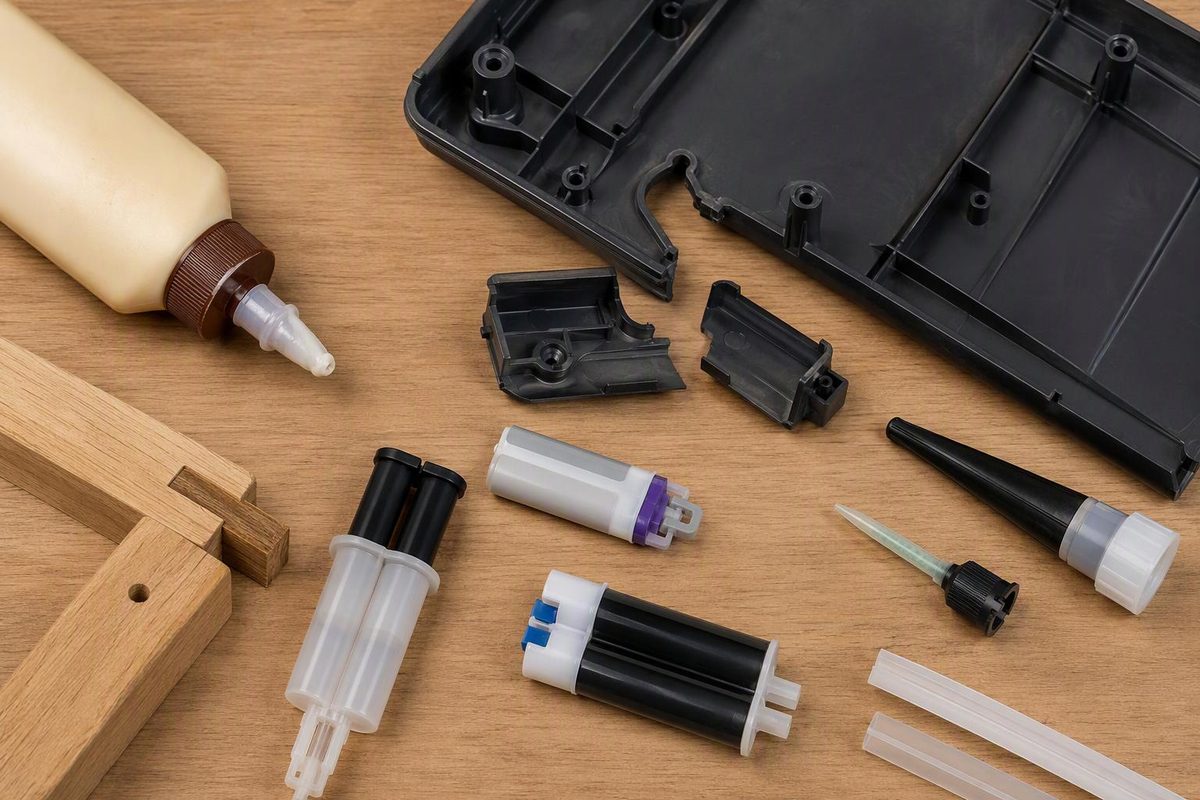
Ordinary white or yellow PVA wood glue is not a reliable default for bonding plastic to plastic—or plastic to wood. Use it only if the manufacturer explicitly supports your materials and application. PVA adhesives are best suited to porous materials; Gorilla Wood Glue, for example, is specified for wood, hardwoods and natural wood composites, not plastic. See Bostik’s PVA guidance and Gorilla’s product guidance.
However, polyurethane glue used for woodworking is a different adhesive chemistry, and some formulations bond compatible plastics. Check the exact product, not just the words “wood glue” or the brand.
Why ordinary wood glue is the wrong starting point
A glue that bonds bare timber well does not necessarily adhere well to a smooth plastic surface. In a plastic-to-wood joint, the plastic side may remain the weak interface. Letting the glue dry longer does not establish plastic compatibility.
Water resistance is a separate property. A “waterproof” wood-glue rating does not mean the product bonds plastic: Titebond describes its Type I and Type II water-resistance tests as tests on glued birch laminates. Titebond’s technical FAQ explains the test conditions.
What to use instead
First identify the plastic from a molded material abbreviation or the part manufacturer’s information. Then check the second material, joint fit, load, flexing, moisture and service temperature against the adhesive’s instructions.
| Joint or material | Adhesive to investigate | Important limit |
|---|---|---|
| Small, close-fitting repair in compatible rigid plastic | Cyanoacrylate, or CA super glue | Choose a grade suited to the joint gap and named plastic; Permabond 102, for example, is designed for close-fitting components. |
| Compatible rigid plastic bonded to wood, especially with a small gap | Two-part epoxy rated for both surfaces | “Plastic” on the package is not enough; verify exclusions and permitted gap. |
| Compatible plastic-to-wood joint that can be clamped | Moisture-curing polyurethane adhesive | Follow its moisture instructions and control expansion during cure. |
| Polyethylene or polypropylene, marked PE or PP | A system explicitly rated for PE/PP, such as a specialty acrylic or matched adhesive-and-primer system | Do not assume ordinary wood glue, epoxy or unprimed super glue will work. |
Manufacturer examples show why the limits matter:
- Gorilla Super Glue lists plastic and wood, but does not recommend PE or PP and is intended primarily for small indoor repairs. Product guidance
- Gorilla Epoxy lists wood and plastic and is gap-filling. Its guidance specifically supports PVC sheets, but does not recommend PE, PP or PVC pipe. Product guidance
- Original Gorilla Glue is polyurethane—not Gorilla Wood Glue. The manufacturer says it bonds many plastics but does not recommend PE or PP; it requires added moisture and expands during cure. Product guidance
For PE and PP, the system matters. Permabond’s guidance specifies its Polyolefin Primer before bonding those plastics with Permabond 102. Alternatively, 3M documents the specialty acrylic DP8005 for many grades of PE and PP and for wood, but labels it for industrial/occupational use, not consumer sale or use. That is evidence of a suitable adhesive category, not a household product recommendation. 3M’s compatibility and use restrictions
For more detail, see when epoxy sticks to plastic.
Prepare and cure the replacement bond
- Remove the failed glue so the replacement adhesive contacts sound material rather than an old glue film.
- Clean with a plastic-compatible method. Do not default to acetone: Gorilla warns that acetone and isopropyl alcohol can damage some plastics. Test cleaners in a hidden area; see super-glue removal from plastic.
- Abrade only as directed. Sanding is surface preparation, not proof of compatibility with PE or PP.
- Dry-fit, apply and immobilize according to the product’s specified layer thickness, mixing ratio and working time. Add moisture only if that adhesive requires it. Follow label precautions for ventilation and protective equipment.
- Wait for full cure before loading. Initial grab or a short “set” time is not the same as full cure; follow the schedule for the actual temperature and joint.
For an unidentified plastic, test a spare piece before repairing the part; a successful trial is not a load rating. For a safety-critical or heavily loaded joint, use a manufacturer-approved repair or appropriately designed mechanical attachment rather than an unverified glue bond.