
4 min read ·
Choose Carbon-Fiber Repair Epoxy by the Damage, Not the Label
Choose epoxy resin for carbon-fiber repairs by damage type, fabric wet-out, working time and cure. Learn when resin alone is not enough.
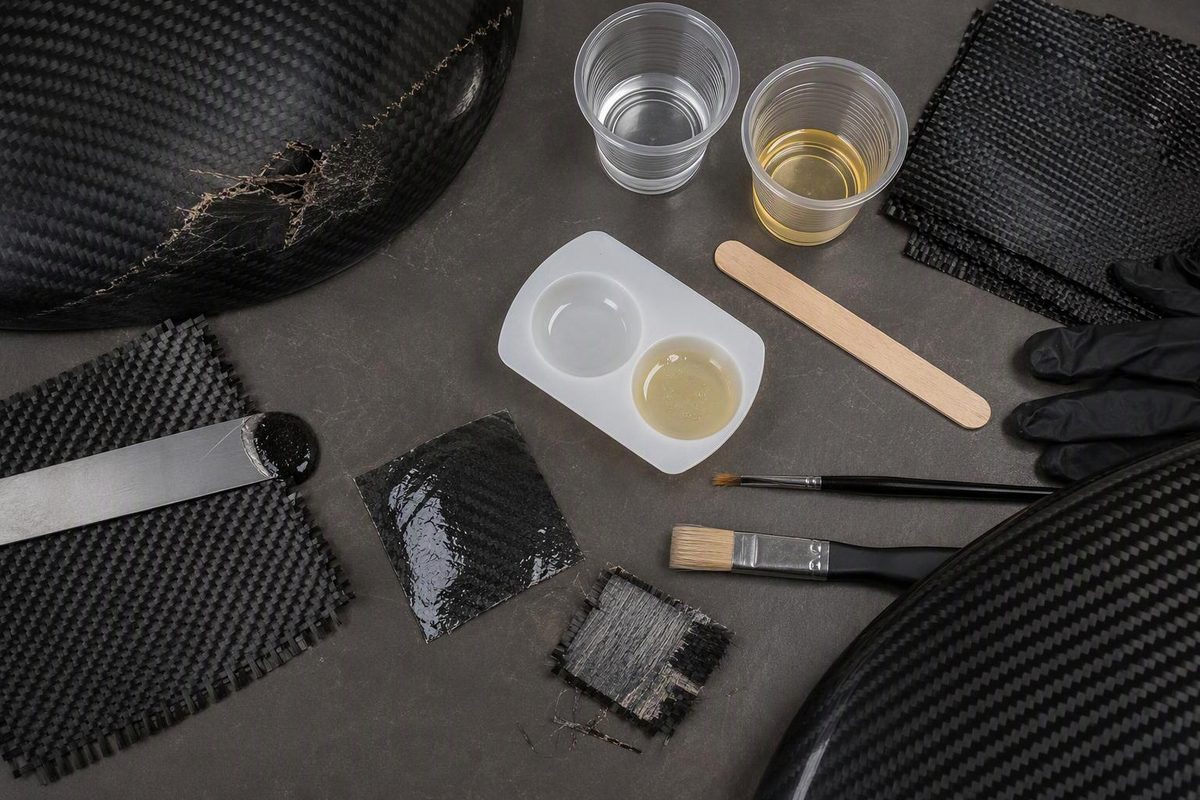
For a carbon-fiber fabric patch, choose a two-part laminating or composite-repair epoxy documented for carbon-fiber wet-out, with enough working time to place and consolidate the reinforcement. Confirm compatibility with the existing laminate, not just the new fabric.
Resin alone does not replace broken reinforcing fibers. In a fiber-reinforced composite, the fibers carry much of the load; the resin supports them. Restoring a damaged laminate therefore requires restoring reinforcement continuity, not simply filling a crack with glue. WEST SYSTEM’s fiberglass-boat repair manual explains this structural principle.
Identify what actually needs repair
| Job | Material-selection direction | Important limit |
|---|---|---|
| Scratch or chip confirmed to affect only the finish | Compatible coating or cosmetic repair filler | This restores appearance or sealing, not structural strength. |
| Damaged laminate requiring a fabric patch | Carbon-compatible laminating or repair epoxy plus the specified reinforcement | Patch dimensions, fiber directions and layer count belong in the repair design. |
| Separated bonded joint or loose insert | Adhesive qualified for both mating surfaces and the joint gap | A wet-lay resin is not automatically the right gap-filling structural adhesive. |
For an insert or carbon-to-metal joint, use the separate carbon-fiber adhesive selection guide.
Do not classify impact damage as cosmetic from appearance alone. Trek warns that carbon components can conceal damage after an accident; for suspected damage to its bicycle frames, forks or parts, it directs owners to stop riding and take the bicycle to an authorized retailer for replacement of the damaged component. Trek Carbon Care
For bicycle load-bearing parts, aircraft components or other parts whose failure could injure someone, obtain a manufacturer-approved disposition or qualified repair assessment before choosing resin. A general panel-patching method is not a repair specification for these components.
Check the resin against the repair conditions
A useful technical datasheet should establish:
- Application: explicit suitability for wet-laying carbon reinforcement. A casting or tabletop description alone does not establish this.
- Working time: enough time at your actual shop temperature to wet the fabric, position every layer and remove trapped air.
- Gap and application thickness: whether the system suits fabric impregnation, adhesive bonding or filling. Treat these as different jobs.
- Cure and exposure: cure temperature, full-property development, post-cure requirements and suitability for the expected heat, moisture or chemical exposure.
Match the reinforcement as well as the resin. For light-to-medium damage to composite canoes and kayaks, Easy Composites recommends using the same reinforcement type as the original boat to better match its behavior. Its tutorial also favors epoxy over polyester or vinylester for that repair application—not as a universal compatibility ruling for every carbon component. Composite kayak repair guidance
Prepare the bond before mixing
Once the repair area and reinforcement schedule have been established:
- Remove contamination before sanding. Oil, wax and mold release can compromise adhesion. Use a cleaner compatible with the existing resin and finish; do not assume an acetone wipe is harmless to every component. If cured epoxy has amine blush, wash it off with clean water and an abrasive pad, then dry before sanding. Solvent wiping is not the recommended blush-removal method.
- Remove unsound material and abrade the intended bonding area. Follow the repair procedure rather than sanding deeper simply to expose more carbon. WEST SYSTEM specifies 80-grit preparation for its smooth, nonporous bonding surfaces; Easy Composites specifies 120 grit in its kayak example. Neither is a universal instruction for a thin carbon tube.
- Remove dust and let the surface dry. Avoid bonding over condensation or residual cleaner. WEST SYSTEM recommends vacuuming or a clean brush rather than compressed air, which may introduce oil or water.
Sources: WEST SYSTEM surface preparation and Easy Composites kayak preparation.
Read the resin, hardener and cleaner safety datasheets before use. Use appropriate hand and eye protection when mixing, and control sanding dust with extraction, ventilation and suitable particulate respiratory protection. Carbon-composite dust should not be inhaled. WEST SYSTEM shop safety
A documented resin example—and its cure limits
Easy Composites EL2 is a laminating epoxy documented for hand lay-up and vacuum bagging of carbon, glass and aramid reinforcement. Its datasheet identifies it as a chemical product for professional use.
The 2025 datasheet specifies 100 parts resin to 30 parts AT30 hardener by weight—not by volume. It allows application at 15–30°C (59–86°F) and recommends at least 20°C (68°F) for best results. Its typical times are:
| EL2 hardener | Pot life at 25°C (77°F) | Demould time at 25°C (77°F) |
|---|---|---|
| AT30 Fast | 12–17 minutes | 4–6 hours |
| AT30 Slow | 95–115 minutes | 20–30 hours |
Pot life varies with temperature and mixed quantity. The same sheet states that full mechanical properties take at least 14 days at 25°C (77°F) during ambient curing. Demould or handling time is therefore not the time to put a repair under full load. EL2 is an example of documented wet-lay suitability, not approval for a particular structural repair. EL2 technical datasheet
Pre-cut and dry-fit reinforcement before mixing. Measure the specified ratio accurately, mix thoroughly, and never add extra hardener to accelerate cure. Mix only what you can use: heat generated in the pot accelerates the reaction. EL2 mixing instructions Leftover resin in the cup is not a reliable indicator of cure on a thin patch. Easy Composites cure-check guidance
If post-curing is required, establish the temperature limits of the whole component, including its original laminate, core and bonded inserts, before heating it. For sunlight exposure, also specify a compatible protective finish; clear epoxy alone should not be treated as durable UV protection. WEST SYSTEM finish-coating guidance