
9 min read ·
Krazy Glue Is Cyanoacrylate, but Not for Every Repair
Check Krazy Glue’s ethyl cyanoacrylate chemistry, material limits, liquid versus gel choice, setting times and safety precautions before starting a repair.
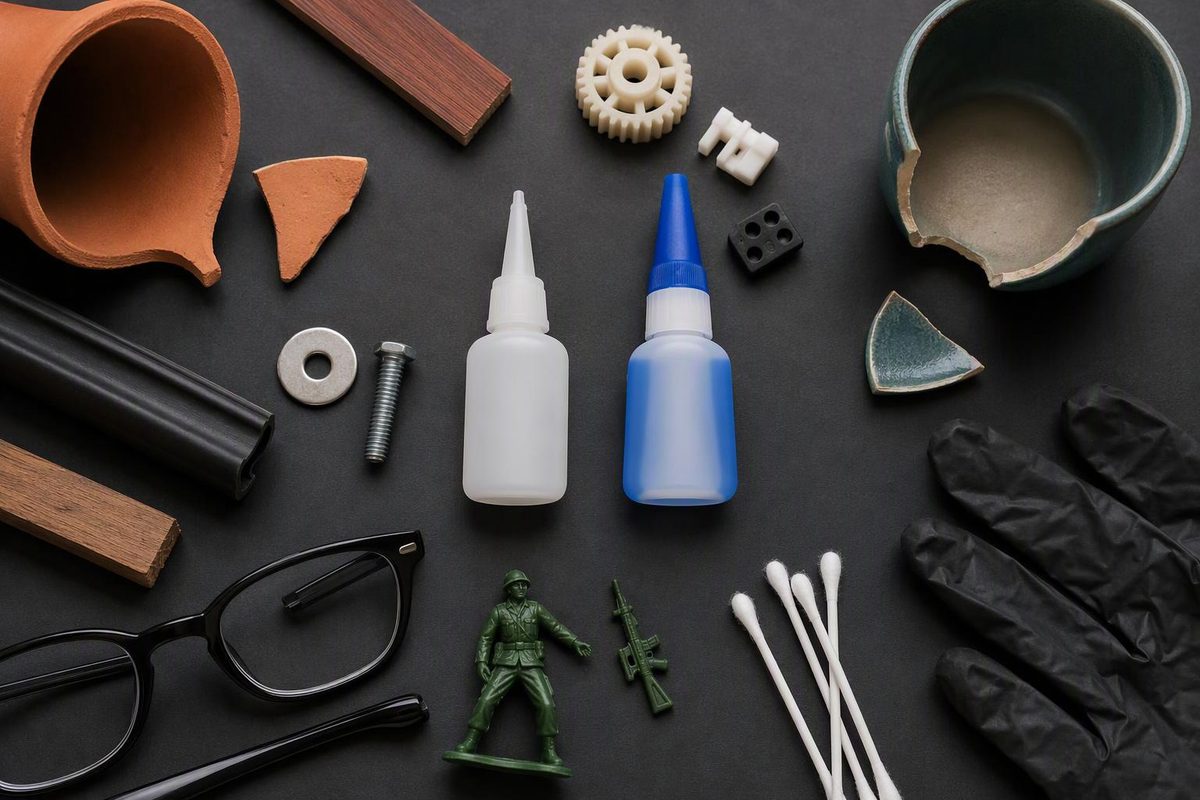
Yes: Krazy Glue All Purpose is an ethyl cyanoacrylate adhesive—the chemistry commonly called CA glue or super glue. Krazy Glue is the brand; cyanoacrylate is the adhesive family. The U.S. All Purpose safety data sheet, revised February 17, 2026, lists ethyl 2-cyanoacrylate, CAS 7085-85-0, at 80–100% by weight, alongside other ingredients. It covers product codes KG517, KG583, KG585, KG829 and KG2084180. That disclosed range does not mean every Krazy Glue product is pure cyanoacrylate or has the same formulation. All Purpose SDS
For a repair, the useful distinction is not simply whether the bottle contains CA. The two materials, how closely the broken faces meet and the joint’s exposure determine whether Krazy Glue is a reasonable candidate. A suitable liquid or gel cannot overcome a material the manufacturer says it does not bond well.
Choose your material, joint fit and exposure; the result identifies a candidate formula or a reason to choose another adhesive.
Krazy Glue Repair Check
Candidate: All Purpose Liquid
Metal, wood and ceramic are listed as suitable. Liquid suits closely fitting faces. This is a selection candidate, not a load or service-life guarantee.
Clean and dry both faces, apply sparingly, join immediately and leave unloaded overnight unless the exact package specifies otherwise.
Limits Behind This Result
- PE, PP, PTFE and other fluorocarbons do not bond well; paper, foam and rearview mirrors are listed as unsuitable.
- Gel controls drips on porous or vertical surfaces. No numerical gap limit or liquid-versus-gel strength comparison is supplied.
- General heat guidance is about 176°F (80°C), with a warning against continuous high temperatures. Prolonged soaking around 140°F (60°C) can weaken the bond.
- Use the exact package and matching safety sheet. This check does not establish compatibility for unidentified plastics or unlisted materials.
Source: Krazy Glue FAQ, cited in the article. Product-specific gap, load and continuous-service ratings: —.
The All Purpose SDS Identifies the Chemistry, Not Every Formula
The chemical name in the All Purpose SDS answers the chemistry question directly: this product uses ethyl cyanoacrylate. The CAS number identifies that ingredient, while the listed product codes identify the products covered by the sheet. Neither the ingredient name nor its percentage range establishes the composition of a differently named Krazy Glue product.
That distinction matters when comparing All Purpose liquid with All Purpose No-Run Gel. They are application choices within the brand, but the liquid SDS should not be treated as a complete specification for the gel. Read the package and safety sheet that match the exact product in your hand, especially when checking handling warnings or a claimed use.
Moisture naturally present on surfaces and in the air triggers the bond. You do not mix All Purpose glue with a hardener. The parts should nevertheless be clean and dry before application: moisture-triggered bonding is not an instruction to wet the broken faces or leave contamination in the joint. Krazy Glue FAQ
“Cyanoacrylate,” “CA glue” and “super glue” describe the adhesive family here. They do not, by themselves, tell you whether a particular bottle is the right consistency for a vertical repair, compatible with an unidentified plastic or appropriate for a joint exposed to hot water.
Material Compatibility Comes Before Liquid or Gel
Krazy Glue lists metal, wood, ceramic and many plastics as suitable materials. Its liquid formula is intended for tight-fitting surfaces. Start with the actual broken faces, not just the name of the object: they should meet closely without needing a thick mass of adhesive between them.
The manufacturer says Krazy Glue does not bond well with polyethylene (PE), polypropylene (PP), PTFE/Teflon or other fluorocarbons. It also lists paper, foam and rearview mirrors as unsuitable. “Works on plastic” therefore does not mean all plastics. Material compatibility guidance
| Material or Item | Manufacturer’s Guidance | Repair Decision |
|---|---|---|
| Metal, wood, ceramic | Listed as suitable | Check fit and exposure next |
| Many plastics | Listed as suitable | Identify the plastic first |
| PE, PP, PTFE/fluorocarbons | Does not bond well | Choose a documented alternative |
| Paper, foam, rearview mirrors | Listed as unsuitable | Do not select Krazy Glue |
For a mixed-material repair, both sides need to pass that compatibility check. A metal piece attached to polypropylene is still a polypropylene bonding job; the compatible metal side does not remove the limitation on the other side.
For bonding polypropylene, select a system explicitly documented for PP rather than simply adding more Krazy Glue. Likewise, do not use the general “many plastics” claim to approve a plastic you cannot identify. The information here does not provide a complete plastic-by-plastic compatibility chart.
A rearview mirror is another case where the object-specific exclusion takes precedence over a broad material category. Do not infer that a mirror attachment is suitable merely because part of the assembly is metal. Follow guidance for that repair rather than stretching the brand’s general compatibility list.
A Close Fit Matters More Than a Thick Layer
Dry-fit the repair before opening the glue. Bring the broken faces together and check whether they meet in the intended position. If a piece is missing, or the parts remain separated by an open gap, the repair needs documented gap-filling capability—not an assumption that a thicker-looking glue will bridge it.
The available guidance does not give a numerical maximum gap for these products. There is therefore no supported gap measurement to enter into a calculator or use as an acceptance limit. The practical distinction supported here is between closely meeting faces and a repair that requires adhesive to replace missing material.
Also check whether you can keep the parts aligned during the initial bond. A suitable surface pair is not enough if the pieces slide out of position while you are holding them. Plan how to support awkward parts before applying glue, rather than trying to arrange the support after the adhesive is on the joint.
This is why choosing liquid or gel comes after checking compatibility and fit. Consistency changes how you place the adhesive. It does not establish compatibility with an excluded plastic or turn an open-gap repair into a documented use.
Liquid Suits Close Faces; Gel Controls Drips
Once the materials and fit suit the job, choose the consistency for application control. Krazy Glue’s guidance distinguishes liquid for tight-fitting surfaces from gel for porous or vertical surfaces where controlling drips matters. Liquid-versus-gel guidance
| Formula | Where It Helps | Limit to Keep |
|---|---|---|
| All Purpose liquid | Closely fitting faces | Not a missing-piece repair |
| All Purpose No-Run Gel | Porous or vertical surfaces | Not automatically gap-filling |
For a small metal repair with faces that meet closely, liquid fits the manufacturer’s stated application. For a compatible vertical repair where runoff is the placement problem, No-Run Gel is the relevant option to consider. In both cases, the joint still needs an acceptable material pair and an appropriate service environment.
Gel is not automatically stronger. The supplied guidance does not provide a comparative strength figure for liquid versus gel, so there is no supported numerical strength ranking to make. Choose between them for placement and control, not an unsubstantiated expectation that the thicker formula must carry more load.
For broader grade selection, see how to choose and apply CA adhesive. Keep the exact product’s instructions in charge of the repair; a general CA description is not a substitute for that formula’s documented capabilities.
Heat and Hot Water Can Rule Out the Repair
Krazy Glue’s general FAQ gives heat resistance up to about 176°F (80°C), but warns against continuous high temperatures. It also says prolonged soaking in hot water around 140°F (60°C) can weaken the bond. Heat-resistance guidance
Do not treat the upper temperature as a continuous-service rating for every formula. It is general brand guidance with a stated caution, not proof that any Krazy Glue joint can remain at that temperature indefinitely.
Consider the repair’s actual exposure before choosing a bottle. A joint that will undergo prolonged hot-water soaking does not become a suitable application simply because its materials appear on the compatibility list. Likewise, a continuously hot location needs adhesive guidance that explicitly supports that service.
The supplied information does not give a load rating, a duration limit for hot-water exposure or a separate continuous-temperature rating for each formula. Those unknowns should remain unknown, rather than becoming a calculated safe operating limit. If the repair depends on one of those ratings, obtain product-specific documentation or choose a system that supplies it.
Apply Sparingly and Separate Setting From Full Strength
Krazy Glue’s general guidance says bonding begins in 10–60 seconds, with most repairs setting in about two minutes. It recommends leaving the repair unloaded overnight for maximum strength, unless the exact package specifies a different cure period. These are different stages, not interchangeable promises. Application and cure instructions
A bond that has begun to form may still need support. A repair that has set is not necessarily ready for its normal load. Plan around the overnight strength guidance rather than using the first apparent grip as permission to return the object to service.
Use this application sequence:
- Dry-fit and plan alignment. Establish the final position and arrange any support before applying glue; repositioning time is limited.
- Clean and dry both faces. Remove dust and contamination using methods compatible with the materials and their finishes.
- Apply sparingly. The manufacturer’s guide is about one drop per square inch (6.45 cm²). More glue can weaken the bond.
- Join immediately and hold still. Keep the pieces aligned until the bond forms, supporting awkward parts so they cannot slip.
- Leave the repair unloaded overnight. Follow a different cure period if the exact package specifies one.
The drop guidance is an application guide, not a bond-strength calculation. It does not provide a drop volume, and it should not be converted into an invented millilitre dose. For a small repair, the point is to avoid flooding the joint—not to increase adhesive quantity until it fills an unsuitable gap.
If the first attempt does not hold, reconsider compatibility, contamination, fit and movement before applying more glue. Those are the conditions the selection and application guidance addresses; extra adhesive is not a documented solution to every failed joint.
Cotton Contact and Eye Exposure Need Specific Precautions
Work with ventilation, eye protection and suitable chemical-resistant gloves. Keep the glue away from heat, sparks and flames. Do not use cotton gloves, cotton balls or cotton swabs with uncured glue: Krazy Glue warns that cotton contact can generate heat and burns. Handling precautions
That warning affects both application and cleanup. A cotton swab is not an appropriate way to spread uncured glue, and a cotton ball is not an appropriate default for wiping it up. Do not let a convenient applicator override the manufacturer’s material-specific precaution.
The February 2026 All Purpose liquid SDS cited above also includes a suspected reproductive-toxicity warning. Read the sheet matching your product rather than relying on a blanket “non-toxic” description of the brand or adhesive family. The chemistry identification and the handling classification answer different questions.
If skin sticks together, do not pull it apart; start with warm, soapy water. For eye exposure, rinse with water for 15 minutes, do not force bonded eyelids open or use solvents, and obtain urgent medical or poison-center guidance. Household Krazy Glue is not a wound or dental adhesive. Poison Control
Removal advice for an object should never be carried over to an eye exposure. In particular, the fact that a solvent may help remove cured glue from a suitable surface does not make it an eye-treatment option.
Cleanup and Storage Have Their Own Limits
Acetone can help remove cured glue, but may damage plastics or finishes. Check where acetone is safe for super-glue removal before applying it. Preserving the repaired object requires checking the remover as well as the adhesive; a compatible bond does not establish solvent compatibility.
Recap the container immediately and store it cool and dry, out of reach of children. Krazy Glue recommends using opened glue within one month for best results. That is the manufacturer’s opened-container recommendation, not a claim that every bottle necessarily fails on the same day. Cleanup and storage guidance
For the next repair, the selection remains the same: confirm both materials, check that the faces meet closely, rule out unsuitable exposure, then choose liquid or gel for placement. The label “cyanoacrylate” correctly identifies All Purpose’s chemistry; those repair conditions determine whether it belongs in the joint.